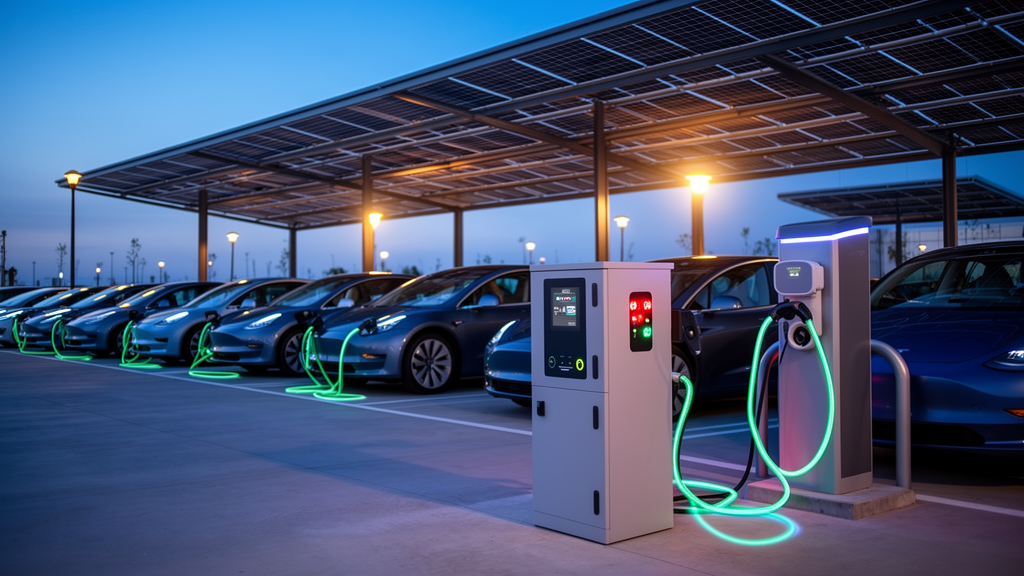
Electric vehicles are multiplying on roads around the world, and the electricity grids that must feed them are feeling the strain. A study published in Discover Electronics describes a simulated charging hub that combines solar power, battery storage and three layers of artificial intelligence to manage charging loads intelligently. The framework, called AI-SLBECH, was tested in a 30-day software co-simulation using real solar irradiance data for Chennai, India, and reported a 38.1% reduction in peak grid demand compared with a conventional grid-only charging setup. The researchers also report a 61.3% drop in monthly carbon dioxide emissions, a 30.7% cut in the average cost per charging session and 48.4% utilisation of renewable energy across the simulated month. Because the entire study was conducted in software rather than on physical hardware, the figures describe what the design achieved in simulation, not yet what a built installation has delivered.
The motivation behind the work lies in a mismatch between how public chargers operate today and how modern energy systems behave. Conventional charging stations draw fixed-rate power from the grid and cannot respond to swings in renewable generation, dynamic electricity pricing or the demand profiles of individual drivers. The authors point to International Energy Agency estimates that the global electric vehicle fleet will surpass 300 million by 2030, a scale at which unstructured charging during peak hours can overload transformers, degrade voltage profiles and, in severe cases, contribute to cascading grid failures. Their response is a hub that co-locates a 200-watt solar photovoltaic array, a lithium iron phosphate battery energy storage system, grid connectivity and an internet-of-things monitoring layer under a single adaptive energy management architecture.
The intelligence of the system is distributed across three complementary components. The first is a finite state machine governed by artificial intelligence logic that dispatches energy across three modes: renewable mode, battery assistance mode and grid assistance mode, each triggered by thresholds on a normalised solar generation index and the battery state of charge. Hysteresis bands of 5% on the solar index and 0.05 on the state of charge prevent the controller from oscillating rapidly between modes when conditions sit near a boundary. The second component is a two-layer long short-term memory neural network that forecasts demand 15 to 30 minutes ahead. The third is a scheduling agent trained with proximal policy optimisation, a reinforcement learning technique, which decides how to allocate charging power among waiting vehicles.
The forecasting network deserves particular attention because it was designed to run on a microcontroller rather than in the cloud. The two-layer network, with 64 cells in the first layer and 32 in the second, was trained on 12 months of solar irradiance data from the NASA POWER database for Chennai together with synthetically generated charging demand from a calibrated Poisson arrival simulator. The dataset was split chronologically into training, validation and testing subsets to prevent data leakage, and dropout regularisation was applied between layers. After post-training quantisation to 8-bit precision, the model occupied roughly 78 kilobytes of flash memory on an ESP32 microcontroller. On the test partition it achieved a normalised root mean squared error of 7.2% and a mean absolute percentage error of 6.8%, and a single inference took only 47 milliseconds, comfortably inside the controller’s one-second control cycle.
The reinforcement learning agent frames charging queue management as a Markov decision process with four discrete actions per charging bay: charge at full rate, charge at half rate, defer by one time step, or suspend charging. Its reward function blends three weighted terms, giving 50% weight to urgency, 30% to cost efficiency and 20% to fairness measured by Jain’s Fairness Index. The agent was trained over 10,000 episodes in a Python simulation built on the Stable-Baselines3 library, and the rolling mean of cumulative rewards stabilised from episode 8,200 onward, indicating convergence. In the final 30-day evaluation simulation the agent recorded a Jain’s Fairness Index of 0.94, suggesting that queued vehicles received nearly equal service. The complete control pipeline, including the LSTM inference and policy lookup, ran on the ESP32 with total loop overhead of about 49 milliseconds, roughly 4.9% of the available cycle time.
To measure what the intelligence actually contributes, the researchers ran three scenarios over the same 30-day irradiance and arrival profiles. Scenario A was a grid-only baseline with no renewables and no AI. Scenario B added solar photovoltaics with grid backup but no intelligent scheduling. Scenario C was the full AI-SLBECH framework. Against the grid-only baseline, the simulated hub reduced total energy imported from the grid by 61.3%, from 1,842 kilowatt-hours to 712 kilowatt-hours, and cut peak demand from 42.3 kilowatts to 26.2 kilowatts. Carbon dioxide emissions, calculated using the Central Electricity Authority’s emission factor of 0.82 kilograms per kilowatt-hour for the Indian grid, fell from 921 kilograms to 356 kilograms over the month. Average per-session charging cost dropped from 88.43 rupees to 61.20 rupees.
The study also examined robustness rather than relying on a single favourable run. Sensitivity analyses across seasonal solar variation, battery capacity and load extremes found peak demand reductions ranging from 29.3% to 45.8%, with solar seasonality the most influential parameter, producing a spread of 16.5 percentage points between the cloudiest and sunniest conditions. Treating the nine sensitivity conditions as independent observations, the authors report a mean peak demand reduction of 37.9% with a standard deviation of 5.9%, and a one-sample t-test against zero improvement yielded a statistically significant result with a 95% confidence interval of 33.4% to 42.4%. A Wilcoxon signed-rank test corroborated the finding. Renewable utilisation showed similar statistical significance across conditions. The authors note that a day-level paired comparison using the full 30-day time series remains a planned confirmatory analysis.
An initial techno-economic assessment suggests the design could be financially viable in the Indian market, though the authors label it preliminary and based on indicative mid-2024 pricing. Estimated capital cost is about 2.8 lakh rupees, roughly 3,360 US dollars. Using the simulated saving of 27.2 rupees per session and an assumed 8,760 sessions per year across four bays, the simple payback calculation comes to roughly 12.6 months, but after accounting for battery replacement cycles, converter maintenance and IoT subscription fees, the adjusted payback period stretches to 28 to 34 months over a ten-year lifespan. Net present value over that period, assuming an 8% annual discount rate and unchanged electricity prices, is estimated at approximately 12 to 15 lakh rupees. Scalability simulations extending the architecture from 4 to 16 charging bays showed peak demand reduction declining only modestly, from 38.1% to 34.2%, while control loop latency rose from 49 to 58 milliseconds.
The limitations section of the paper is unusually candid and deserves equal weight with the headline numbers. Every performance figure derives from software co-simulation; no physical prototype has been built and no hardware-in-the-loop testing has been performed, so real sensor noise, component tolerances and installation variability could shift the results. The cybersecurity architecture, which proposes TLS 1.3 encryption, per-device API tokens, secure boot and signed over-the-air updates, has been designed but never penetration-tested. The synthetic vehicle arrival model, while calibrated to published urban charging patterns, is a Poisson approximation that may not capture real driver behaviour. The authors also flag practical deployment concerns ranging from Wi-Fi degradation inside metal enclosures to sensor calibration drift and thermal management in hot climates. Future work includes physical prototype validation, vehicle-to-grid integration, federated learning across deployments and a field pilot. Until then, the reported gains stand as a detailed simulation of what an edge-deployable, AI-managed charging hub could achieve.
Subject of Research: AI-based smart load balancing for electric vehicle charging hubs using LSTM forecasting and reinforcement learning
Article Title: AI-based smart load balancing for sustainable electric vehicle charging hubs using LSTM forecasting and reinforcement learning
Article References: Santhoshkumar, R., & Suresh, S. (2026). AI-based smart load balancing for sustainable electric vehicle charging hubs using LSTM forecasting and reinforcement learning. Discover Electronics, 3(1), Article 134. https://doi.org/10.1007/s44291-026-00288-7
Image Credits: AI Generated
DOI: 10.1007/s44291-026-00288-7
Keywords: electric vehicles, charging hubs, load balancing, LSTM forecasting, reinforcement learning, solar photovoltaics, battery energy storage, smart grid, edge computing, ESP32, renewable energy, simulation study
News Source: Faith Mcneil. (October 30, 2026). AI-Managed EV Charging Hub Slashes Grid Peak Demand in Simulation. Scienmag.