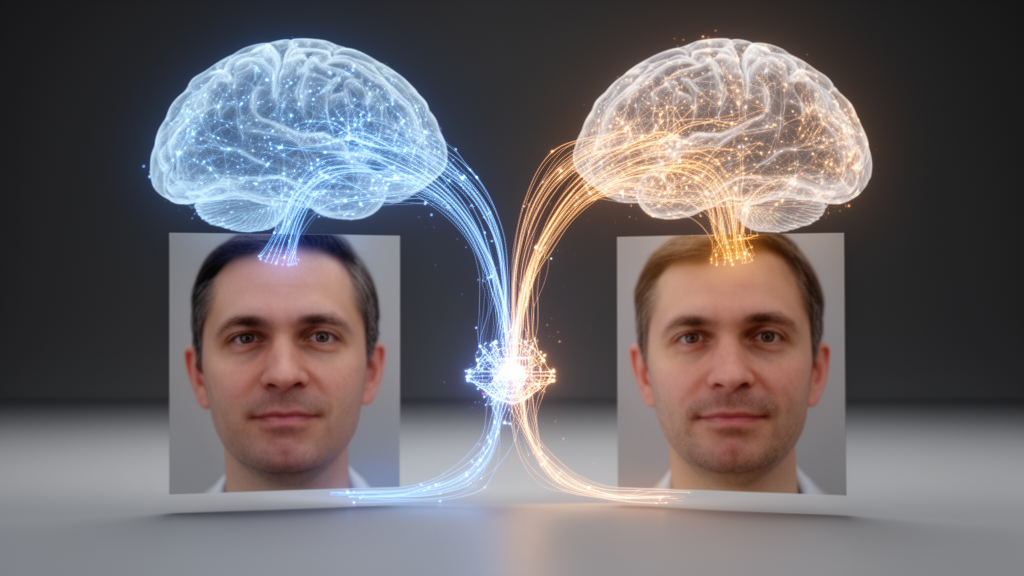
Family resemblance is something humans detect almost instinctively: the shared arch of an eyebrow, the familiar set of a jaw, the echo of a parent’s smile in a child’s face. Teaching a machine to make the same judgment, however, has proven remarkably difficult. Kinship verification from facial images must contend with sweeping differences in age between parents and children, shifting illumination, varied poses, changing expressions, and the stubborn fact that hereditary facial similarities are often subtle enough to escape even sophisticated algorithms. A new study published in Multimedia Tools and Applications by Nasrin Rasouli, Kamal Mirzaie, and Mohsen Sardari Zarchi, researchers at Islamic Azad University in Maybod and Meybod University in Iran, tackles this problem with a hybrid deep learning architecture that pairs two complementary ways of seeing a face, and the results suggest the combination is more than the sum of its parts.
The framework, named KFV-SNViT, is built around a marriage of Siamese networks and Vision Transformers, two architectures that approach the problem of image comparison from fundamentally different angles. A Siamese network consists of two identical feature-extraction branches that share the same weights, processing two images in parallel and mapping them into a common representation space. Because the branches are tied together, the network learns what similarity itself looks like: faces from the same family are pulled closer together in this learned space, while unrelated faces drift apart. This makes Siamese architectures a natural fit for kinship verification, which is fundamentally a binary decision problem, asking whether a given parent-child pair is related or not.
Where the Siamese branch excels at learning discriminative similarity representations, it can miss the bigger picture. Vision Transformers address this gap by treating an image not as a grid of local patterns, as convolutional networks tend to do, but as a sequence of small patches that can all attend to one another. Through a mechanism called self-attention, every patch of the face can weigh its relationship to every other patch, allowing the model to capture global contextual dependencies and long-range relationships across the entire face. A slight narrowing around the eyes might be meaningless in isolation, but when the transformer can relate it to the shape of the chin and the spacing of the cheekbones in a single computational step, faint hereditary signatures become far easier to register.
KFV-SNViT runs both branches in parallel and fuses their outputs, jointly optimizing the combined representation within a single unified learning framework. The Siamese pathway contributes its sensitivity to pairwise similarity, honed on parent-child image pairs, while the transformer pathway contributes its holistic grasp of facial geometry. The fused representation is trained to be more discriminative than either branch alone could achieve, and the ablation experiments reported in the paper underline why this matters: the authors found that employing finer image patches in the transformer improved verification performance, a result that highlights the importance of capturing the small-scale facial characteristics where heredity leaves its faintest traces.
The evaluation was conducted on three publicly available benchmark datasets: KinFaceW-I, KinFaceW-II, and Family101. Crucially, the authors used family-disjoint evaluation protocols, meaning that no family appearing in the training data was allowed to appear in the test set. This design choice prevents identity leakage, a subtle but serious pitfall in kinship research where a model might appear to detect kinship while actually memorizing specific individuals. Before any images reached the network, they passed through a comprehensive preprocessing pipeline involving face detection, alignment, normalization, and data augmentation, all intended to improve the model’s ability to generalize beyond the specific photographs it was trained on.
The headline numbers are striking. On KinFaceW-II, KFV-SNViT achieved an accuracy of 95.0 percent, a precision of 94.0 percent, a recall of 93.0 percent, and an F1-score of 93.0 percent. Performance was assessed across the full suite of standard metrics, including ROC-AUC, and the hybrid model outperformed six representative state-of-the-art kinship verification methods: OR2Net, an online re-weighting relation network; KFC, which relies on fair contrastive loss and multi-task learning; AW k-TMN, an adaptively weighted k-tuple metric network; Adversarial Similarity Learning, known as ASL; Deep Metric Learning, or DML; and a standalone Vision Transformer baseline. The fact that the hybrid beat the transformer on its own is perhaps the clearest evidence that the two branches genuinely complement each other rather than duplicating effort.
Perhaps more interesting than the benchmark scores is the model’s behavior under adverse conditions, because real-world deployments rarely offer laboratory-quality photographs. When the authors simulated low-light environments, the system maintained an accuracy of 89.2 percent, and when 30 percent of the face was occluded, accuracy dropped only to 87.4 percent. That resilience matters for the applications the authors envision. In biometric authentication, a system that fails the moment lighting changes or a scarf covers part of a face is of limited use. In forensic investigations, where investigators may have only degraded or partial images to work with, robustness under occlusion and poor illumination can make the difference between a usable lead and a dead end. Multimedia analysis platforms, which must process images of wildly variable quality, stand to benefit in similar ways.
The study arrives amid a broader shift in computer vision toward hybrid architectures that blend convolutional or metric-learning components with transformer-based modeling. Recent surveys of foundation models in vision have documented how attention mechanisms have reshaped tasks from face recognition to remote sensing change detection, and prior work has already explored Siamese networks combined with Vision Transformers for age-related face recognition and for kinship verification in childhood images. What the new study adds is a careful, benchmark-driven demonstration that this hybrid strategy specifically suits the kinship problem, where the signal to be detected is not a stable identity but a probabilistic, generation-spanning resemblance distorted by age gaps and environmental noise.
The authors are candid about the ethical shadow that falls across any facial recognition technology. Kinship verification raises concerns that go beyond ordinary face matching: inferring family relationships from faces touches on privacy in ways that individual identification does not, potentially exposing biological relationships that people have every right to keep private. The paper’s ethical considerations section warns of privacy violations, racial or gender bias, and misuse for surveillance, and the authors explicitly encourage researchers and practitioners to develop safeguards such as fairness audits and transparent data policies before deploying such systems in real-world settings. It is a notable gesture of restraint in a field where capability often outruns caution, and it frames the technology’s future as much as a governance question as a technical one.
For now, KFV-SNViT stands as a demonstration that the hardest problems in facial analysis may yield not to any single architecture but to thoughtful combinations of them. The Siamese branch asks whether two faces look alike in the ways that matter; the Vision Transformer asks what the whole face reveals when every region is allowed to speak to every other. Fused and trained together, they read family resemblance with an accuracy that approaches the practical thresholds needed for biometric, multimedia, and forensic use. Whether such systems earn the public trust required for deployment will depend on the fairness audits and transparent policies the authors themselves call for, but the technical blueprint they have laid out is likely to shape how kinship verification research proceeds from here.
Subject of Research: Deep learning-based kinship verification from facial images using hybrid Siamese networks and Vision Transformers
Article Title: Enhanced kinship verification through hybrid siamese networks and vision transformers: a deep learning approach to familial facial recognition
Article References: Rasouli, N., Mirzaie, K., & Zarchi, M. S. (2026). Enhanced kinship verification through hybrid siamese networks and vision transformers: a deep learning approach to familial facial recognition. Multimedia Tools and Applications, 85(11), Article 817. https://doi.org/10.1007/s11042-026-21959-3
Image Credits: AI Generated
DOI: 10.1007/s11042-026-21959-3
Keywords: kinship verification, facial recognition, Siamese networks, Vision Transformers, deep learning, biometrics, computer vision, parent-child face matching, forensics, self-attention, KinFaceW-II, Family101
News Source: Blake Davidson. (October 19, 2026). AI Learns to Spot Family Resemblance by Fusing Siamese Networks with Vision Transformers. Scienmag.