Artificial intelligence is being explored across nearly every stage of stroke rehabilitation, from predicting who will recover function to monitoring movement at home and guiding robotic therapy. But a new review argues that the field’s enthusiasm has outpaced its evidence, and that strong technical performance should not be mistaken for proven clinical benefit. The paper, published in the journal Cyborg and Bionic Systems on October 8, 2026, offers a structured map of where AI applications stand in stroke rehabilitation and how far they remain from routine clinical use.
The review was led by researchers at Capital Medical University, with Weihua Song as a corresponding voice among the authors, who also include Shuai Si, Yinghui Wang, Hong Chang, and Xiaoying Tang. It was published as a peer-reviewed article under the title “Application of Artificial Intelligence in the Prediction and Management of Stroke Rehabilitation.” According to the authors, the work was motivated by a persistent confusion in the literature: acute diagnosis, early prognostication, and rehabilitation-specific outcomes are often discussed together even though they address different clinical questions.
“Acute diagnosis, early prognostication, and rehabilitation-specific outcomes are often discussed together despite addressing different clinical questions, and many rehabilitation applications remain supported mainly by small datasets, internal validation, or early feasibility studies,” said Weihua Song, a researcher at Capital Medical University. “Technical performance therefore should not be equated with rehabilitation benefit.” Song added that this gap creates a need for a structured review that maps AI applications to their clinical decision points, rehabilitation relevance, validation maturity, and readiness for clinical translation.
Stroke is a major cause of long-term disability, and recovery varies substantially across motor, cognitive, communication, and activities-of-daily-living domains, making continuous assessment and individualized rehabilitation essential. Yet current rehabilitation decisions still rely heavily on periodic clinical scales, clinician experience, and local resources, which may not fully capture differences in lesion characteristics, baseline function, comorbidities, and recovery trajectories. Access is also limited by geographic barriers, uneven service capacity, and intermittent follow-up, factors that have fueled interest in technologies capable of more adaptive and continuous care.
To build the review, the team used a structured narrative design, systematically searching PubMed/MEDLINE, IEEE Xplore, Web of Science, and Scopus for studies on artificial intelligence and stroke rehabilitation published from January 2010 to March 2025, with a PRISMA-style process used to improve transparency. The database searches identified 1,247 records, and after deduplication, title and abstract screening, and full-text assessment, 108 publications were included in the thematic synthesis. The reviewers extracted information on study design, AI technique, sample size, rehabilitation domain, outcomes, model performance, validation methods, and reported limitations.
The evidence was organized into four major themes: AI for rehabilitation-outcome prediction, rehabilitation assessment and monitoring, therapeutic intervention and management, and the integration of AI with robotics, virtual reality, brain–computer interfaces, wearable technologies, and telerehabilitation. Importantly, the review distinguishes acute diagnostic or prognostic evidence from rehabilitation-specific outcomes and evaluates each application according to validation quality, clinical relevance, and implementation barriers, rather than treating all AI studies as equivalent.
One of the major applications examined is the prediction of subsequent functional recovery using clinical scales, imaging, EEG, wearable-sensor data, and demographic information. Existing studies have explored prediction of 90-day functional status, changes in the Barthel Index, motor-function scores, language and cognitive recovery, quality-of-life improvement, and long-term mortality, using machine learning, deep learning, and explainable models to identify factors associated with recovery trajectories. Acute imaging and early prognostic models can provide baseline information on lesion burden, initial severity, and treatment response that may inform later rehabilitation planning, whereas rehabilitation-specific prediction focuses more directly on changes in motor function, activities of daily living, participation, and patient-reported outcomes over time.
However, the authors caution that most prediction studies remain retrospective, small, or single-center and rely mainly on internal validation, while independent multicenter external validation and prospective clinical-impact studies are still uncommon. Strong predictive accuracy indicates potential for risk stratification, they write, but does not by itself demonstrate that AI-guided treatment improves rehabilitation outcomes. That distinction between what a model can forecast and what a patient actually gains from care runs throughout the review and forms one of its central messages.
A second theme concerns the automation of assessment and continuous monitoring. Artificial intelligence is increasingly being used to evaluate motor function, posture, gait, and rehabilitation progress after stroke, complementing conventional clinical scales and periodic follow-up. Existing systems combine EEG, EMG, wearable sensors, motion tracking, and home-monitoring data to quantify movement patterns, exercise quality, and functional changes, while machine learning can identify abnormal movements or estimate clinical motor scores. Wearable and remote-monitoring technologies can extend assessment into the home, providing longitudinal information on rehabilitation adherence and progression. Yet many of these studies focus primarily on technical feasibility, classification accuracy, or short-term surrogate outcomes, and commonly involve small samples, single-center datasets, and limited independent external validation. Heterogeneity in devices, data formats, and assessment schedules also restricts generalizability, and the authors call for standardized outcome measures, multicenter designs, and long-term prospective studies to determine whether AI-based monitoring can meaningfully improve rehabilitation decisions and patient outcomes.
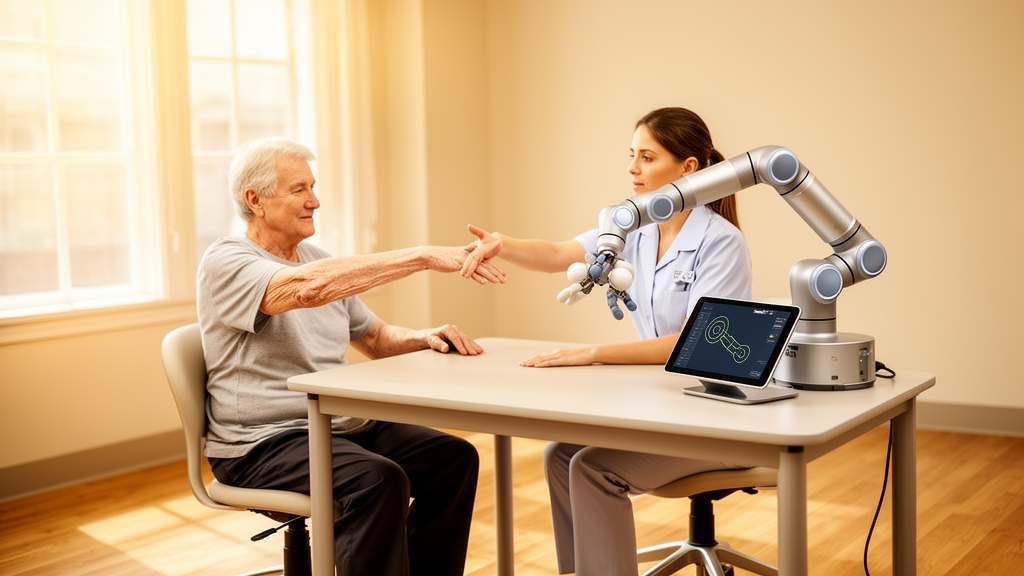
Beyond prediction and monitoring, the review examines how AI is being explored to support rehabilitation adjustment and the coordinated use of assistive technologies. Current approaches aim to adapt training intensity, task difficulty, and feedback frequency according to motor performance, cognitive status, and sensor-derived information, while integrating AI with rehabilitation robots, virtual reality, brain–computer interfaces, wearable devices, and telerehabilitation platforms. Robotic systems can provide standardized assisted movement, virtual reality emphasizes interactive task practice and augmented feedback, and BCIs can use neural signals to control external feedback or assistance when voluntary movement is severely limited. The authors note, however, that these technologies currently function mainly as rehabilitation adjuncts, with much of the evidence coming from small samples, short follow-up, and exploratory or single-arm studies; convincing evidence of superiority over conventional rehabilitation remains limited. A key future direction they identify is the development of patient-centered closed-loop systems in which EEG, EMG, and wearable-sensor signals dynamically adjust robotic assistance, extended-reality tasks, and remote feedback while maintaining clinical supervision, interoperability, affordability, and compatibility with routine rehabilitation workflows.
The review also catalogs the barriers standing between promising prototypes and clinical translation. Rehabilitation datasets are often small, heterogeneous, and inconsistently sampled, while multimodal clinical and sensor data remain difficult to standardize, increasing the risk of overfitting and limiting cross-institutional generalizability. The “black-box” nature of complex models can reduce clinical interpretability and trust, and improved predictive accuracy alone does not guarantee better treatment decisions or patient outcomes. Wearable monitoring, home rehabilitation, and remote-care platforms additionally raise concerns regarding privacy, security, data sharing, and device reliability. The authors recommend that future research emphasize multicenter external validation and prospective clinical trials while developing genuinely closed-loop rehabilitation systems that combine clinical information, imaging, EEG, EMG, and wearable-sensor data to dynamically adjust robotic assistance, extended-reality training, and remote feedback.
“Greater attention to explainability, interoperability, cost-effectiveness, and fairness will also be essential, with AI positioned as an adjunct to multidisciplinary care rather than a replacement for clinicians,” said Song. The work was supported by the National Science and Technology Major Project, the Capital’s Funds for Health Improvement and Research, the Key R&D Program of China, the Project for Innovation and Development of Beijing Municipal Geriatric Medical Research Center, the Beijing “Young Seedling Program” for High-Level Innovative and Entrepreneurial Leading Talents, and a 2023 Special Nursing Project of Xuanwu Hospital, Capital Medical University. For clinicians and researchers watching AI move toward stroke care, the review’s bottom line is measured: the technology offers new opportunities for more adaptive and continuous rehabilitation, but proving that those opportunities translate into better recovery for patients remains the field’s unfinished task.
Subject of Research: Artificial intelligence applications in stroke rehabilitation prediction, assessment, and management
Article Title: Application of artificial intelligence in the prediction and management of stroke rehabilitation
Article References: Application of artificial intelligence in the prediction and management of stroke rehabilitation. Original publication (Bibliographic details unavailable.)
Image Credits: AI Generated
DOI: Not provided
Keywords: artificial intelligence, stroke rehabilitation, machine learning, functional recovery prediction, wearable sensors, brain-computer interfaces, rehabilitation robotics, telerehabilitation, virtual reality, EEG, external validation, clinical translation
News Source: Cassandra Pierce. (October 28, 2026). AI in Stroke Rehabilitation: A New Review Maps Promise and Pitfalls. Scienmag.