


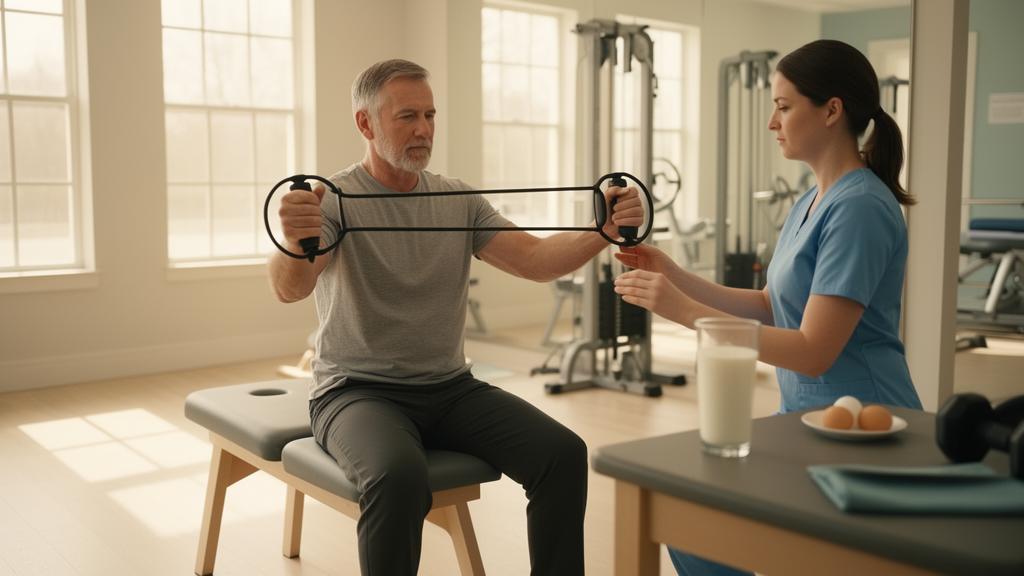
Survivors of intensive care often carry lasting weakness and reduced muscle mass long after they leave the hospital, and the biological reasons why recovery stalls have remained frustratingly unclear. A new study from Karolinska University Hospital in Sweden now offers an unexpectedly encouraging answer: the fundamental machinery that builds muscle in response to hard resistance exercise and protein intake appears largely intact in former intensive care unit patients, even months after severe critical illness. Using direct tracer measurements inside muscle tissue, researchers found that when ICU survivors performed a maximal bout of flywheel leg extensions followed by a dose of whey protein, their muscles reached essentially the same rate of protein synthesis as those of healthy, age-matched controls.
The study, published in Critical Care, enrolled former ICU patients within three to six months of discharge, a window chosen deliberately because physical function is known to improve most during this period. Between March 2022 and January 2024, the team screened 1491 patients who had spent at least 72 hours in an intensive care unit, enrolled 24 survivors and 23 controls recruited through public advertisements, and ultimately completed the full protocol with 20 participants in each group, matched one to one by sex and age within five years. The survivors were seriously ill during their hospitalisation: median ICU stay was ten days, mean invasive mechanical ventilation lasted 9.1 days, the mean SAPS 3 illness severity score was 62.3 points, nineteen of twenty patients required vasopressors, and nearly one third received renal replacement therapy.
The experimental protocol was identical for both cohorts. After an overnight fast, participants received a primed, continuous intravenous infusion of deuterated phenylalanine, a stable isotope tracer, with arterial blood sampled every fifteen minutes. At the end of a 150-minute baseline period, researchers took a biopsy from the vastus lateralis muscle of the non-dominant leg. Participants then performed four sets of ten maximal coupled concentric-eccentric leg extensions on a flywheel ergometer, actively coached by supervising staff to reach volitional fatigue in every set. Immediately afterwards they drank 24 grams of hydrolysed whey protein, enriched with the same tracer to maintain precursor measurements, and a second biopsy was taken from the exercised leg 150 minutes later. By measuring how much tracer had been incorporated into mixed muscle protein, the team could calculate the fractional synthetic rate, the most direct available estimate of acute muscle protein synthesis.
On the study day, the consequences of critical illness were clearly visible. Quadriceps muscle layer thickness measured by ultrasound was lower in ICU survivors than controls, 2.99 versus 3.49 centimetres, and maximum handgrip strength was 32.9 versus 39.4 kilograms, differences that reached statistical significance. Survivors also scored higher on the functional comorbidity index and clinical frailty scale, and reported markedly lower quality of life on both the physical and mental composite scores of the RAND-36 survey. During the exercise itself, perceived exertion was high and comparable between groups, but concentric and eccentric power output were lower in the survivors, confirming that the stimulus, while subjectively maximal, was delivered from a weaker starting point.
The central result concerned muscle protein synthesis. Measured from plasma precursor amino acids, the fractional synthetic rate was actually higher at baseline in ICU survivors than in controls, 0.041 versus 0.030 percent per hour. After the intervention, synthesis increased in both groups, but the increment was smaller in survivors, a change of 0.031 versus 0.040 percent per hour. Critically, the post-intervention rates converged: 0.071 percent per hour in survivors versus 0.070 percent per hour in controls, a difference that was not statistically significant. In other words, the apparently blunted incremental response simply reflected a higher starting point, not a ceiling imposed by critical illness. When the researchers repeated the calculation using intracellular muscle precursor enrichment, the alternative standard method, the pattern was directionally consistent but did not reach significance, and the authors present both analyses without a predefined hierarchy because neither approach is clearly superior.
Signalling measurements inside the muscle reinforced this picture. At baseline, anabolic signalling did not differ between groups, reflected by similar ratios of phosphorylated to total S6 and phosphorylated to total eEF2, two readouts of the protein synthesis machinery. The intervention increased phosphorylated S6 to a nearly identical extent in both groups, with no significant between-group difference in eEF2 phosphorylation. On the breakdown side, survivors showed lower activation of the autophagy-lysosomal pathway at baseline, including lower p62 abundance, a lower LC3BII to LC3BI ratio, and reduced cathepsin B activity, while markers of the ubiquitin-proteasome pathway such as MuRF1, MaFbx, ubiquitinated protein and 20S proteasome activity were indistinguishable from controls. The exercise and protein challenge reduced initiation of autophagy in both groups and increased components of the ubiquitin-proteasome pathway, along with a non-proteasome degradative activity, potentially calpain, that rose only in the survivors.
Taken together, the authors argue, these findings suggest that maximal skeletal muscle anabolic capacity is preserved during post-ICU recovery. The higher baseline synthesis rate, combined with reduced autophagic proteolysis, may even indicate a more favourable protein balance during recovery rather than pathological turnover. This interpretation stands in contrast to the acute phase of critical illness, when inflammation and immobilisation drive anabolic resistance and net muscle loss, and it contrasts with the only previous comparable experiment, in which mechanically ventilated ICU patients showed a blunted anabolic response to duodenal protein infusion. In the present study, combining protein with strenuous eccentric loading produced a post-exercise increase in synthesis similar in magnitude to that reported in pooled analyses of healthy volunteers.
The study was prospectively registered at ClinicalTrials.gov and analysed with linear mixed models including participant and matching-pair random effects, with post hoc contrasts estimated from marginal means. The authors are candid about limitations. Muscle protein breakdown itself was not measured, so net protein balance remains unknown, and pathway markers served only as surrogate measures. Mixed muscle rather than myofibrillar protein synthesis was assessed, leaving open the possibility of a differential contractile protein response. Only acute effects over roughly five hours were captured, so any attenuation of the prolonged 24 to 48 hour anabolic response cannot be excluded. The precursor pool for the primary calculation was not specified in advance, participation was demanding and may have introduced selection bias, prior physical activity histories were not documented, and no formal testing of isotopic steady state was performed, although enrichment appeared stable and amino acid concentrations rose similarly in both groups after protein intake.
Even with those caveats, the clinical implication is substantial. Post-ICU exercise rehabilitation trials have shown only modest benefits, and much mechanistic commentary has emphasised seemingly intractable obstacles such as epigenetic changes, fibrosis, myosteatosis, reduced satellite cell populations and proposals for stem cell or microRNA therapies. This study instead suggests an intact response to conventional anabolic interventions, providing what the authors describe as the first mechanistic support for structured exercise-nutrition rehabilitation after critical illness. The researchers also note that survivors might have a higher anabolic threshold and could respond less to submaximal stimuli, which could partly explain mixed results in previous rehabilitation trials, and they point to open questions about optimal protein dosing schedules, since healthy adults sustain myofibrillar synthesis better with moderate, regular feedings after exercise.
For the growing population of intensive care survivors living with weakness and lost independence, the message is cautiously optimistic. The muscle of a critically ill patient, months after multiple organ failure, can still sense a heavy eccentric load, still translate a large dose of whey protein into new protein synthesis, and still reach the same post-exercise rate as a healthy neighbour of the same age and sex. What remains unknown is whether repeated sessions of this preserved anabolic capacity translate into rebuilt muscle mass and recovered function over months and years, and what dose, timing and training form would maximise that rebuilding before chronic degenerative changes take hold.
Subject of Research: Skeletal muscle anabolic response to resistance exercise and protein intake in ICU survivors
Article Title: Preserved anabolic skeletal muscle capacity in response to exercise and protein intake after critical illness
Article References: Fischer-Hammerschmied, A., Tardif, N., Mandić, M., Gustafsson, T., Apro, W., Helleberg, J., Amouzandeh, M., Grip, J., Seldén, D., Rooyackers, O., & Sundström Rehal, M. (2026). Preserved anabolic skeletal muscle capacity in response to exercise and protein intake after critical illness. Critical Care, 30(1), Article 549. https://doi.org/10.1186/s13054-026-06418-7
Image Credits: AI Generated
DOI: 10.1186/s13054-026-06418-7
Keywords: critical illness, ICU survivors, muscle protein synthesis, resistance exercise, protein intake, anabolic resistance, ICU-acquired weakness, fractional synthetic rate, rehabilitation, autophagy, ubiquitin-proteasome pathway, Karolinska
News Source: Ophelia Keating. (October 29, 2026). After Critical Illness, Muscle Retains Its Response to Exercise and Protein. Scienmag.



