Researchers supported by FAPESP have developed a noninvasive system combining aerial drones and artificial intelligence to map the growth of Nelore cattle, determining the optimal time for sale up to a week earlier than predicted by conventional feedlot management methods. Developed to track fattening without requiring individual weighing on physical scales, the platform uses aerial imagery to monitor weight gain and guide slaughter decisions.
The technology was detailed in the journal Computers and Electronics in Agriculture and presented on October 28 during FAPESP Week Netherlands by Jayme Garcia Arnal Barbedo, a researcher at Embrapa Digital Agriculture, a decentralized unit of the Brazilian Agricultural Research Corporation (EMBRAPA). The research was carried out under the Science Center for Development in Digital Agriculture (Semear Digital) with funding from FAPESP across projects 23/03870-8, 24/15430-5, 25/05985-2, and 25/10602-5. Barbedo reported that the team is close to completing a fully functional prototype, with the next phase focusing on partnerships with agricultural startups and industry firms to convert the findings into a commercial product.
In beef cattle operations, identifying the precise point of sale directly affects production costs because animals eventually reach a natural physiological growth limit where weight gain slows significantly. As Barbedo explained, the weight gain curve of slaughter-bound cattle forms a characteristic S-shape that begins slowly during adaptation, accelerates into a rapid growth phase, and ultimately plateaus in a final stage where feed is no longer converted into meat at the same rate. Continuing confinement beyond that saturation plateau forces producers to pay for feed without securing additional meat, meaning that shifting a sale or slaughter decision by even a single day can alter operational profits by 5% to 10%.
Traditional feedlot tracking relies on periodically driving cattle into narrow restraint chutes to squeeze and immobilize each animal for weighing on physical scales. Barbedo noted that forcing cattle through these cramped corridors requires extensive labor, damages equipment, and elevates animal stress alongside the risk of injuries and bruising. Due to the difficulty and invasive nature of manual chute weighing, producers typically weigh animals only upon initial entry to the feedlot and months later when loading them for the slaughterhouse, leaving herd growth unmonitored during the intervening weeks.
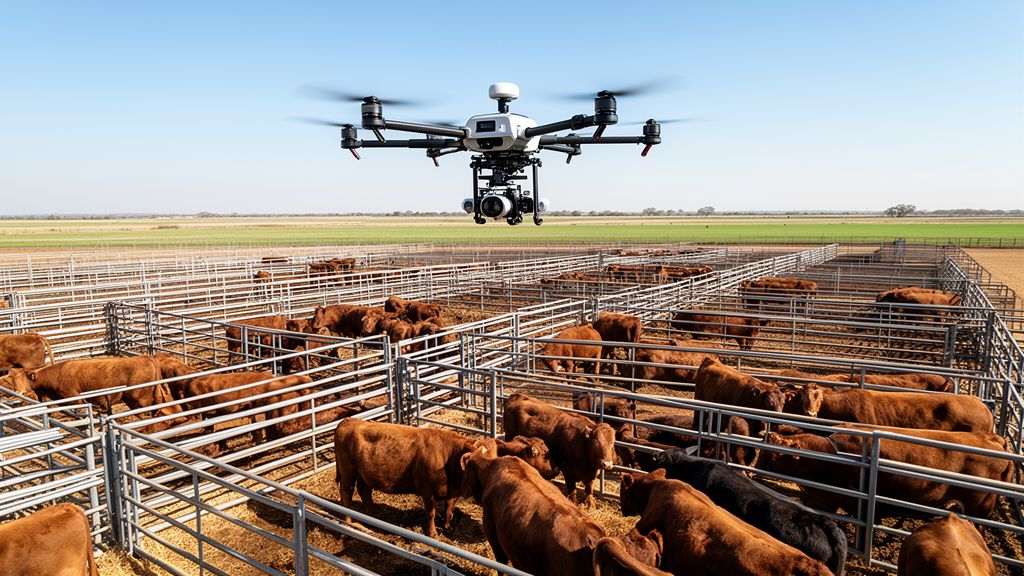
The drone-based system addresses these limitations by substituting physical confinement with autonomous aerial observation. Field tests assessing flights at altitudes of 5, 10, and 15 meters demonstrated that Nelore cattle did not notice drones flying at the 15-meter altitude. At that height, the cattle continued their natural grazing and resting behavior without any impact on animal welfare.
The computational framework pairs two artificial intelligence models to extract morphological metrics from the 15-meter aerial photos. The primary object-detection model was fine-tuned to locate individual Nelore steers within feedlot pens, achieving an accuracy of 95.56%. A secondary model then delineates the steer’s physical contours at the pixel level, enabling the system to segment the body and compute the mathematical ratio of width relative to length.
This width-to-length ratio provides a reliable metric that remains consistent even when drone flight altitude fluctuates slightly between passes. As cattle accumulate muscle and fat over weeks in confinement, their bodies visibly widen relative to their body length. By tracking changes in this proportional ratio over successive missions, the artificial intelligence reliably records weight gain trends without depending on absolute physical scale dimensions within the photographic frames.
To maintain data integrity amid constant animal movement in commercial feedlots, the researchers integrated an automated filtering mechanism. Because cattle frequently lie down or assume curved postures, the algorithm evaluates the whole batch and discards animals resting on the ground or positioned at unfavorable angles. By restricting calculations strictly to standing animals exhibiting straight postures within the central window of the image, the system derives an accurate average metric for the herd.
Validation took place under commercial production conditions at Campanário Ranch in Laguna Carapã, Mato Grosso do Sul, a facility managing roughly 14,600 feedlot cattle. Analysts tracked a test cohort of 110 Nelore cattle, averaging 18 months of age initially, across a 112-day fattening cycle using 12 aerial flights spaced ten days apart. The resulting data fed a mathematical model that mapped the three biological phases: initial adaptation, accelerated growth, and the economic saturation plateau.
By recognizing that the cohort’s weight gain had entered its deceleration phase one week ahead of dates projected by conventional management schedules, the system signaled the optimal slaughter window early, avoiding unnecessary feed expenditure. In the evaluated batch of 110 animals, this advance detection yielded BRL 15,000 in saved costs. If extrapolated across the ranch’s full feedlot capacity of 14,600 head, the projected efficiency gains could reach approximately BRL 2 million.
Beyond fattening curve management in beef cattle, EMBRAPA researchers are expanding the system to detect stress-related behaviors in feedlots remotely, including trough misalignments and feeding disputes where cattle fail to line up side by side. Following inquiries from industry partners, the team is also investigating dairy farming applications, evaluating the drone and artificial intelligence pipeline for tracking feeding behavior and enabling early identification of diseases such as mastitis. Barbedo emphasized that commercial technology transfer remains the project’s next objective.
Subject of Research: Drone and artificial intelligence monitoring of beef cattle fattening curves
Article Title: System using drones and artificial intelligence identifies the ideal time for cattle slaughter
Article References: System using drones and artificial intelligence identifies the ideal time for cattle slaughter. Original publication (Bibliographic details unavailable.)
Image Credits: AI Generated
DOI: Not provided
Keywords: Nelore cattle, precision livestock farming, agricultural drones, artificial intelligence, deep learning, object detection, feedlot management, animal welfare, Embrapa Digital Agriculture, FAPESP, Computers and Electronics in Agriculture, morphological metrics, Campanário Ranch, fattening curves, slaughter timing, restraint chute, Semear Digital, dairy farming
News Source: William Thompson. (November 14, 2026). Aerial Drones and Artificial Intelligence Identify Optimal Cattle Slaughter Timing in Feedlots. Scienmag.