• HOME
  • NEWS
  • EXPLORE
    • CAREER
      • Companies
      • Jobs
    • EVENTS
    • iGEM
      • News
      • Team
    • PHOTOS
    • VIDEO
    • WIKI
  • BLOG
  • COMMUNITY
    • FACEBOOK
    • INSTAGRAM
    • TWITTER
Thursday, July 2, 2026
BIOENGINEER.ORG
No Result
View All Result
  • Login
  • HOME
  • NEWS
  • EXPLORE
    • CAREER
      • Companies
      • Jobs
        • Lecturer
        • PhD Studentship
        • Postdoc
        • Research Assistant
    • EVENTS
    • iGEM
      • News
      • Team
    • PHOTOS
    • VIDEO
    • WIKI
  • BLOG
  • COMMUNITY
    • FACEBOOK
    • INSTAGRAM
    • TWITTER
  • HOME
  • NEWS
  • EXPLORE
    • CAREER
      • Companies
      • Jobs
        • Lecturer
        • PhD Studentship
        • Postdoc
        • Research Assistant
    • EVENTS
    • iGEM
      • News
      • Team
    • PHOTOS
    • VIDEO
    • WIKI
  • BLOG
  • COMMUNITY
    • FACEBOOK
    • INSTAGRAM
    • TWITTER
No Result
View All Result
Bioengineer.org
No Result
View All Result
Home NEWS Science News Chemistry

Advancing gene therapies: PIP pip hurray!

Bioengineer by Bioengineer
February 28, 2020
in Chemistry
Reading Time: 2 mins read
0
IMAGE
Share on FacebookShare on TwitterShare on LinkedinShare on RedditShare on Telegram

A new compound with the potential to turn genes on and off could lead to new cancer and hereditary disease treatment strategies
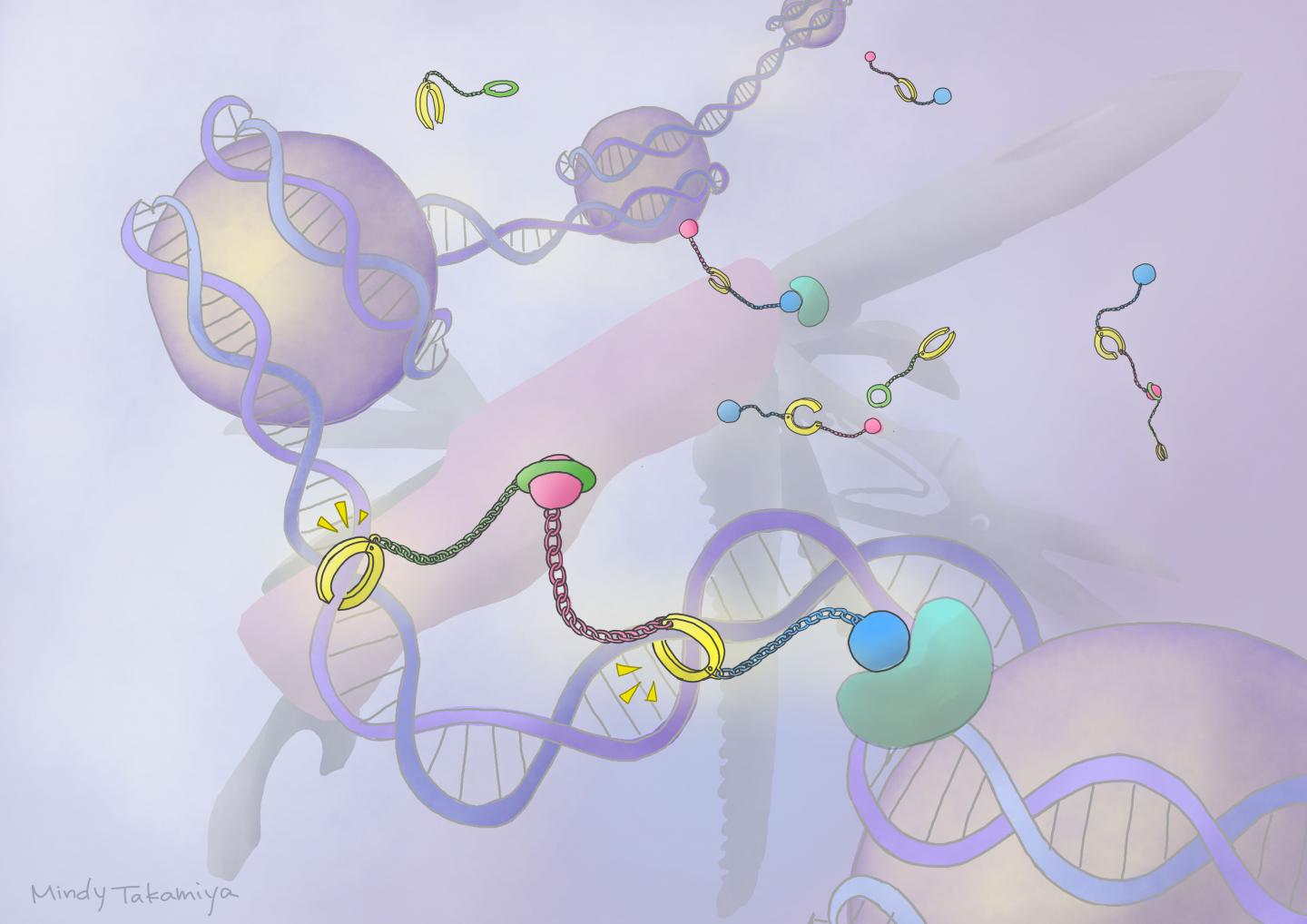
IMAGE

Credit: Illustration by Mindy Takamiya (CC BY 4.0)


A new compound has the potential to bind to DNA and activate genes, which could lead to new treatments for cancers and hereditary diseases. Zutao Yu, Ganesh Pandian Namasivayam, and Hiroshi Sugiyama of Kyoto University’s Integrated Cell-Material Sciences (iCeMS) collaborated with colleagues in Japan and the USA to design and test a compound that could target specific DNA sequences and recruit gene-modifying molecules. Their findings were published in the journal ChemComm.

Scientists have long worked with small molecules called pyrrole-imidazole polyamides (PIPs) that have the ability to bind to minor grooves found in the DNA helix. They have been experimenting with PIPs as a drug-delivery mode that can switch genes on and off.

One such system involves combining a PIP with a ‘host-guest assembly’ (HoGu) that can strongly bind to DNA and act similarly to proteins, called transcription factors, that target and bind to specific genes to signal for them to turn on or off.

These PIP-HoGu systems can successfully mimic and disrupt transcription factor pairs from binding to DNA, resulting in a variety of biological effects. But they don’t have the ability to specifically activate genes.

Sugiyama and colleagues experimented with the idea of combining a PIP-HoGu system with an epigenetic drug, which can bind to and affect gene activation.

First, they improved the design of PIP-HoGu by selecting molecules that can strongly bind to DNA, while also being non-toxic, cell-permeable, water-soluble, and chemically stable. They then fine-tuned the molecules so that they targeted specific DNA nucleic acid sequences with flexible gap spacings.

The team next attached their new PIP-HoGu system to an epigenetic regulator molecule, forming what they refer to as ‘ePIP-HoGu’. They found that it more specifically bound to the targeted nucleic acid sequences and efficiently marked them for epigenetic modification.

“Our ePIP-HoGu is formed of three main components: a DNA-binding PIP, a cooperation domain, and an epigenetic modulator. Fine-tuning each of the three parts led to positive activity. Further optimization is required to explore its full potential and expand its biological and therapeutic applications,” says Yu.

This study builds on previous research to help advance PIPs as potential therapeutic drugs to address unmet needs in cancer treatment, rare hereditary diseases and in regenerative medicine, adds Namasivayam.

###

DOI: 10.1039/c9cc09608f

About Kyoto University’s Institute for Integrated Cell-Material Sciences (iCeMS)

At iCeMS, our mission is to explore the secrets of life by creating compounds to control cells, and further down the road to create life-inspired materials.

https://www.icems.kyoto-u.ac.jp/

For more information, contact

I. Mindy Takamiya/ Mari Toyama

[email protected]

Media Contact
Mindy Takamiya
[email protected]
81-757-539-764

Related Journal Article

http://dx.doi.org/10.1039/c9cc09608f

Tags: BiochemistryBiologyBiomechanics/BiophysicsBiomedical/Environmental/Chemical EngineeringBiotechnologyCell BiologyGenesGeneticsMolecular Biology
Share12Tweet8Share2ShareShareShare2

Related Posts

Breaking Thermodynamic Limits: Wavelength-Driven Catalysis Advances Ammonia Synthesis — Chemistry

Breaking Thermodynamic Limits: Wavelength-Driven Catalysis Advances Ammonia Synthesis

July 2, 2026
From Quantum Mechanics to AI-Powered Materials Discovery: MARVEL Marks 12 Years of Transforming Computational Science — Chemistry

From Quantum Mechanics to AI-Powered Materials Discovery: MARVEL Marks 12 Years of Transforming Computational Science

July 2, 2026

Djire Recognized with National Award for Outstanding Contributions in Research and Teaching

July 2, 2026

Innovative Detector Design Promises to Broaden Horizons in Dark Matter Exploration

July 2, 2026
Please login to join discussion

POPULAR NEWS

  • Detection of EDCs in Breast Milk and Infant Urine Up to Six Months Highlights Early Exposure Risks

    77 shares
    Share 31 Tweet 19
  • Saying Goodbye to PGY-6: Pediatric Fellowship Realities

    103 shares
    Share 41 Tweet 26
  • New Drug Candidate Developed at McMaster Shows Potential for Treating Brain Cancer

    58 shares
    Share 23 Tweet 15
  • KTU Researchers Explore Ultrasound’s Role in Enhancing Blood Flow Beyond Diagnostics

    53 shares
    Share 21 Tweet 13

About

We bring you the latest biotechnology news from best research centers and universities around the world. Check our website.

Follow us

Recent News

Apelin-APLNR Pathway: Endothelial Roles in Health

Cross-Stage, Cross-Species Malaria CD8+ T Cell Antigens Identified

Food Web Complexity Drives Biodiversity Impact

Subscribe to Blog via Email

Enter your email address to subscribe to this blog and receive notifications of new posts by email.

Join 82 other subscribers
  • Contact Us

Bioengineer.org © Copyright 2023 All Rights Reserved.

Welcome Back!

Login to your account below

Forgotten Password?

Retrieve your password

Please enter your username or email address to reset your password.

Log In
No Result
View All Result
  • Homepages
    • Home Page 1
    • Home Page 2
  • News
  • National
  • Business
  • Health
  • Lifestyle
  • Science

Bioengineer.org © Copyright 2023 All Rights Reserved.