Engineering professor receives major Department of Energy grants
Credit: Photo illustration by Joy Smoker
Climate-conscious consumers often take steps to curb their emissions of greenhouse gases. For example, you might drive a hybrid car to reduce your use of fossil fuels, which release carbon dioxide into the atmosphere during combustion.
These approaches reduce the amount of carbon dioxide added to the atmosphere. Some scientists are also working on ways to subtract carbon dioxide from the atmosphere. The goal is to capture the greenhouse gas and transform it into another substance altogether. Sound like magic? It’s not — it’s chemistry.
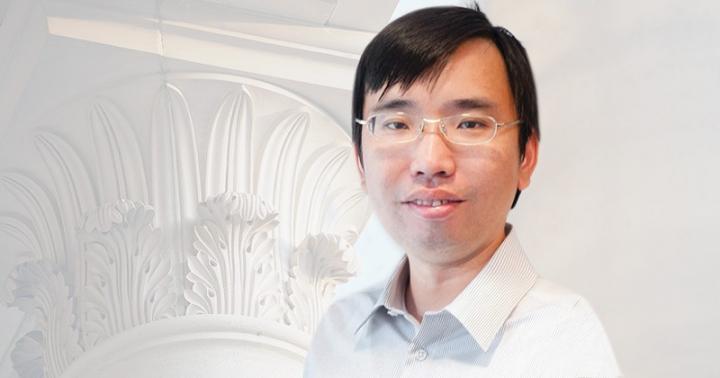
One of the leaders in this field of carbon capture and utilization is Feng Jiao, Robert Grasselli Development Professor of Chemical and Biomolecular Engineering at the University of Delaware.
“We are working on turning carbon dioxide, which is considered a bad gas, and using it as a carbon source to produce the chemicals we use for every day,” said Jiao, who is also the director of UD’s Center for Catalytic Science and Technology, a research center that has pioneered multidisciplinary research in the scientific and engineering principles of catalysis.
Jiao recently received two grants from the Department of Energy (DOE) to advance technologies for carbon capture and utilization through catalysis, the use of substances to speed the rate of chemical reactions.
Electrochemical Production of Formic Acid
Jiao is the principal investigator of a new $2.5 million award from the DOE Office of Energy Efficiency and Renewable Energy Bioenergy Technologies Office.
In this project, Jiao and collaborators from Rice University, the National Renewable Energy Laboratory and OCO, Inc. will design a reactor to produce formic acid from carbon dioxide without a purification step. Formic acid is a chemical used in a variety of industries, such as agriculture, pharmaceuticals and textiles.
The team will utilize electrochemistry, a branch of chemistry in which scientists study and utilize both the chemical and electrical properties of the materials they work with.
Inside the reactor, electrically charged particles will move across membranes and layers and combine to form formic acid molecules that can then be collected and used.
Multi-Carbon Chemical Production
Jiao is also the principal investigator of a new $1 million grant from the DOE’s Office of Fossil Energy to develop a new two-step electrochemical process to produce ethylene and acetic acid from carbon dioxide emitted from coal-fired power plants.
Millions of tons of these chemicals are used worldwide each year. Ethylene is a precursor to plastics and polymers and is widely used in the chemical industry. Acetic acid is used in paints, coatings, inks and more.
To transform carbon dioxide into these valuable chemicals, the first step is to break down carbon dioxide into carbon monoxide. Then, the team uses a special copper catalyst to reduce the carbon monoxide into ethylene and acetic acid.
Jiao and the people in his lab have already demonstrated that their novel reactor works, but now, they will attempt to increase the scale of the system by about 100 times its original size. This will bring their novel technology one step closer to commercialization.
Recognition of Expertise
Jiao is a recognized leader in his field. Earlier this year, Research Corporation for Science Advancement (RSCA) named Jiao a Fellow for its new initiative, Scialog: Negative Emissions Science. Co-sponsored by RCSA and the Alfred P. Sloan Foundation, the series will begin virtually with its first conference Nov. 5-6, 2020.
At Scialog: Negative Emissions Science, more than 50 promising early-career scientists will take up the pressing challenge of greenhouse gases accumulating in the Earth’s atmosphere and oceans.
###
Media Contact
Peter Kerwin
[email protected]
Original Source
https:/