Prolonged exposure to microgravity poses profound challenges to human physiology, notably affecting the musculoskeletal system that has evolved under Earth’s gravitational pull. Professor Dario Farina elucidates the rapid atrophy of anti-gravity muscles such as the soleus and quadriceps during spaceflight, with muscle mass losses soaring up to 16% even on short-duration missions aboard the International Space Station (ISS). Furthermore, weight-bearing bones manifest a concerning decrease in density ranging from 1 to 2 percent monthly. The recovery post-mission, particularly for bone health, is arduous, often requiring two to three years to approach pre-flight baselines. Complicating this biological deterioration are ancillary stressors intrinsic to space travel—radiation doses between 50-100 mSv over a six-month mission far exceed Earth’s background levels, while psychosocial stressors like isolation heighten cortisol levels, exacerbating musculoskeletal degeneration.
Despite advancements in countermeasures such as the Advanced Resistive Exercise Device (ARED) and sophisticated treadmills like COLBERT, these traditional exercise regimens remain mired by significant logistical burdens. Their mass — extending to several hundred kilograms — coupled with voluminous spatial demands, render them less feasible for long-term extraterrestrial habitation where launch costs can exceed $1,700 per kilogram. Moreover, repetitive use has led to musculoskeletal injuries, including shoulder and back strains, underscoring limitations in existing exercise methodologies. This inefficiency prompts a paradigm shift in space health science, championing wearable technology not as supplementary but as integral therapeutic apparatuses seamlessly integrated into the astronaut’s daily routine.
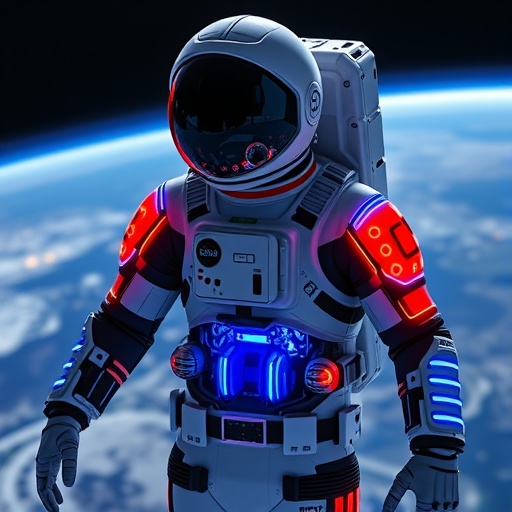
Emerging wearable systems represent this innovation frontier, pivoting away from bulky gym equipment towards lightweight, adaptive solutions that transform all astronaut movements into continuous rehabilitative exercise. Devices such as the Gravity Loading Countermeasure Skinsuit (GLCS) adopt a passive approach, employing elastic fabrics designed to simulate gravitational forces and mitigate spinal elongation and related discomfort. Yet, physical constraints and discomfort limit their efficacy for prolonged wear. In response, active countermeasures like the Variable Vector Countermeasure Suit (V2Suit), leveraging inertial measurement units and controlled moment gyroscopes, dynamically deliver targeted resistance tailored to user movements, promising enhanced physiological preservation.
NASA’s progressive endeavors reflect this trajectory, with prototypes such as the X1 exoskeleton and Robo-Glove developed in collaboration with General Motors transitioning toward powered assistance. Complementing these are soft exosuits composed of textiles actuated via cables or pneumatic artificial muscles, offering low-profile, energy-efficient, and flexible alternatives customized for microgravity environments. The absence of Earth’s gravity intriguingly reduces the necessary output forces for meaningful resistance, allowing actuators to function effectively with minimal energy expenditure. This phenomenon breaks the conventional feedback loop in terrestrial exoskeleton design, where increased actuation load necessitates larger battery reserves, thereby inflating mass and compromising wearability.
A key technological pillar underpinning these advances is the integration of sophisticated wearable sensors. Cutting-edge textile-embedded strain sensors, utilizing liquid metals or carbon composites, alongside high-density electromyography (EMG) sleeves and flexible transistor arrays, have emerged as vital tools in real-time biomechanical and physiological monitoring. These sensors can quantify suit-body interactions, track muscle fatigue, assess skin hydration, and detect early indications of injury. The potential for such smart suits to proactively adapt their stiffness or issue warnings—particularly when interfacing adversely with rigid space suit components—is a transformative stride toward preventive healthcare in orbit. Coupling this sensory input with brain-computer interface technologies and eye-tracking systems enables closed-loop control paradigms, facilitating intuitive exoskeleton assistance tailored to an astronaut’s intent.
However, significant technical hurdles persist. Space radiation poses a persistent threat to the longevity and functionality of embedded electronics, demanding the development of radiation-hardened components that simultaneously maintain miniaturization for wearable applications. Moreover, microgravity disrupts inertial measurement accuracy, necessitating novel computational algorithms capable of mitigating drift and enhancing orientation fidelity. Equally crucial is the ergonomic and psychological acceptability of such systems. Historical trials like the GLCS have underscored the critical importance of user-centered design paradigms. Without comfort, ease of donning/doffing, and psychological suitability, adoption rates among astronauts can falter, undermining the utility of the technology.
The authors advocate for a comprehensive, multidisciplinary approach to surmount these challenges, integrating novel materials such as boron nitride nanotubes for radiation shielding and ultrathin radiative cooling interfaces to maintain thermal homeostasis under extreme environmental conditions. Furthermore, they envision the utilization of neuromusculoskeletal digital twins—digital replicas of an astronaut’s biomechanical system—that can synergize with artificial intelligence-based adaptive controllers to optimize physiological status in real-time. Such innovations herald a future in which routine activities—reaching, walking, sleeping—are not merely passive behaviors but dynamically optimized therapeutic interventions preserving muscle and bone integrity on deep-space voyages.
Beyond the immediate scope of space exploration, the translational potential of these wearable technologies is profound. Advanced exoskeletons, adaptive sensory systems, and AI-driven controllers could revolutionize rehabilitation methodologies on Earth, particularly benefiting aging populations and individuals affected by musculoskeletal disorders. This bidirectional flow of knowledge underscores how the rigors of spaceflight can catalyze breakthroughs in global healthcare, forging new paradigms for human resilience across diverse environments.
The discourse culminates with recognition of the collaborative effort driving this research forward. The paper, co-authored by Shamas U.E. Khan, Rejin J. Varghese, Panagiotis Kassanos, Dario Farina, and Etienne Burdet, represents a synthesis of engineering, physiology, and computer science. Supported by UK EPSRC projects FAIR-SPACE and NISNEM and the European Union’s Horizon 2020 CONBOTS initiative, their work embodies the future of wearable technologies as an indispensable asset for human space exploration.
As humanity sets its sights beyond low-Earth orbit toward lunar bases and Mars expeditions, the imperative to safeguard astronaut health grows ever more urgent. Wearable systems that effortlessly blend into daily life, offering continuous biomechanical support and monitoring, represent the vanguard of this mission. In doing so, they may not only ensure the success of long-duration missions but also redefine our understanding of human-machine symbiosis in the harshest environments imaginable.
Subject of Research: Physiological adaptations in microgravity and wearable countermeasures for musculoskeletal health in space.
Article Title: Space Physiology and Technology: Adaptations, Countermeasures, and Opportunities for Wearable Systems
News Publication Date: April 3, 2026
Web References: DOI: 10.34133/cbsystems.0477
Image Credits: Etienne Burdet, Department of Bioengineering, Imperial College London
Keywords
Space sciences, Applied sciences and engineering, Health and medicine, Microgravity, Musculoskeletal atrophy, Wearable technology, Exoskeleton, Radiation shielding, Neuromusculoskeletal digital twins, Human spaceflight, Exercise countermeasures, Space physiology
Tags: Advanced Resistive Exercise Device (ARED)anti-gravity muscle atrophy in spacebone density loss in astronautschallenges of exercise countermeasures in spaceCOLBERT treadmill in spacecortisol impact on muscle degradationmicrogravity effects on musclesmusculoskeletal health in spaceflightpsychosocial stress in astronautsradiation exposure in space missionsspace physiology researchwearable technology for astronaut health