• HOME
  • NEWS
  • EXPLORE
    • CAREER
      • Companies
      • Jobs
    • EVENTS
    • iGEM
      • News
      • Team
    • PHOTOS
    • VIDEO
    • WIKI
  • BLOG
  • COMMUNITY
    • FACEBOOK
    • INSTAGRAM
    • TWITTER
Wednesday, May 13, 2026
BIOENGINEER.ORG
No Result
View All Result
  • Login
  • HOME
  • NEWS
  • EXPLORE
    • CAREER
      • Companies
      • Jobs
        • Lecturer
        • PhD Studentship
        • Postdoc
        • Research Assistant
    • EVENTS
    • iGEM
      • News
      • Team
    • PHOTOS
    • VIDEO
    • WIKI
  • BLOG
  • COMMUNITY
    • FACEBOOK
    • INSTAGRAM
    • TWITTER
  • HOME
  • NEWS
  • EXPLORE
    • CAREER
      • Companies
      • Jobs
        • Lecturer
        • PhD Studentship
        • Postdoc
        • Research Assistant
    • EVENTS
    • iGEM
      • News
      • Team
    • PHOTOS
    • VIDEO
    • WIKI
  • BLOG
  • COMMUNITY
    • FACEBOOK
    • INSTAGRAM
    • TWITTER
No Result
View All Result
Bioengineer.org
No Result
View All Result
Home NEWS Science News Chemistry

Adjusting processing temperature results in better hydrogels for biomedical applications

Bioengineer by Bioengineer
March 24, 2020
in Chemistry
Reading Time: 3 mins read
0
IMAGE
Share on FacebookShare on TwitterShare on LinkedinShare on RedditShare on Telegram

Using different temperatures creates sturdier hydrogels for tissue repair, surgical sealants and 3D printing
IMAGE

Credit: Heon E. Park


WASHINGTON, March 24, 2020 — Biohydrogels — biomaterials composed of polymer chains dispersed in water — have been studied closely by researchers for their potential use in biomedical applications, such as in tissue repair, as surgical sealants, and in 3D biofabrication.

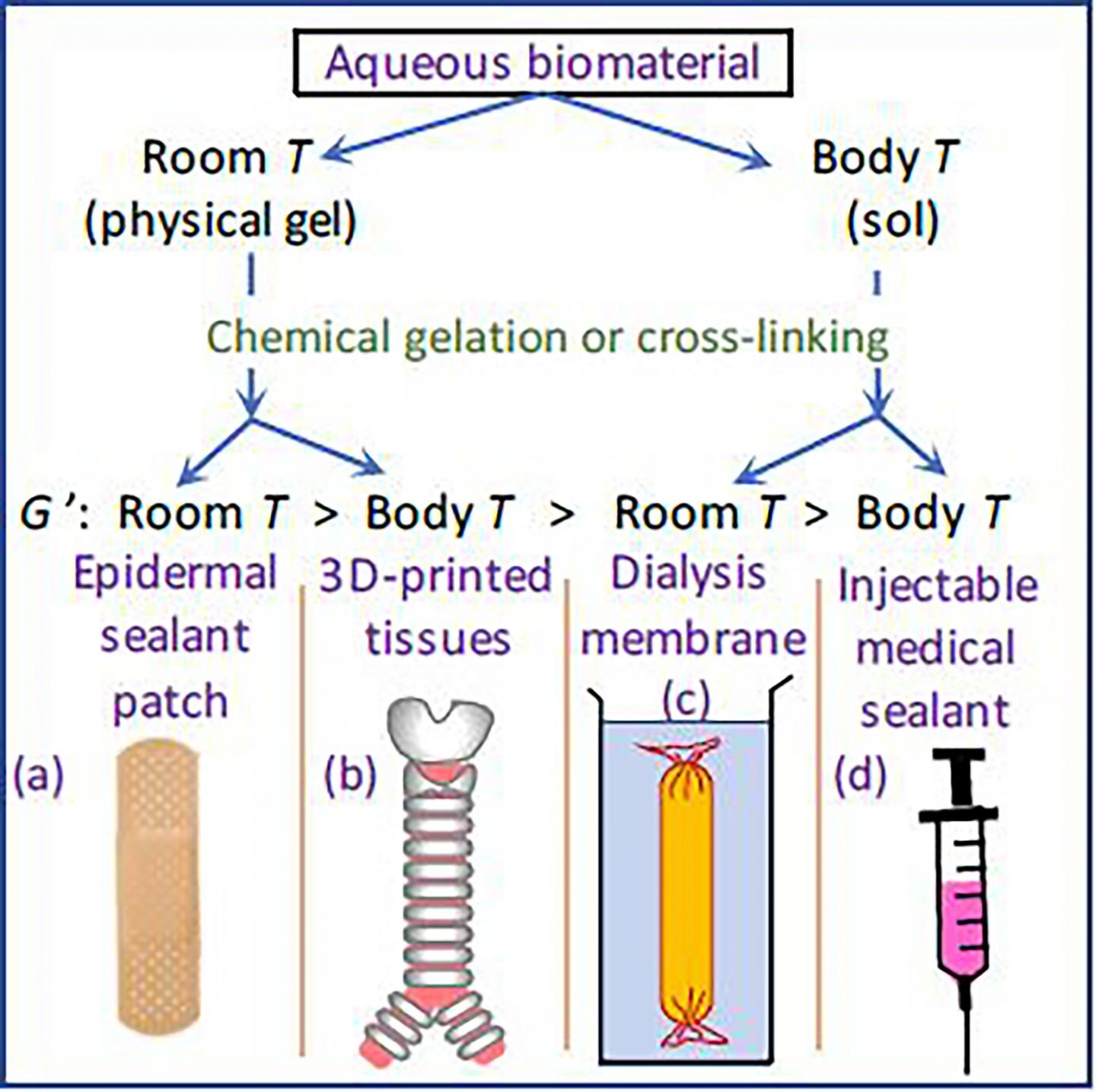
Since these gels contain particles in the solid state that are dispersed as molecules in the liquid state, they often move between sols (the liquid form of a colloid) and gels (the soft solid form of a colloid), depending on whether they are at room or body temperature. These changes can pose issues depending on their intended use.

In this week’s Physics of Fluids, from AIP Publishing, researchers in New Zealand, Canada and the United States studied the effect of temperature on hydrogels. They found that creating hydrogels at room temperature or below results in more robust materials that function more effectively when used in the body.

“When we want to create a patch for a lung puncture, we want something that can biodegrade in the body but is, at the same time, very sticky, so it adheres to the lung and is tough, so it can work as the lung expands and shrinks,” said author Heon Park, at the University of Canterbury.

The findings could be very useful in the 3D printing of biomaterials. When printing tissues, such as a piece of a lung, or printing artificial material, such as dialysis membrane, bioink (hydrogel plus cells) is currently stored in a syringe barrel, and it flows out of the syringe through a nozzle by squeezing a piston.

The authors demonstrate that the bioink will flow irregularly like a gel through the nozzle, if the nozzle or the barrel is at room temperature, and this will result in a printed part that is out of shape.

“Our research also shows the temperature of the bioink in the printing syringe should be at body temperature, so that it flows easily when it emerges, and that the printing bed should be room temperature or below, so that the printed part toughens,” said Park.

The researchers also discovered methods for minimizing drying of hydrogels, a problem uncovered in many current studies.

“Big picture, we have shown that the best way to engineer biomaterials that are rigid and sticky is by changing the temperature rather than by reformulating the hydrogels,” said Park.

###

The article, “Effect of temperature on gelation and cross-linking of gelatin methacryloyl for biomedical applications,” is authored by Heon E. Park, Nathan Gasek, Jaden Hwang, Daniel J. Weiss and Patrick C. Lee. The article will appear in Physics of Fluids on March 24, 2020 (DOI: 10.1063/1.5144896). After that date, it can be accessed at https://aip.scitation.org/doi/10.1063/1.5144896.

ABOUT THE JOURNAL

Physics of Fluids is devoted to the publication of original theoretical, computational, and experimental contributions to the dynamics of gases, liquids, and complex or multiphase fluids. See https://aip.scitation.org/journal/phf.

Media Contact
Larry Frum
[email protected]
301-209-3090

Related Journal Article

http://dx.doi.org/10.1063/1.5144896

Tags: BiologyBiomechanics/BiophysicsChemistry/Physics/Materials SciencesMaterialsMedicine/HealthMolecular BiologyMolecular PhysicsParticle Physics
Share12Tweet8Share2ShareShareShare2

Related Posts

Harnessing Neural Networks for Advances in Nonlinear Optics — Chemistry

Harnessing Neural Networks for Advances in Nonlinear Optics

May 12, 2026
Innovative Method Unveiled to Detect Signs of Dark Matter — Chemistry

Innovative Method Unveiled to Detect Signs of Dark Matter

May 12, 2026

Illuminating the Science Behind Historical Featherwork Art

May 12, 2026

Humans and Zebra Finches Share Similar Speech Learning Techniques #ASA190

May 11, 2026
Please login to join discussion

POPULAR NEWS

  • Research Indicates Potential Connection Between Prenatal Medication Exposure and Elevated Autism Risk

    842 shares
    Share 337 Tweet 211
  • New Study Reveals Plants Can Detect the Sound of Rain

    728 shares
    Share 290 Tweet 182
  • Salmonella Haem Blocks Macrophages, Boosts Infection

    62 shares
    Share 25 Tweet 16
  • Breastmilk Balances E. coli and Beneficial Bacteria in Infant Gut Microbiomes

    57 shares
    Share 23 Tweet 14

About

We bring you the latest biotechnology news from best research centers and universities around the world. Check our website.

Follow us

Recent News

Mayo Clinic to Undergo Leadership Transition, Honoring Dr. Gianrico Farrugia’s Transformational Impact

Study Finds Sustained Weight Loss Possible by Transitioning from Injectable Obesity Drugs to Daily Oral Orforglipron (ATTAIN-MAINTAIN)

Weight Loss Maintained Seven Times More Effectively with Continued Maximum Dose of Tirzepatide, Study Finds

Subscribe to Blog via Email

Enter your email address to subscribe to this blog and receive notifications of new posts by email.

Join 82 other subscribers
  • Contact Us

Bioengineer.org © Copyright 2023 All Rights Reserved.

Welcome Back!

Login to your account below

Forgotten Password?

Retrieve your password

Please enter your username or email address to reset your password.

Log In
No Result
View All Result
  • Homepages
    • Home Page 1
    • Home Page 2
  • News
  • National
  • Business
  • Health
  • Lifestyle
  • Science

Bioengineer.org © Copyright 2023 All Rights Reserved.