Credit: Miquel Duran-Frigola, IRB Barcelona
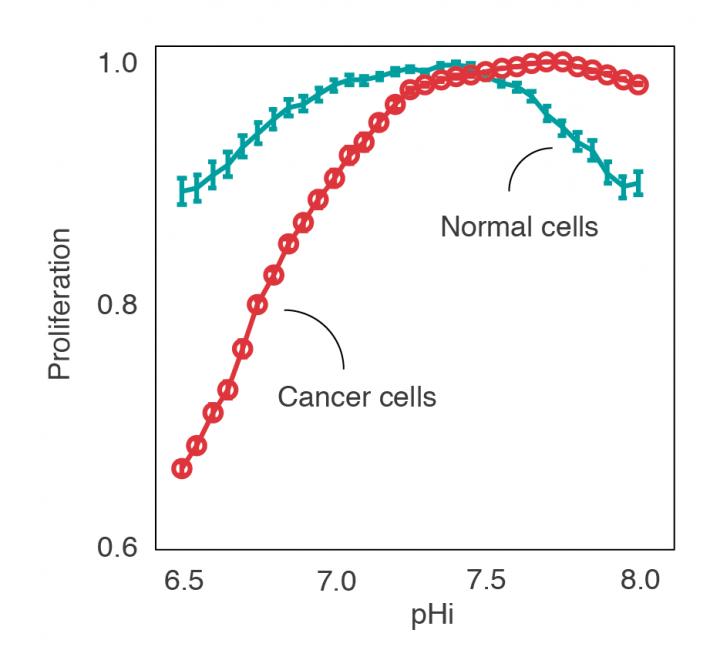
Cancer cells are known to acidify their environment and, consequently, the interior of the cells themselves is alkalised. In principle, this deregulation should hinder the development and proliferation of these cells. However, exactly the opposite happens in cancer. A computational study co-authored by computational chemist Miquel Duran-Frigola, from the Institute for Research in Biomedicine (IRB Barcelona), has demonstrated that cancer cells proliferate less and in a less robust manner when their internal pH is lowered, that is to say it becomes more acidic. This finding thus reveals opportunities for new therapeutic approaches to tackle the disease.
Using hundreds of thousands of data from previous biochemical assays and a database on the gene expression of cancer cells, the researchers have developed a computational model that analyses how variations in pH affect the activity of almost 2000 metabolic enzymes. "We are a computational lab and we are devoted to systems biology. We wanted to address the question on a large scale," says Miquel Duran-Frigola, Associate Researcher with the Structural Bioinformatics and Network Biology lab, headed by ICREA researcher Patrick Aloy. "Understanding the link between metabolic pathways that work better under different pHs can give us an idea about the mechanisms used by cancer to survive at basic pH," explains Duran-Frigola.
Acidification as an objective
The researchers have confirmed the hypothesis that they initially formulated. According to this hypothesis, if cancer cells proliferate easily in an alkaline environment, then they would be more vulnerable under acidic conditions. This paves the way to considering the acidification of the cancer cells themselves, combined with more conventional therapies, as a good therapeutic strategy.
New therapeutic targets
Furthermore, the researchers have identified the metabolic enzymes that work synergistically with intracellular acidity in the development of cancer, thus revealing these molecules as possible therapeutic targets. Indeed, five of these potential targets have already been tested in the lab using breast cancer cell lines and have yielded promising results.
"This work is still very academic, but we believe that some of the targets identified are ready to be tested in animals, thus allowing us to move into more advanced pre-clinical trial stages," says Miquel Duran-Frigola. The study, which has been performed in collaboration with the Moffitt Cancer Center and the University of Maryland, both in the US, has been published in Nature Communications.
###
The study has been done in collaboration with the University of Maryland and the MOFFIT.
Reference article:
Erez Persi, Miquel Duran-Frigola, Mehdi Damaghi, William R. Roush, Patrick Aloy, John L. Cleveland, Robert J. Gillies & Eytan Ruppin
Systems analysis of intracellular pH vulnerabilities for cancer therapy
Nature Communications (2018): DOI 10.1038/s41467-018-05261-x
Media Contact
Sònia Armengou
[email protected]
34-934-037-255
http://www.irbbarcelona.org
Original Source
https://www.irbbarcelona.org/en/news/acidic-ph-the-weakness-of-cancer-cells http://dx.doi.org/10.1038/s41467-018-05261-x