• HOME
  • NEWS
  • EXPLORE
    • CAREER
      • Companies
      • Jobs
    • EVENTS
    • iGEM
      • News
      • Team
    • PHOTOS
    • VIDEO
    • WIKI
  • BLOG
  • COMMUNITY
    • FACEBOOK
    • INSTAGRAM
    • TWITTER
Saturday, June 27, 2026
BIOENGINEER.ORG
No Result
View All Result
  • Login
  • HOME
  • NEWS
  • EXPLORE
    • CAREER
      • Companies
      • Jobs
        • Lecturer
        • PhD Studentship
        • Postdoc
        • Research Assistant
    • EVENTS
    • iGEM
      • News
      • Team
    • PHOTOS
    • VIDEO
    • WIKI
  • BLOG
  • COMMUNITY
    • FACEBOOK
    • INSTAGRAM
    • TWITTER
  • HOME
  • NEWS
  • EXPLORE
    • CAREER
      • Companies
      • Jobs
        • Lecturer
        • PhD Studentship
        • Postdoc
        • Research Assistant
    • EVENTS
    • iGEM
      • News
      • Team
    • PHOTOS
    • VIDEO
    • WIKI
  • BLOG
  • COMMUNITY
    • FACEBOOK
    • INSTAGRAM
    • TWITTER
No Result
View All Result
Bioengineer.org
No Result
View All Result
Home NEWS Science News Health

A video game aids in research on Alzheimer’s disease

Bioengineer by Bioengineer
April 24, 2019
in Health
Reading Time: 2 mins read
0
IMAGE
Share on FacebookShare on TwitterShare on LinkedinShare on RedditShare on Telegram

IMAGE

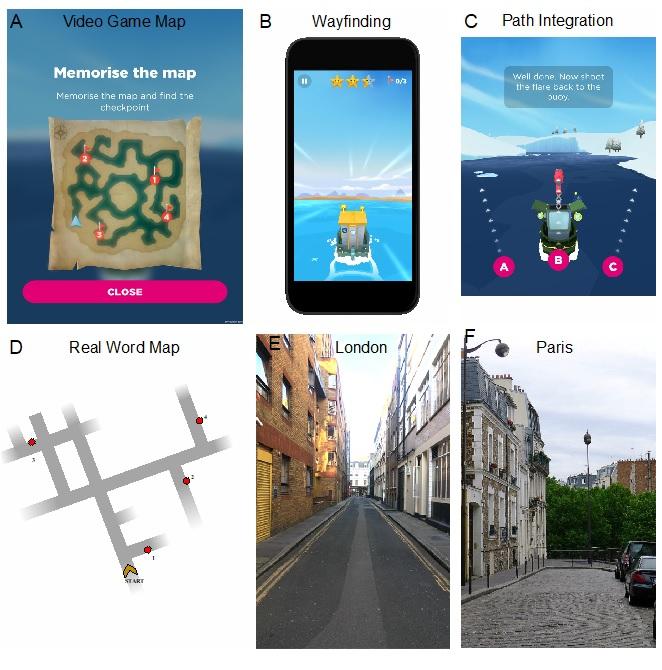
Credit: © Virtual navigation tested on a mobile app is predictive of real-world wayfinding navigation performance. Coutrot, A et al. PLOS ONE, 18 March 2019. DOI: https://doi.org/10.1371/journal.pone.0213272…

How do we find our way around? Why do I always get lost while my friend never does? Why does people’s sense of direction vary so widely in general? Is it linked to inherent, genetic characteristics or determined by cultural factors? To answer these questions, Antoine Coutrot, a CNRS researcher at the Laboratoire des sciences du numérique in Nantes, France (CNRS/Ecole centrale de Nantes/Université de Nantes/IMT Atlantique) and English colleagues at University College London and the University of East Anglia, developed a video game that has been played by 4 million people since. Strategies deployed to succeed at the game’s different quests represent the equivalent of 10,000 years of data collected in labs using traditional experimentation methods.

But how can we check whether player success is linked to spatial orientation skills or the ability to use a cell phone or a video game habit? To confirm their initial hypothesis, researchers compared navigational performance on male and female volunteers of all ages, in both the real and virtual world, in Paris and London. Their results and first article, published on PLOS ONE, validate this theory: virtual navigation performance is strongly on par with that of the real world.

Once the value of assessing navigational abilities via a video game was established, scientists then compared the results of those who played Sea Hero Quest with those who, while not suffering from dementia, have a greater likelihood of developing Alzheimer’s disease since they are are APOE type-4 allele carriers*. The latter, tested in the laboratory, recorded normal scores in their answers to traditional neuropsychological surveys. However, comparing their performance to Sea Hero Quest players of the same age, gender and country of origin highlighted changes in navigational habits even before clinical Alzheimer’s symptoms appear.

These results show for the first time how large-scale digital cognitive testing could hold potential for the early detection of Alzheimer’s disease and help in personalized testing processes to diagnose the illness in individuals showing no clinical symptoms.

  • 25% of the population carry this allele. As a result, they are four times more likely to develop the disease. See in particular the following study: Strittmatter et al. “Apolipoprotein E: high-avidity binding to beta-amyloid and increased frequency of type 4 allele in late-onset familial Alzheimer disease.” Proceedings of the National Academy of Sciences 90.5 (1993): 1977-1981.

###

Media Contact
Alexiane Agullo
[email protected]

Original Source

http://www.cnrs.fr/en/video-game-aids-research-alzheimers-disease

Related Journal Article

http://dx.doi.org/10.1073/pnas.1901600116

Tags: AlzheimerDiagnosticsMedicine/Healthneurobiology
Share12Tweet8Share2ShareShareShare2

Related Posts

Tracking Lanthanide-Labeled Microplastics in Plants

June 25, 2026

Neural Design Enables Zero-Shot Drug-Binding Proteins

June 25, 2026

Genomic Insights into Human Skin Fungi Diversity

June 25, 2026

Chiral Laser Gyroscopes Surpass Lock-In Limit

June 25, 2026
Please login to join discussion

POPULAR NEWS

  • Saying Goodbye to PGY-6: Pediatric Fellowship Realities

    103 shares
    Share 41 Tweet 26
  • Multi-Hospital Study Reveals Long Covid Burden Is Twice as High as Current Estimates

    92 shares
    Share 36 Tweet 23
  • Detection of EDCs in Breast Milk and Infant Urine Up to Six Months Highlights Early Exposure Risks

    77 shares
    Share 31 Tweet 19
  • New Drug Candidate Developed at McMaster Shows Potential for Treating Brain Cancer

    58 shares
    Share 23 Tweet 15

About

We bring you the latest biotechnology news from best research centers and universities around the world. Check our website.

Follow us

Recent News

Tracking Lanthanide-Labeled Microplastics in Plants

POSTECH Researchers Slash Cost of Reconstituted Cell-Free Systems by 95%

AI and Physics Collaborate to Design Advanced Hydrogen Storage Materials

Subscribe to Blog via Email

Success! An email was just sent to confirm your subscription. Please find the email now and click 'Confirm' to start subscribing.

Join 82 other subscribers
  • Contact Us

Bioengineer.org © Copyright 2023 All Rights Reserved.

Welcome Back!

Login to your account below

Forgotten Password?

Retrieve your password

Please enter your username or email address to reset your password.

Log In
No Result
View All Result
  • Homepages
    • Home Page 1
    • Home Page 2
  • News
  • National
  • Business
  • Health
  • Lifestyle
  • Science

Bioengineer.org © Copyright 2023 All Rights Reserved.