• HOME
  • NEWS
  • EXPLORE
    • CAREER
      • Companies
      • Jobs
    • EVENTS
    • iGEM
      • News
      • Team
    • PHOTOS
    • VIDEO
    • WIKI
  • BLOG
  • COMMUNITY
    • FACEBOOK
    • INSTAGRAM
    • TWITTER
Friday, June 26, 2026
BIOENGINEER.ORG
No Result
View All Result
  • Login
  • HOME
  • NEWS
  • EXPLORE
    • CAREER
      • Companies
      • Jobs
        • Lecturer
        • PhD Studentship
        • Postdoc
        • Research Assistant
    • EVENTS
    • iGEM
      • News
      • Team
    • PHOTOS
    • VIDEO
    • WIKI
  • BLOG
  • COMMUNITY
    • FACEBOOK
    • INSTAGRAM
    • TWITTER
  • HOME
  • NEWS
  • EXPLORE
    • CAREER
      • Companies
      • Jobs
        • Lecturer
        • PhD Studentship
        • Postdoc
        • Research Assistant
    • EVENTS
    • iGEM
      • News
      • Team
    • PHOTOS
    • VIDEO
    • WIKI
  • BLOG
  • COMMUNITY
    • FACEBOOK
    • INSTAGRAM
    • TWITTER
No Result
View All Result
Bioengineer.org
No Result
View All Result
Home NEWS Science News Chemistry

A thermometer can be stretched and crumpled by water

Bioengineer by Bioengineer
February 10, 2020
in Chemistry
Reading Time: 2 mins read
0
IMAGE
Share on FacebookShare on TwitterShare on LinkedinShare on RedditShare on Telegram

IMAGE

Credit: Taiho Park(POSTECH)

Recent outbreaks of the novel coronavirus have emphasized the importance of quarantine and prevention more than ever. When monitoring changes in our body, body temperature is first measured. So, it is very significant to measure the temperature accurately and promptly. With this regard, a research team recently developed a stretchable and crumpling polymer ionic conductor to realize a thermal sensor that could measure body temperature by simple contacts such as wearing clothes or shaking hands and an actuator that could control movements of artificial muscle.

Prof. Taiho Park and his student, Junwoo Lee from POSTECH Department of Chemical Engineering developed a thermally stable and flexible ionic conductor by using water solvent on a joint research with Nanyang Technological University for the first time. Their research accomplishment was published in the latest issue of the online version of Advanced Materials, the most renowned journal in the field of materials science.

Various materials for ionic conductors have been developed, however, with limitations to overcome. A semiconductor device used in most of the electronic devices has a problem with diminished electronic performances due to mechanical stress when it is stretched or contracted. Also, a rubber with nano-silver particle requires a difficult process and is not transparent. Hydrogel ions are easily dried out and lose their flexibility.

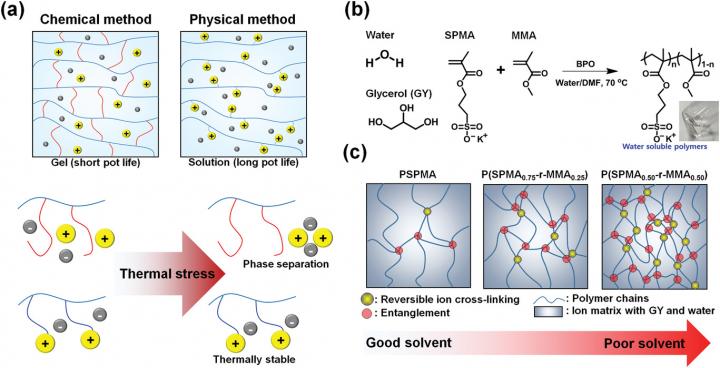
To solve these problems, the research team designed a P (SPMA-r-MMA) polymers with different ratios of ionic side chain and chemically linked ionic materials with polymer chains. When making an ionic conductor, it is critical to have a solution process at room temperature. So, the newly developed polymer ionic conductor was processed with water as a solvent and covered with thin film. The process was much simpler than the conventional ones and it did not use toxic solvent and could be mass-produced.

The chemically linked ionic conductor was thermally stable and stretchable. Also, it was self-healable that could recover its structures when it was ripped or broken. The research team used this ionic conductor to realize an actuator thermally stable up to 100°C and a flexible thermal sensor applicable to a body for the first time.

Junwoo Lee who performed the research said, “This is the first example of developing a polymer ionic conductor, which is used in a next-generation stretchable device, by facilitating a water solvent instead of a toxic chemical solvent. The polymer ionic conductor that we developed this time is stretchable, self-healable and thermally stable. For this reason, we anticipate that our research will impact greatly on the stretchable wearable electronic device industry.”

###

The research was supported by the Center for Advanced Soft Electronics under the Global Frontier Research Program. Meantime, Junwoo Lee who investigated the research has been selected as a grantee of the Global PhD Fellowship since 2016.

Media Contact
Jinyoung Huh
[email protected]
82-542-792-415

Original Source

http://postech.ac.kr/eng/a-thermometer-can-be-stretched-and-crumpled-by-water/?pageds=1&k=&c=

Related Journal Article

http://dx.doi.org/10.1002/adma.201906679

Tags: Chemistry/Physics/Materials SciencesElectrical Engineering/ElectronicsElectromagneticsMaterialsSuperconductors/Semiconductors
Share13Tweet8Share2ShareShareShare2

Related Posts

AI and Physics Collaborate to Design Advanced Hydrogen Storage Materials

June 25, 2026

International Team Including Dresden Scientists Develops Novel Designer Proteins for Advanced Study of Living Tissue

June 25, 2026

New Study Uncovers Key Factors Driving Water Chemistry in Nanoscale Environments

June 25, 2026

Plasma Technology Extends Catalyst Lifespan in Hydrogen Production

June 24, 2026
Please login to join discussion

POPULAR NEWS

  • Saying Goodbye to PGY-6: Pediatric Fellowship Realities

    103 shares
    Share 41 Tweet 26
  • Multi-Hospital Study Reveals Long Covid Burden Is Twice as High as Current Estimates

    92 shares
    Share 36 Tweet 23
  • Detection of EDCs in Breast Milk and Infant Urine Up to Six Months Highlights Early Exposure Risks

    77 shares
    Share 31 Tweet 19
  • New Drug Candidate Developed at McMaster Shows Potential for Treating Brain Cancer

    58 shares
    Share 23 Tweet 15

About

We bring you the latest biotechnology news from best research centers and universities around the world. Check our website.

Follow us

Recent News

Tracking Lanthanide-Labeled Microplastics in Plants

POSTECH Researchers Slash Cost of Reconstituted Cell-Free Systems by 95%

AI and Physics Collaborate to Design Advanced Hydrogen Storage Materials

Subscribe to Blog via Email

Success! An email was just sent to confirm your subscription. Please find the email now and click 'Confirm' to start subscribing.

Join 82 other subscribers
  • Contact Us

Bioengineer.org © Copyright 2023 All Rights Reserved.

Welcome Back!

Login to your account below

Forgotten Password?

Retrieve your password

Please enter your username or email address to reset your password.

Log In
No Result
View All Result
  • Homepages
    • Home Page 1
    • Home Page 2
  • News
  • National
  • Business
  • Health
  • Lifestyle
  • Science

Bioengineer.org © Copyright 2023 All Rights Reserved.