• HOME
  • NEWS
  • EXPLORE
    • CAREER
      • Companies
      • Jobs
    • EVENTS
    • iGEM
      • News
      • Team
    • PHOTOS
    • VIDEO
    • WIKI
  • BLOG
  • COMMUNITY
    • FACEBOOK
    • INSTAGRAM
    • TWITTER
Thursday, June 25, 2026
BIOENGINEER.ORG
No Result
View All Result
  • Login
  • HOME
  • NEWS
  • EXPLORE
    • CAREER
      • Companies
      • Jobs
        • Lecturer
        • PhD Studentship
        • Postdoc
        • Research Assistant
    • EVENTS
    • iGEM
      • News
      • Team
    • PHOTOS
    • VIDEO
    • WIKI
  • BLOG
  • COMMUNITY
    • FACEBOOK
    • INSTAGRAM
    • TWITTER
  • HOME
  • NEWS
  • EXPLORE
    • CAREER
      • Companies
      • Jobs
        • Lecturer
        • PhD Studentship
        • Postdoc
        • Research Assistant
    • EVENTS
    • iGEM
      • News
      • Team
    • PHOTOS
    • VIDEO
    • WIKI
  • BLOG
  • COMMUNITY
    • FACEBOOK
    • INSTAGRAM
    • TWITTER
No Result
View All Result
Bioengineer.org
No Result
View All Result
Home NEWS Science News

A stretchable stopwatch lights up human skin

Bioengineer by Bioengineer
October 30, 2019
in Science News
Reading Time: 2 mins read
0
IMAGE
Share on FacebookShare on TwitterShare on LinkedinShare on RedditShare on Telegram

IMAGE

Credit: Adapted from ACS Materials Letters 2019, DOI:
10.1021/acsmaterialslett.9b00376.


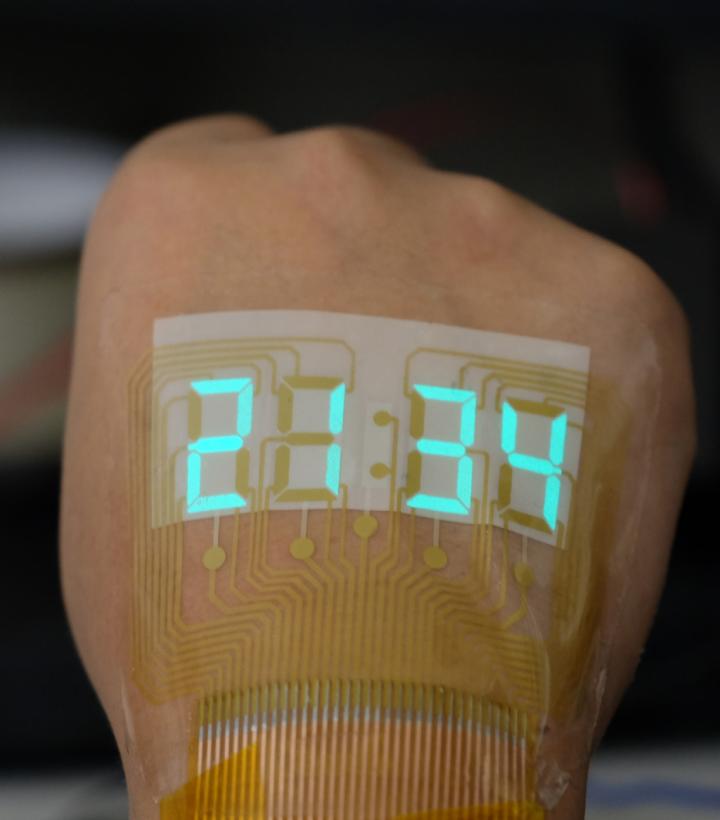
Imagine a runner who doesn’t need to carry a stopwatch or cell phone to check her time: She could just gaze at the glowing stopwatch display on the back of her hand. Such human-machine interfaces are no longer science fiction, but they still have a way to go before becoming mainstream. Now, researchers reporting in ACS Materials Letters have developed a stretchable light-emitting device that operates at low voltages and is safe for human skin.

Recently, scientists have developed stretchable light-emitting devices called alternating-current electroluminescent (ACEL) displays that can be stuck on skin or other surfaces like a temporary tattoo. However, the displays require relatively high voltages to achieve sufficient brightness, which could create safety concerns. So, Desheng Kong and colleagues wanted to develop an ACEL that could operate at lower voltages and thus be safer for human skin.

To make their device, the researchers sandwiched an electroluminescent layer, made of light-emitting microparticles dispersed in a stretchable dielectric material, between two flexible silver nanowire electrodes. The device contained a new type of dielectric material, in the form of ceramic nanoparticles embedded in a rubbery polymer, that increased the brightness compared with existing ACEL displays. They used this material to make a four-digit stopwatch display, which they mounted onto a volunteer’s hand. At low voltages, the stretchable display was sufficiently bright to be seen under indoor lighting. The bright stretchable display could find a broad range of applications in smart wearables, soft robotics and human-machine interfaces, the researchers say.

###

The authors acknowledge funding from National Key Research and Development Program of China, National Natural Science Foundation of China and Fundamental Research Funds for the Central Universities.

The abstract that accompanies this study is available here.

The American Chemical Society, the world’s largest scientific society, is a nonprofit organization chartered by the U.S. Congress. ACS is a global leader in providing access to chemistry-related information and research through its multiple databases, peer-reviewed journals and scientific conferences. ACS does not conduct research, but publishes and publicizes peer-reviewed scientific studies. Its main offices are in Washington, D.C., and Columbus, Ohio.

To automatically receive news releases from the American Chemical Society, contact [email protected].

Follow us on Twitter | Facebook

Media Contact
Katie Cottingham
[email protected]
301-775-8455

Related Journal Article

http://dx.doi.org/10.1021/acsmaterialslett.9b00376

Tags: BiotechnologyChemistry/Physics/Materials SciencesElectrical Engineering/ElectronicsNanotechnology/MicromachinesRobotry/Artificial IntelligenceSports/Recreation
Share12Tweet8Share2ShareShareShare2

Related Posts

Natural Hallucinogens: Evolution’s Ecological Tools, Not Mere Chemical Byproducts

June 25, 2026

Neural Design Enables Zero-Shot Drug-Binding Proteins

June 25, 2026

Genomic Insights into Human Skin Fungi Diversity

June 25, 2026

Energy-Saving Membrane Technology Developed by KAIST and Georgia Tech Enables Crude Oil Separation Without Boiling

June 25, 2026
Please login to join discussion

POPULAR NEWS

  • Saying Goodbye to PGY-6: Pediatric Fellowship Realities

    103 shares
    Share 41 Tweet 26
  • Multi-Hospital Study Reveals Long Covid Burden Is Twice as High as Current Estimates

    92 shares
    Share 36 Tweet 23
  • Detection of EDCs in Breast Milk and Infant Urine Up to Six Months Highlights Early Exposure Risks

    77 shares
    Share 31 Tweet 19
  • New Drug Candidate Developed at McMaster Shows Potential for Treating Brain Cancer

    58 shares
    Share 23 Tweet 15

About

We bring you the latest biotechnology news from best research centers and universities around the world. Check our website.

Follow us

Recent News

Natural Hallucinogens: Evolution’s Ecological Tools, Not Mere Chemical Byproducts

Neural Design Enables Zero-Shot Drug-Binding Proteins

Genomic Insights into Human Skin Fungi Diversity

Subscribe to Blog via Email

Enter your email address to subscribe to this blog and receive notifications of new posts by email.

Join 82 other subscribers
  • Contact Us

Bioengineer.org © Copyright 2023 All Rights Reserved.

Welcome Back!

Login to your account below

Forgotten Password?

Retrieve your password

Please enter your username or email address to reset your password.

Log In
No Result
View All Result
  • Homepages
    • Home Page 1
    • Home Page 2
  • News
  • National
  • Business
  • Health
  • Lifestyle
  • Science

Bioengineer.org © Copyright 2023 All Rights Reserved.