• HOME
  • NEWS
  • EXPLORE
    • CAREER
      • Companies
      • Jobs
    • EVENTS
    • iGEM
      • News
      • Team
    • PHOTOS
    • VIDEO
    • WIKI
  • BLOG
  • COMMUNITY
    • FACEBOOK
    • INSTAGRAM
    • TWITTER
Thursday, May 21, 2026
BIOENGINEER.ORG
No Result
View All Result
  • Login
  • HOME
  • NEWS
  • EXPLORE
    • CAREER
      • Companies
      • Jobs
        • Lecturer
        • PhD Studentship
        • Postdoc
        • Research Assistant
    • EVENTS
    • iGEM
      • News
      • Team
    • PHOTOS
    • VIDEO
    • WIKI
  • BLOG
  • COMMUNITY
    • FACEBOOK
    • INSTAGRAM
    • TWITTER
  • HOME
  • NEWS
  • EXPLORE
    • CAREER
      • Companies
      • Jobs
        • Lecturer
        • PhD Studentship
        • Postdoc
        • Research Assistant
    • EVENTS
    • iGEM
      • News
      • Team
    • PHOTOS
    • VIDEO
    • WIKI
  • BLOG
  • COMMUNITY
    • FACEBOOK
    • INSTAGRAM
    • TWITTER
No Result
View All Result
Bioengineer.org
No Result
View All Result
Home NEWS Science News Chemistry

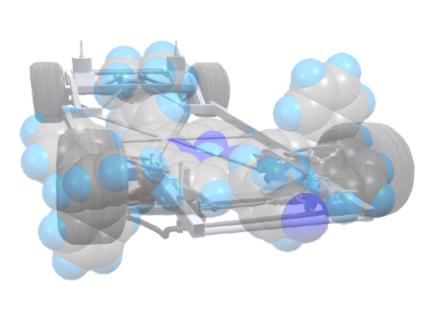
A new family of nanocars ready for the next nano Grand Prix

Bioengineer by Bioengineer
June 16, 2020
in Chemistry
Reading Time: 3 mins read
0
IMAGE
Share on FacebookShare on TwitterShare on LinkedinShare on RedditShare on Telegram

IMAGE

Credit: G. Rapenne, NAIST and UPS

Gwénaël Rapenne, Professor at NAIST (Nara, Japan) and University Paul Sabatier (Toulouse, France) – June 12th, 2020

According to the British Royal Automobile and the French Automobile clubs, the first car was created in 1770 by the Frenchman Joseph Cugnot. This “Fardier” (French name for a trolley used to transport heavy loads) was a car propelled by a steam engine and powered by a boiler. This 7 m long self-propelled machine reached a speed of 4 km/h, for an average autonomy of 15 min. 250 years later, researchers at the Nara Institute of Science and Technology (NAIST), Japan, in partnership with colleagues in the University Paul Sabatier (Toulouse, France), report in Chemistry – A European Journal a new family of nanocars integrating a dipole to speed up their motion in the nanoworld.

After the first nanocar race organized in spring 2017, in Toulouse (France) we designed a new family of molecules to behave as cars in the nanoworld. When I established my laboratory in NAIST in April 2018, Toshio Nishino (Assistant Professor) and Hiroki Takeuchi (Master student) started the synthesis. Two years later, we are reporting the results in a publication presenting the synthesis of 9 dipolar nanocars. The result is amazing. In every flask, about 100 mg of green or blue powders (i.e. 60 x 1018 nanocars) stick to the walls. These are the Franco-Japanese racing cars that sleep wisely in the garage waiting for the next Grand Prix in 2021.

“To hope to win the race, nanocars have to be fast but they need also to be controllable,” emphasizes Gwénaël Rapenne. The design of the molecules has long been thought to need a compromise between opposite requirements. Consistently, the nanocar Rapenne and his colleagues designed is made up of 150 atoms (chemical formula C85H59N5Zn). A planar chassis made from porphyrin, a fragment already used in nature for many processes like oxygen transportation (hemoglobin) or photosynthesis (chlorophyl). Ultimately, the presence of a zinc atom could allow transportation of small molecules on the car body. “The nanocar is 2 nm long and surrounded by four wheels designed to minimize contact with the ground and has two legs which are able to donate or accept electrons making the nanocar dipolar” specifies the researcher.

What kind of application could be envisioned with such small vehicles?

“Honestly, today, we do not know yet what this technology will be used for. But just like the liquid crystals discovered in 1910 and not used until half a century later in calculator screens and now in all our LCD supports, the manipulation of molecules could well be revolutionary, ” dreams Gwénaël Rapenne. One of the directions of the research could be to carry a load to transport reactants or drugs from one place to another.

###

Resource

Title: A dipolar nanocar based on a porphyrin backbone

Authors: Toshio Nishino, Colin J. Martin, Hiroki Takeuchi, Florence Lim, Kazuma Yasuhara, Yohan Gisbert, Seifallah Abid, Nathalie Saffon-Merceron, Claire Kammerer, Gwénaël Rapenne

Journal: Chemistry – A European Journal

DOI: 10.1002/chem.202001999

Media Contact
Takahito Shikano
[email protected]

Related Journal Article

http://dx.doi.org/10.1002/chem.202001999

Tags: Chemistry/Physics/Materials SciencesNanotechnology/Micromachines
Share12Tweet8Share2ShareShareShare2

Related Posts

Advancing In Vivo and In Situ Monitoring: Science Bulletin Highlights Host-Based Antifouling Gold Nanotube Sensor for Selective Detection of Mechanically Sensitive Serotonin Release in Intestinal Mucosa — Chemistry

Advancing In Vivo and In Situ Monitoring: Science Bulletin Highlights Host-Based Antifouling Gold Nanotube Sensor for Selective Detection of Mechanically Sensitive Serotonin Release in Intestinal Mucosa

May 20, 2026
How Magnetic Orientation Could Influence the Building Blocks of Life — Chemistry

How Magnetic Orientation Could Influence the Building Blocks of Life

May 20, 2026

Breaking a 200-Year-Old Belief: Novel Surface Design Achieves Two Distinct Wetting States on One Substrate

May 20, 2026

Unveiling Sound Waves: Scientists Discover Hidden Behaviors in Acoustic Phenomena

May 20, 2026
Please login to join discussion

POPULAR NEWS

  • blank

    New Study Reveals Plants Can Detect the Sound of Rain

    733 shares
    Share 292 Tweet 183
  • ESMO 2025: mRNA COVID Vaccines Enhance Efficacy of Cancer Immunotherapy

    301 shares
    Share 120 Tweet 75
  • Research Indicates Potential Connection Between Prenatal Medication Exposure and Elevated Autism Risk

    846 shares
    Share 338 Tweet 212
  • Breastmilk Balances E. coli and Beneficial Bacteria in Infant Gut Microbiomes

    58 shares
    Share 23 Tweet 15

About

We bring you the latest biotechnology news from best research centers and universities around the world. Check our website.

Follow us

Recent News

Experts Warn of a Moral Crisis in Healthcare

Common Food Preservatives Associated with Elevated Blood Pressure and Increased Heart Disease Risk

Study Finds Reusable Catheters a Safe Option That Could Save the NHS Millions

Subscribe to Blog via Email

Enter your email address to subscribe to this blog and receive notifications of new posts by email.

Join 82 other subscribers
  • Contact Us

Bioengineer.org © Copyright 2023 All Rights Reserved.

Welcome Back!

Login to your account below

Forgotten Password?

Retrieve your password

Please enter your username or email address to reset your password.

Log In
No Result
View All Result
  • Homepages
    • Home Page 1
    • Home Page 2
  • News
  • National
  • Business
  • Health
  • Lifestyle
  • Science

Bioengineer.org © Copyright 2023 All Rights Reserved.