• HOME
  • NEWS
  • EXPLORE
    • CAREER
      • Companies
      • Jobs
    • EVENTS
    • iGEM
      • News
      • Team
    • PHOTOS
    • VIDEO
    • WIKI
  • BLOG
  • COMMUNITY
    • FACEBOOK
    • INSTAGRAM
    • TWITTER
Saturday, June 27, 2026
BIOENGINEER.ORG
No Result
View All Result
  • Login
  • HOME
  • NEWS
  • EXPLORE
    • CAREER
      • Companies
      • Jobs
        • Lecturer
        • PhD Studentship
        • Postdoc
        • Research Assistant
    • EVENTS
    • iGEM
      • News
      • Team
    • PHOTOS
    • VIDEO
    • WIKI
  • BLOG
  • COMMUNITY
    • FACEBOOK
    • INSTAGRAM
    • TWITTER
  • HOME
  • NEWS
  • EXPLORE
    • CAREER
      • Companies
      • Jobs
        • Lecturer
        • PhD Studentship
        • Postdoc
        • Research Assistant
    • EVENTS
    • iGEM
      • News
      • Team
    • PHOTOS
    • VIDEO
    • WIKI
  • BLOG
  • COMMUNITY
    • FACEBOOK
    • INSTAGRAM
    • TWITTER
No Result
View All Result
Bioengineer.org
No Result
View All Result
Home NEWS Science News Biology

A glimmer of hope for the world's coral reefs

Bioengineer by Bioengineer
December 10, 2018
in Biology
Reading Time: 3 mins read
0
IMAGE
Share on FacebookShare on TwitterShare on LinkedinShare on RedditShare on Telegram

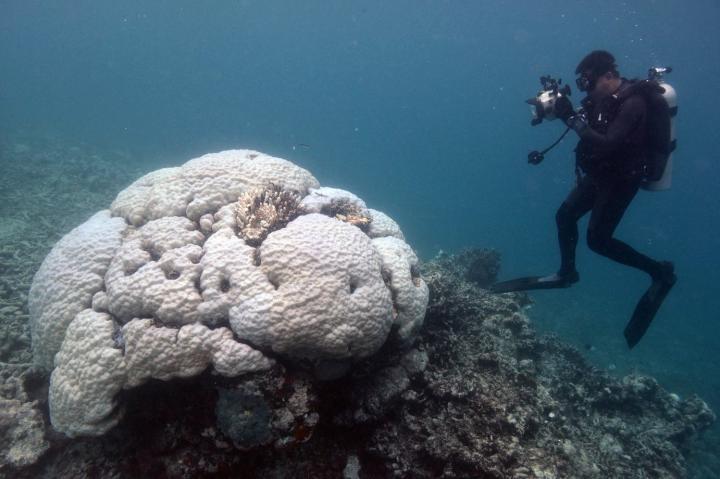
The future of the world’s coral reefs is uncertain, as the impact of global heating continues to escalate
IMAGE

Credit: Justin Marshall

The future of the world’s coral reefs is uncertain, as the impact of global heating continues to escalate. However, according to a study published today in Nature Climate Change, the response of the Great Barrier Reef to extreme temperatures in 2017 was markedly different to one year earlier, following two back-to-back bouts of coral bleaching. Remarkably, corals that bleached and survived 2016 were more resistant in 2017 to a recurrence of hot conditions.

“Dead corals don’t bleach for a second time. The north lost millions of heat-sensitive corals in 2016, and most of the survivors were the tougher species. As a result of bleaching, the mix of species is changing very rapidly,” said lead author Prof Terry Hughes, Director of the Australian Research Council Centre of Excellence for Coral Reef Studies (Coral CoE), headquartered at James Cook University.

“We were astonished to find less bleaching in 2017, because the temperatures were even more extreme than the year before,” he said.

The new research highlights the extent of damage, or “geographic footprint” of multiple coral bleaching events across the 2,300 km length of the world-heritage listed area.

The back-to-back heatwaves bring the total number of mass bleaching events on the Great Barrier Reef to four over the past two decades (in 1998, 2002, 2016 and 2017). The scientists found that only 7% of the Great Barrier Reef escaped bleaching entirely since 1998, and after the 2017 event, 61% of reefs have now been severely bleached at least once.

“We found, using the National Oceanic and Atmospheric Administration’s (NOAA) satellite-based coral bleaching tools, that corals in the north of the Great Barrier Reef were exposed to the most heat stress in 2016. A year later, the central region saw the most prolonged heating,” said co-author Dr Mark Eakin, from NOAA’s Coral Reef Watch program, in Maryland, USA.

The southern third of the Great Barrier Reef was cooler in both years due to local weather conditions, and escaped with only minor bleaching.

“It’s only a matter of time before we see another mass-bleaching event, triggered by the next marine heatwave, driven by global heating,” said co-author Dr Andrew Hoey of Coral CoE at James Cook University. “One of the worst possible scenarios is we’ll see these southern corals succumb to bleaching in the near future.”

“The outcome in 2017 depended on the conditions experienced by the corals one year earlier. We called that ‘ecological memory,’ and show that these repeating events are now acting together in ways that we didn’t expect,” said Prof Hughes.

“We’ve never seen back-to-back mass coral bleaching before on the Great Barrier Reef, in two consecutive summers. The combined footprint has killed close to half of the corals on two-thirds of the world’s largest reef system,” said Dr Hoey.

“We need urgent global action on greenhouse emissions to save the world’s coral reefs. Australia should be – but regrettably isn’t – at the forefront of tackling global heating,” said Prof Hughes.

###

Media Contact
Melissa Lyne
[email protected]
042-878-5895

Original Source

https://www.coralcoe.org.au/media-releases/a-glimmer-of-hope-for-the-worlds-coral-reefs

Related Journal Article

http://dx.doi.org/10.1038/s41558-018-0351-2

Tags: BiodiversityBiologyClimate ChangeEcology/EnvironmentMarine/Freshwater Biology
Share12Tweet8Share2ShareShareShare2

Related Posts

Natural Hallucinogens: Evolution’s Ecological Tools, Not Mere Chemical Byproducts

June 25, 2026

This Famous Butterfly Revealed: Three Distinct Species Hidden in One

June 25, 2026

Scientists Attack Soybean Cyst Nematode by Starving Its Food Source

June 25, 2026

Decoding the Secret Code of a Crucial Immune Sensor

June 24, 2026
Please login to join discussion

POPULAR NEWS

  • Saying Goodbye to PGY-6: Pediatric Fellowship Realities

    103 shares
    Share 41 Tweet 26
  • Multi-Hospital Study Reveals Long Covid Burden Is Twice as High as Current Estimates

    92 shares
    Share 36 Tweet 23
  • Detection of EDCs in Breast Milk and Infant Urine Up to Six Months Highlights Early Exposure Risks

    77 shares
    Share 31 Tweet 19
  • New Drug Candidate Developed at McMaster Shows Potential for Treating Brain Cancer

    58 shares
    Share 23 Tweet 15

About

We bring you the latest biotechnology news from best research centers and universities around the world. Check our website.

Follow us

Recent News

Tracking Lanthanide-Labeled Microplastics in Plants

POSTECH Researchers Slash Cost of Reconstituted Cell-Free Systems by 95%

AI and Physics Collaborate to Design Advanced Hydrogen Storage Materials

Subscribe to Blog via Email

Success! An email was just sent to confirm your subscription. Please find the email now and click 'Confirm' to start subscribing.

Join 82 other subscribers
  • Contact Us

Bioengineer.org © Copyright 2023 All Rights Reserved.

Welcome Back!

Login to your account below

Forgotten Password?

Retrieve your password

Please enter your username or email address to reset your password.

Log In
No Result
View All Result
  • Homepages
    • Home Page 1
    • Home Page 2
  • News
  • National
  • Business
  • Health
  • Lifestyle
  • Science

Bioengineer.org © Copyright 2023 All Rights Reserved.