• HOME
  • NEWS
  • EXPLORE
    • CAREER
      • Companies
      • Jobs
    • EVENTS
    • iGEM
      • News
      • Team
    • PHOTOS
    • VIDEO
    • WIKI
  • BLOG
  • COMMUNITY
    • FACEBOOK
    • INSTAGRAM
    • TWITTER
Thursday, May 21, 2026
BIOENGINEER.ORG
No Result
View All Result
  • Login
  • HOME
  • NEWS
  • EXPLORE
    • CAREER
      • Companies
      • Jobs
        • Lecturer
        • PhD Studentship
        • Postdoc
        • Research Assistant
    • EVENTS
    • iGEM
      • News
      • Team
    • PHOTOS
    • VIDEO
    • WIKI
  • BLOG
  • COMMUNITY
    • FACEBOOK
    • INSTAGRAM
    • TWITTER
  • HOME
  • NEWS
  • EXPLORE
    • CAREER
      • Companies
      • Jobs
        • Lecturer
        • PhD Studentship
        • Postdoc
        • Research Assistant
    • EVENTS
    • iGEM
      • News
      • Team
    • PHOTOS
    • VIDEO
    • WIKI
  • BLOG
  • COMMUNITY
    • FACEBOOK
    • INSTAGRAM
    • TWITTER
No Result
View All Result
Bioengineer.org
No Result
View All Result
Home NEWS Science News

A geospatial analysis identifies the areas most vulnerable to COVID-19

Bioengineer by Bioengineer
June 1, 2020
in Science News
Reading Time: 2 mins read
0
IMAGE
Share on FacebookShare on TwitterShare on LinkedinShare on RedditShare on Telegram

IMAGE

Credit: TAPTAP COVID-19 Report.

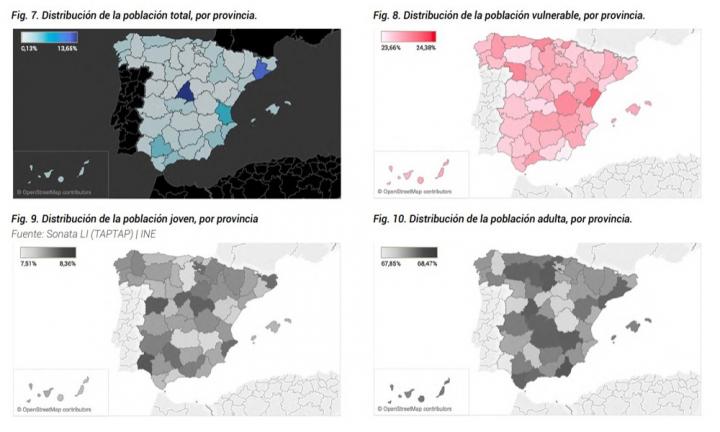
A report based on a geospatial analysis conducted by researchers from the Universidad Carlos III de Madrid (UC3M) in collaboration with TAPTAP Digital, using additional data from Predicio and Tamoco, identifies the areas in Spain that require increased measures of protection against new outbreaks of the COVID19 epidemics.

Based on their population density, Madrid and Barcelona are the Spanish cities with an increased risk of infection; however, when considering other variables, such as the rates of the at-risk population and, in particular, coverage of critical points of interest (such as hospitals, pharmacies or supermarkets), the areas requiring additional measures of protection, in particular contexts, can be identified.

The most vulnerable areas, according to the proportional concentration of at-risk groups, are Castellón, Cantabria and Gipuzkoa. Likewise, Toledo, Segovia, Salamanca, and Navarre are the areas which have the least hospital coverage in relation to their vulnerable population, according to the conclusions of the study.

“The analysis of indicators which affect the evolution of the virus or risk in a particular geographic area in isolation could lead to incorrect conclusions or biased assessments. The multi-variable rates provide a more comprehensive analysis”, the report indicates.

Extracting multi-variable rates facilitates a broader analysis of the evolving behavior of the COVID-19 pandemic based on several factors such as, the area, the population’s mobility or possible propagation of the virus in relation to the phased recovery of commercial and industrial activity, for example.

From 25km to 5km a day during isolation

At a national level, the population’s mobility decreased from 25 to 5 kilometres per person per day during the isolation period, a decrease of approximately 80%. In addition, the study finds that the restriction of all non-essential activity began to significantly affect mobility about 5 days later.

“These results can help institutions and the community analyse various indicators and better understand the COVID19 pandemic”, explains one of the report’s authors, Rubén Cuevas, a professor at the UC3M’s Telematics Engineering Department. This research has been carried out as part of the TAPTAP Digital-UC3M Chair. “Before the COVID-19 pandemic, we were able to use our geospatial engine, called Sonata Location Intelligence (LI), to gain an understanding of the population’s mobility, demographic significance and interactions with points of interest or essential services, such as hospitals, pharmacies or supermarkets, during the isolation period”, notes Álvaro Mayol, Partner and Chief Product & Technology Officer at TAPTAP Digital.

This tool enables additional analyses with regard to other issues related to COVID-19. “Because the data provided by TAPTAP and its partner, Predicio, is global, we are now working on a scientific article which compares population mobility patterns in different countries”, notes Rubén Cuevas.

###

More information: TAPTAP COVID-19 Report

Media Contact
Javier Alonso
[email protected]

Original Source

https://www.uc3m.es/ss/Satellite/UC3MInstitucional/en/Detalle/Comunicacion_C/1371292332861/1371215537949/A_geospatial_analysis_identifies_the_areas_most_vulnerable_to_COVID-19

Tags: Medicine/HealthResearch/DevelopmentTechnology/Engineering/Computer Science
Share12Tweet8Share2ShareShareShare2

Related Posts

Label-Free Super-Resolution Imaging of Live Cells — Technology and Engineering

Label-Free Super-Resolution Imaging of Live Cells

May 21, 2026

Genetic Insights from 619,372 Metabolic Profiles

May 21, 2026

Bacterial STIs Hit Record Levels in Europe as Congenital Syphilis Cases Nearly Double

May 21, 2026

Embryonic Cell Migration: The Journey of Life Begins

May 21, 2026
Please login to join discussion

POPULAR NEWS

  • blank

    New Study Reveals Plants Can Detect the Sound of Rain

    733 shares
    Share 292 Tweet 183
  • ESMO 2025: mRNA COVID Vaccines Enhance Efficacy of Cancer Immunotherapy

    304 shares
    Share 122 Tweet 76
  • Research Indicates Potential Connection Between Prenatal Medication Exposure and Elevated Autism Risk

    846 shares
    Share 338 Tweet 212
  • Breastmilk Balances E. coli and Beneficial Bacteria in Infant Gut Microbiomes

    58 shares
    Share 23 Tweet 15

About

We bring you the latest biotechnology news from best research centers and universities around the world. Check our website.

Follow us

Recent News

Label-Free Super-Resolution Imaging of Live Cells

Genetic Insights from 619,372 Metabolic Profiles

Bacterial STIs Hit Record Levels in Europe as Congenital Syphilis Cases Nearly Double

Subscribe to Blog via Email

Enter your email address to subscribe to this blog and receive notifications of new posts by email.

Join 82 other subscribers
  • Contact Us

Bioengineer.org © Copyright 2023 All Rights Reserved.

Welcome Back!

Login to your account below

Forgotten Password?

Retrieve your password

Please enter your username or email address to reset your password.

Log In
No Result
View All Result
  • Homepages
    • Home Page 1
    • Home Page 2
  • News
  • National
  • Business
  • Health
  • Lifestyle
  • Science

Bioengineer.org © Copyright 2023 All Rights Reserved.