• HOME
  • NEWS
  • EXPLORE
    • CAREER
      • Companies
      • Jobs
    • EVENTS
    • iGEM
      • News
      • Team
    • PHOTOS
    • VIDEO
    • WIKI
  • BLOG
  • COMMUNITY
    • FACEBOOK
    • INSTAGRAM
    • TWITTER
Sunday, June 28, 2026
BIOENGINEER.ORG
No Result
View All Result
  • Login
  • HOME
  • NEWS
  • EXPLORE
    • CAREER
      • Companies
      • Jobs
        • Lecturer
        • PhD Studentship
        • Postdoc
        • Research Assistant
    • EVENTS
    • iGEM
      • News
      • Team
    • PHOTOS
    • VIDEO
    • WIKI
  • BLOG
  • COMMUNITY
    • FACEBOOK
    • INSTAGRAM
    • TWITTER
  • HOME
  • NEWS
  • EXPLORE
    • CAREER
      • Companies
      • Jobs
        • Lecturer
        • PhD Studentship
        • Postdoc
        • Research Assistant
    • EVENTS
    • iGEM
      • News
      • Team
    • PHOTOS
    • VIDEO
    • WIKI
  • BLOG
  • COMMUNITY
    • FACEBOOK
    • INSTAGRAM
    • TWITTER
No Result
View All Result
Bioengineer.org
No Result
View All Result
Home NEWS Science News Chemistry

A flexible brain for AI

Bioengineer by Bioengineer
March 9, 2020
in Chemistry
Reading Time: 3 mins read
0
IMAGE
Share on FacebookShare on TwitterShare on LinkedinShare on RedditShare on Telegram

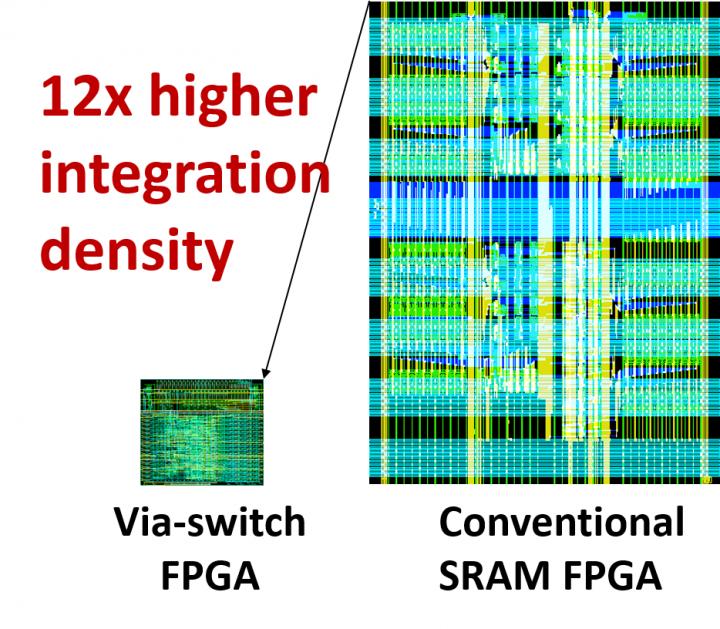
Researchers at Osaka Univ. fabricate an energy efficient reconfigurable computing engine that can be rewired to optimize its performance for artificial intelligence tasks. This work may lead to inexpensive and eco-friendly custom machine learning hardware
IMAGE

Credit: @[2020] IEEE. International Solid-State Circuits Conference


Osaka, Japan – Scientists at Osaka University built a new computing device from field-programmable gate arrays (FPGA) that can be customized by the user for maximum efficiency in artificial intelligence applications. Compared with currently used rewireable hardware, the system increases circuit density by a factor of 12. Also, it is expected to reduce energy usage by 80%. This advance may lead to flexible artificial intelligence (AI) solutions that provide enhanced performance while consuming much less electricity.

AI is becoming a part of everyday life for almost all consumers. Ridesharing smartphone apps like Uber, Gmail’s spam filters, and smart-home devices like Siri and Nest all rely on AI. However, implementing these algorithms often require a large amount of computing power, which means large electricity bills, as well as big carbon footprints. Systems that could–like the human brain–be rewired to optimize the computer circuitry for each task would provide greatly enhanced energy efficiency.

Normally, we think of hardware, which includes the physical logic gates and transistors of a computer’s processor, as fixed by the manufacturer. However, field-programmable gate arrays are specialized logical elements that can be rewired “in the field” by the user for custom logic applications. The research team used non-volatile “via-switches” that remain connected until the user decided to reconfigure them. Using novel nanofabrication methods, they were able to pack twelve times more elements into a grid-like “crossbar” layout. By reducing the distance electronic signals need to be routed, the devices ended up needing 80% less power.

“Our system based on field-programmable gate arrays has a very fast design cycle. It can be reprogrammed daily if desired to get the most computing power for each new AI application,” first author Masanori Hashimoto says. The use of via-switches also eliminates the need for the programing silicon area that was necessary in previous FPGA devices.

“Via-switch FPGA is suitable as a high-performance implementation platform of the latest AI algorithms,” says senior author Jaehoon Yu.

###

The article, “Via-switch FPGA: 65nm CMOS implementation and architecture extension for AI applications” was published in the technical digests of the IEEE International Solid-State Circuits Conference 2020.

About Osaka University

Osaka University was founded in 1931 as one of the seven imperial universities of Japan and now has expanded to one of Japan’s leading comprehensive universities. The University has now embarked on open research revolution from a position as Japan’s most innovative university and among the most innovative institutions in the world according to Reuters 2015 Top 100 Innovative Universities and the Nature Index Innovation 2017. The university’s ability to innovate from the stage of fundamental research through the creation of useful technology with economic impact stems from its broad disciplinary spectrum.

Website: https://resou.osaka-u.ac.jp/en/top

Media Contact
Saori Obayashi
[email protected]
81-661-055-886

Original Source

https://resou.osaka-u.ac.jp/en/research/2020/20200218_1

Tags: Computer ScienceElectrical Engineering/ElectronicsHardwareNanotechnology/MicromachinesResearch/DevelopmentRobotry/Artificial IntelligenceTechnology/Engineering/Computer ScienceTheory/Design
Share12Tweet8Share2ShareShareShare2

Related Posts

AI and Physics Collaborate to Design Advanced Hydrogen Storage Materials

June 25, 2026

International Team Including Dresden Scientists Develops Novel Designer Proteins for Advanced Study of Living Tissue

June 25, 2026

New Study Uncovers Key Factors Driving Water Chemistry in Nanoscale Environments

June 25, 2026

Plasma Technology Extends Catalyst Lifespan in Hydrogen Production

June 24, 2026
Please login to join discussion

POPULAR NEWS

  • Saying Goodbye to PGY-6: Pediatric Fellowship Realities

    103 shares
    Share 41 Tweet 26
  • Multi-Hospital Study Reveals Long Covid Burden Is Twice as High as Current Estimates

    92 shares
    Share 36 Tweet 23
  • Detection of EDCs in Breast Milk and Infant Urine Up to Six Months Highlights Early Exposure Risks

    77 shares
    Share 31 Tweet 19
  • New Drug Candidate Developed at McMaster Shows Potential for Treating Brain Cancer

    58 shares
    Share 23 Tweet 15

About

We bring you the latest biotechnology news from best research centers and universities around the world. Check our website.

Follow us

Recent News

Tracking Lanthanide-Labeled Microplastics in Plants

POSTECH Researchers Slash Cost of Reconstituted Cell-Free Systems by 95%

AI and Physics Collaborate to Design Advanced Hydrogen Storage Materials

Subscribe to Blog via Email

Success! An email was just sent to confirm your subscription. Please find the email now and click 'Confirm' to start subscribing.

Join 82 other subscribers
  • Contact Us

Bioengineer.org © Copyright 2023 All Rights Reserved.

Welcome Back!

Login to your account below

Forgotten Password?

Retrieve your password

Please enter your username or email address to reset your password.

Log In
No Result
View All Result
  • Homepages
    • Home Page 1
    • Home Page 2
  • News
  • National
  • Business
  • Health
  • Lifestyle
  • Science

Bioengineer.org © Copyright 2023 All Rights Reserved.