• HOME
  • NEWS
  • EXPLORE
    • CAREER
      • Companies
      • Jobs
    • EVENTS
    • iGEM
      • News
      • Team
    • PHOTOS
    • VIDEO
    • WIKI
  • BLOG
  • COMMUNITY
    • FACEBOOK
    • INSTAGRAM
    • TWITTER
Monday, June 29, 2026
BIOENGINEER.ORG
No Result
View All Result
  • Login
  • HOME
  • NEWS
  • EXPLORE
    • CAREER
      • Companies
      • Jobs
        • Lecturer
        • PhD Studentship
        • Postdoc
        • Research Assistant
    • EVENTS
    • iGEM
      • News
      • Team
    • PHOTOS
    • VIDEO
    • WIKI
  • BLOG
  • COMMUNITY
    • FACEBOOK
    • INSTAGRAM
    • TWITTER
  • HOME
  • NEWS
  • EXPLORE
    • CAREER
      • Companies
      • Jobs
        • Lecturer
        • PhD Studentship
        • Postdoc
        • Research Assistant
    • EVENTS
    • iGEM
      • News
      • Team
    • PHOTOS
    • VIDEO
    • WIKI
  • BLOG
  • COMMUNITY
    • FACEBOOK
    • INSTAGRAM
    • TWITTER
No Result
View All Result
Bioengineer.org
No Result
View All Result
Home NEWS Science News

A flash of light to identify tumors: the results of the VIBRA project of the Politecnico di Milano

Bioengineer by Bioengineer
October 16, 2020
in Science News
Reading Time: 2 mins read
0
IMAGE
Share on FacebookShare on TwitterShare on LinkedinShare on RedditShare on Telegram

Funded by ERC and just completed, the project uncovers the cellular mechanisms underlying various diseases thanks to a new optical microscopy technique
IMAGE

Credit: Politecnico di Milano

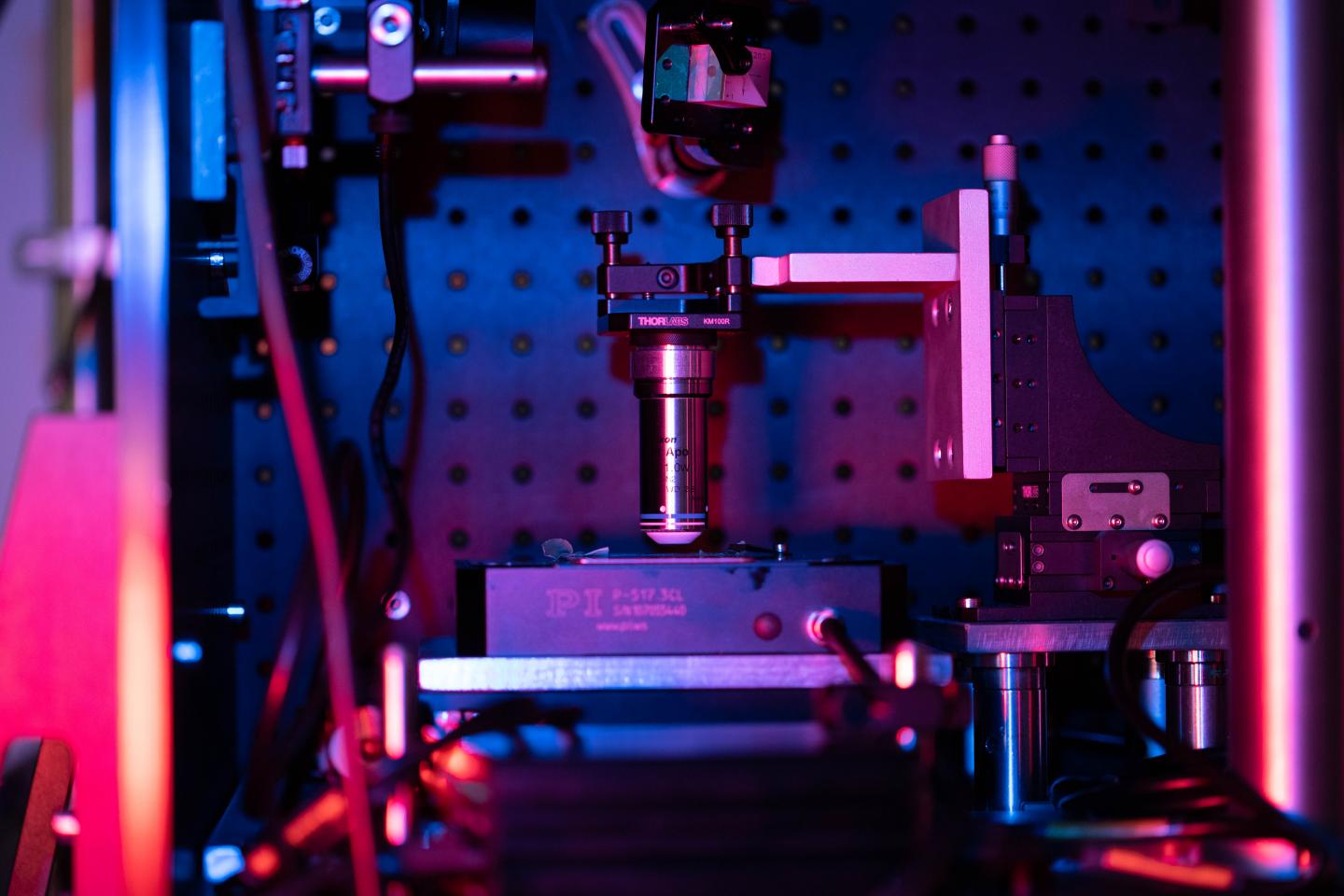
The VIBRA project, “Very fast Imaging by Broadband coherent Raman”, has just ended at the Politecnico di Milano. Funded by the prestigious European Research Council of the European Community and lasted 5 years (2015-2020), it led to the development of a new revolutionary optical microscope in the biological and biomedical fields. “Today, the identification of tumors and other diseases is largely based on the subjective judgment of a pathologist who visually inspects the tissue under a microscope. Our optical microscope, based on coherent Raman spectroscopy, is able to quickly visualize the chemical content of a biological sample to identify diseased cells in human biopsy – an accurate, reliable and non-invasive tool that can guide the surgeon’s work in real time”, explains Dario Polli, Professor of Physics at the Politecnico di Milano and scientific director of the project.

By exploiting sophisticated laser techniques that generate ultra-short light pulses (lasting millionths of millionths of a second, among the shortest events ever made by man), it was possible to record the fingerprint of the molecules that make up matter. Each molecule, in fact, is recognizable by the “sound” it emits when it vibrates. Hence the name of the project. The laser pulses have the double function of hitting molecules like a hammer to make them vibrate and then recording their vibration, at frequencies billions of times higher than the sounds we can perceive with our ears. All this in a non-invasive way, that is, without adding any contrast agent or destroying or disturbing the sample. It was therefore possible to map the concentration of the various constituents of matter and create detailed three-dimensional maps of cells and tissues. “The results obtained will have a great impact in biology and medicine. In the future, they will allow researchers to visualize the properties of organic samples with great bio-chemical specificity. The aim will be to study the cellular mechanisms underlying various pathologies and to automatically identify tumors in biopsies, with a degree of accuracy and reproducibility better than we can do today”, comments Professor Dario Polli.

###

Link to the VIBRA project website: http://www.vibra.polimi.it

Media Contact
Francesca Pierangeli
[email protected]

Original Source

http://www.vibra.polimi.it

Tags: Biomedical/Environmental/Chemical EngineeringBiotechnologycancerMedicine/HealthMicrobiologyMolecular BiologyMolecular PhysicsOpticsResearch/Development
Share12Tweet8Share2ShareShareShare2

Related Posts

Tracking Lanthanide-Labeled Microplastics in Plants

June 25, 2026

POSTECH Researchers Slash Cost of Reconstituted Cell-Free Systems by 95%

June 25, 2026

AI and Physics Collaborate to Design Advanced Hydrogen Storage Materials

June 25, 2026

Natural Hallucinogens: Evolution’s Ecological Tools, Not Mere Chemical Byproducts

June 25, 2026
Please login to join discussion

POPULAR NEWS

  • Saying Goodbye to PGY-6: Pediatric Fellowship Realities

    103 shares
    Share 41 Tweet 26
  • Multi-Hospital Study Reveals Long Covid Burden Is Twice as High as Current Estimates

    92 shares
    Share 36 Tweet 23
  • Detection of EDCs in Breast Milk and Infant Urine Up to Six Months Highlights Early Exposure Risks

    77 shares
    Share 31 Tweet 19
  • New Drug Candidate Developed at McMaster Shows Potential for Treating Brain Cancer

    58 shares
    Share 23 Tweet 15

About

We bring you the latest biotechnology news from best research centers and universities around the world. Check our website.

Follow us

Recent News

Tracking Lanthanide-Labeled Microplastics in Plants

POSTECH Researchers Slash Cost of Reconstituted Cell-Free Systems by 95%

AI and Physics Collaborate to Design Advanced Hydrogen Storage Materials

Subscribe to Blog via Email

Success! An email was just sent to confirm your subscription. Please find the email now and click 'Confirm' to start subscribing.

Join 82 other subscribers
  • Contact Us

Bioengineer.org © Copyright 2023 All Rights Reserved.

Welcome Back!

Login to your account below

Forgotten Password?

Retrieve your password

Please enter your username or email address to reset your password.

Log In
No Result
View All Result
  • Homepages
    • Home Page 1
    • Home Page 2
  • News
  • National
  • Business
  • Health
  • Lifestyle
  • Science

Bioengineer.org © Copyright 2023 All Rights Reserved.