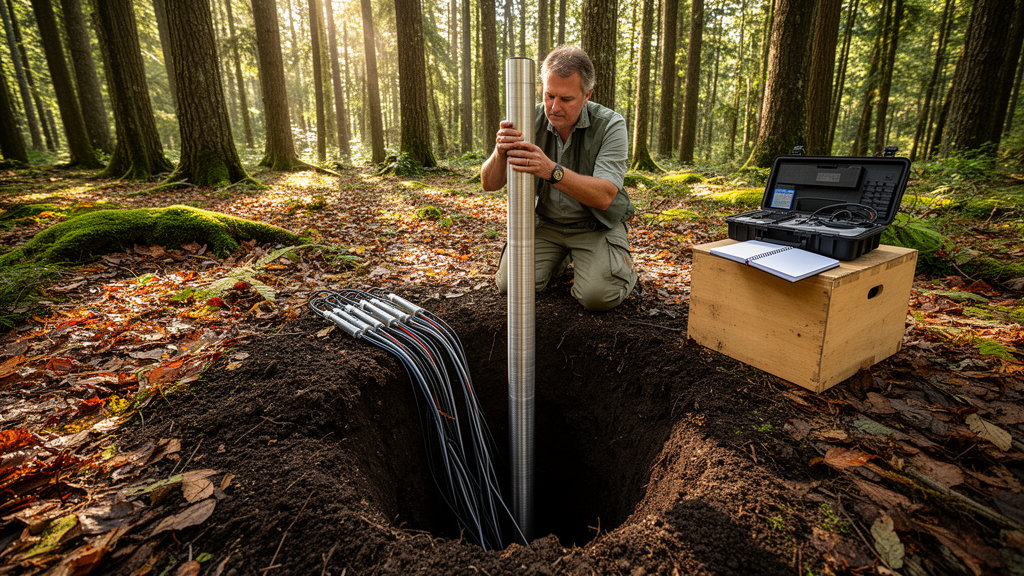
Beneath the mixed-conifer forests of the Sierra Nevada foothills, an unusual experiment has been running for nearly a decade. At the Blodgett Forest Research Station of the University of California, Berkeley, researchers have been heating patches of ground to four degrees Celsius above ambient temperature, not just at the surface but all the way down to one meter. The goal is deceptively simple: to find out what happens to the enormous reservoir of carbon stored in soil when the world warms. Now, after 9.5 years of continuous whole-soil warming, a team led by Binyan Sun and Mike Rowley of the University of Zurich, together with colleagues at Lawrence Berkeley National Laboratory, has delivered one of the clearest answers yet, and it comes with a twist about depth that could reshape how climate models treat the ground beneath our feet.
Soil is the largest actively cycling terrestrial carbon pool, holding more carbon than the atmosphere and all living vegetation combined. Under the high-emissions SSP5-8.5 scenario, the Intergovernmental Panel on Climate Change projects global temperatures to rise by 3.3 to 5.7 degrees Celsius by 2100. If warming accelerates the microbial decomposition of soil organic carbon, that carbon escapes as carbon dioxide, which in turn drives further warming in a dangerous positive feedback loop. Yet field experiments have produced strikingly inconsistent results, ranging from no net cumulative carbon change to substantial losses, largely because bulk soil measurements average together pools of organic matter that behave in fundamentally different ways. The new study, published in the journal SOIL, sidesteps that problem by physically separating soil carbon into fractions with distinct protective regimes before measuring how each responds to heat.
The researchers focused on two principal fractions. Particulate organic matter consists of partially decomposed fragments of plant tissue, either sitting freely in the soil matrix or sealed inside aggregates, and it is essentially unprotected food for microbes. Mineral-associated organic matter, by contrast, consists of plant-derived biomolecules and microbial products that are chemically bound to mineral surfaces through reactions such as ligand exchange with metal oxyhydroxides. Because of these organo-mineral bonds, mineral-associated carbon is far less accessible to decomposers and typically turns over much more slowly. The long-standing assumption in soil science has been that mineral-associated organic matter is comparatively resistant to warming, while particulate organic matter is the first to go. Testing that assumption empirically, especially in subsoils, has been a persistent gap in the literature.
The Blodgett experiment, which began in January 2014, is uniquely suited to the task. Each three-meter-diameter plot is surrounded by twenty-two vertical conduit pipes reaching 2.4 meters deep, with heating cables threaded through them in warmed plots and inert wires in controls. Two concentric rings of surface cable complete the heating, holding the entire soil column four degrees above the temperature of its paired control plot. In May 2023, after 9.5 years of treatment, the team extracted soil cores from three depth intervals: 10 to 20 centimeters, 40 to 50 centimeters, and 80 to 90 centimeters. They then used density fractionation in sodium polytungstate solution, with a carefully calibrated sonication step to break open aggregates, to isolate free particulate organic matter, occluded particulate organic matter, and the mineral-associated residue.
The results were depth-dependent in a way that bulk measurements would have completely missed. In the topsoil and mid-depths, at or above 50 centimeters, warming produced no significant quantitative losses in any fraction, apparently because fresh plant inputs continued to replenish what decomposition removed. But in the deep soil at 80 to 90 centimeters, the story changed dramatically. Free particulate organic carbon was marginally reduced by about 70 percent, and occluded particulate organic carbon fell by a statistically significant 80 percent. Meanwhile, the mass and chemical composition of mineral-associated organic matter showed no significant response to warming at any depth. Below 50 centimeters, bulk soil carbon concentrations also declined, with mean reductions of roughly 54 to 56 percent at 60 to 70 and 80 to 90 centimeters, though wide confidence intervals mean these figures should be read as strong trends rather than precise point estimates.
To probe the chemistry behind these shifts, the team turned to diffuse reflectance infrared Fourier transform spectroscopy, a technique that identifies the functional groups of soil organic carbon by the way mid-infrared light interacts with specific chemical bonds. Spectral peaks corresponding to aliphatic carbon-hydrogen stretches, aromatic carbon-carbon bonds, carboxylic groups, and lignin-like residues were quantified as areas under the curve, then analyzed with principal component analysis and linear mixed effects models. The spectra revealed that subsoil carbon composition shifted under warming toward lignin-like residues and aromatic carbon-hydrogen bonds, a signature consistent with the preferential microbial consumption of more labile, energy-rich compounds. At 40 to 50 centimeters, free particulate organic matter showed a significant enrichment in lignin-like signals, and because that fraction accounts for nearly 40 percent of total soil carbon at that depth, the change was strong enough to imprint on the bulk soil signal.
Why does deep particulate carbon vanish while its mineral-bound neighbor holds firm? The authors point to a convergence of factors. Roughly 80 percent of root biomass at the site resides in the top 30 centimeters, so deep soil receives scant fresh plant input to replace what microbes consume. Previous work at Blodgett showed that warming boosted microbial activity in the subsoil and increased the relative abundance of Actinobacteria, bacteria capable of degrading complex carbon compounds. With little replenishment, the deep particulate pool simply runs down. Mineral-associated matter, in contrast, appears buffered by organo-mineral protection, and the team hypothesizes that carbon liberated from decomposing particulate matter may even be re-adsorbed onto mineral surfaces, or delivered downward as dissolved organic matter, effectively recycling rather than releasing it.
The fate of the topsoil tells a subtler story. The researchers speculate that warming may have stimulated deeper root growth over the decade, compensating for carbon losses at mid-depths, a hypothesis supported by other forest warming experiments showing that fine root responses can change sign between short-term and decadal timescales. Warming-induced drying of surface soils during the Mediterranean summer may also suppress microbial activity, and the nitrogen-poor, lignin-rich coniferous litter at the site keeps microbial carbon use efficiency low. Together, these site-specific factors appear to have shielded the upper half meter from measurable losses, at least so far.
The implications for climate modeling are considerable. If the early surge of warming-enhanced carbon dioxide flux from soils is driven by the depletion of a finite, labile particulate pool in the subsoil, then those fluxes may attenuate over decadal timescales as the pool is exhausted, while the mineral-bound reservoir persists as a long-term buffer. The study is the first to resolve carbon composition across density fractions within a whole-soil warming experiment after nearly a decade of heating, and it demonstrates that combining density fractionation with infrared spectroscopy yields far more mechanistic insight than bulk soil analysis alone. As the authors conclude, future whole-soil warming experiments should prioritize subsoils and distinct carbon fractions, because the vulnerability of the planet’s largest terrestrial carbon reservoir is written not in its total, but in its parts.
Subject of Research: Response of subsoil particulate and mineral-associated organic matter to a decade of whole-soil warming in a temperate forest
Article Title: Subsoil particulate organic matter is more responsive to ∼ 10 years of whole-soil warming than mineral-associated organic matter in a temperate forest
Article References: Subsoil particulate organic matter is more responsive to ∼ 10 years of whole-soil warming than mineral-associated organic matter in a temperate forest. (n.d.). https://doi.org/10.5194/soil-12-757-2026
Image Credits: AI Generated
Keywords: soil organic carbon, whole-soil warming, particulate organic matter, mineral-associated organic matter, subsoil, carbon-climate feedback, density fractionation, DRIFT spectroscopy, temperate forest, Blodgett Forest, soil carbon sequestration, climate change
News Source: Alan Morgan. (October 9, 2026). A Decade of Underground Warming Reveals Which Soil Carbon Clings On and Which Vanishes. Scienmag.