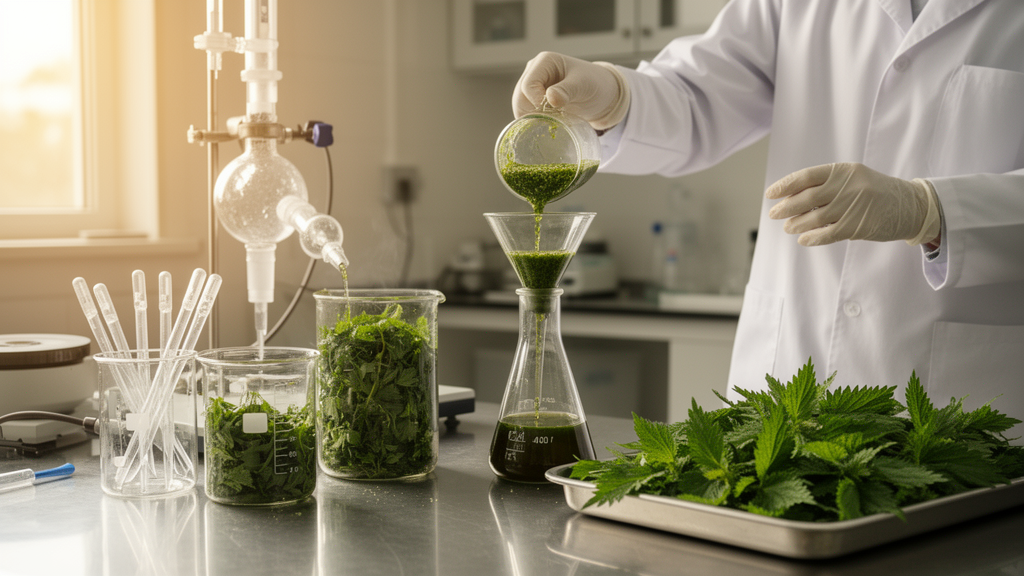
The stinging nettle, Urtica dioica, has been a fixture of folk medicine for centuries, but turning its leaves into a usable, chemically rich extract is a surprisingly delicate engineering problem. A new study from researchers at Bahir Dar University and Debre Tabor University in Ethiopia, published in BMC Plant Biology, tackles that problem with the tools of modern process optimization, mapping out precisely how temperature, extraction time, and the ratio of plant material to solvent interact to determine how much useful chemistry can be pulled from Ethiopian nettle leaves. The work, led by Shambel Amare Getahun, offers both a practical recipe for laboratory-scale extraction and an early look at the chemical fingerprint of the resulting extract.
The motivation behind the research sits at the intersection of agriculture and green chemistry. Plant-derived extracts are increasingly investigated as sources of environmentally compatible compounds that could replace synthetic chemicals in agricultural applications, from crop protection to soil amendments. Nettle is an attractive candidate because it is widely available, grows readily in Ethiopia, and is known to contain a diverse array of secondary metabolites. Yet the value of any plant extract depends heavily on how efficiently those compounds are recovered, and the authors note that information on optimized extraction of Ethiopian Urtica dioica leaves has remained limited. Without that information, any downstream application would rest on guesswork rather than on a characterized, reproducible process.
The extraction method at the heart of the study is the Soxhlet technique, a workhorse of natural products chemistry that has been in use for well over a century. In a Soxhlet apparatus, a solvent is repeatedly cycled through the plant material: solvent vapor rises, condenses, drips onto a thimble holding the powdered leaves, and once the siphon fills, the solvent carrying dissolved compounds drains back into the boiling flask. Each cycle exposes the plant matrix to fresh solvent, which is why Soxhlet extraction is prized for its thoroughness. But the same thoroughness comes with sensitivity to conditions. Too much heat can degrade thermolabile compounds or drive off volatile ones; too little time leaves valuable chemistry locked in the plant tissue; and the solid-to-solvent ratio governs how much material the solvent can dissolve before it approaches saturation.
Rather than testing conditions one variable at a time, the team employed response surface methodology, or RSM, a statistical framework that treats an industrial or laboratory process as a mathematical surface whose height, in this case the extraction yield, depends on the settings of several input variables. Within RSM, the researchers used a central composite design, a specific experimental layout that efficiently samples the corners, faces, and center of the experimental space. The design allowed them to vary three factors simultaneously: extraction temperature across a range of 50 to 70 degrees Celsius, extraction time from 3 to 5 hours, and the solid-to-solvent ratio from 0.125 to 0.1875 grams per milliliter. By fitting a quadratic model to the resulting yield data, they could capture not only the individual effect of each factor but also the interactions between them, which one-variable-at-a-time experiments would miss entirely.
The statistical quality of the fitted model proved strong. The quadratic model was highly significant, with a p-value below 0.0001, indicating that the relationship between the process variables and extraction yield was unlikely to be a statistical accident. Equally important, the lack-of-fit test came back non-significant, with a p-value of 0.0749. In the language of experimental design, a significant lack of fit would signal that the quadratic equation was missing genuine structure in the data, whereas a non-significant result means the model adequately describes the response surface across the tested range. That combination, a significant model with an insignificant lack of fit, is exactly what an experimenter hopes to see before trusting the model to make predictions outside the exact conditions that were physically tested.
With the validated model in hand, the researchers turned to numerical optimization to find the point on the response surface where yield is maximized. The optimum landed at an extraction temperature of 64.62 degrees Celsius, an extraction time of just 3.01 hours, and a solid-to-solvent ratio of 0.139 grams per milliliter. Under those conditions, the model predicted an extraction yield of 0.330 percent by weight. Several features of that optimum are noteworthy. The predicted best temperature sits comfortably inside the tested range rather than at an extreme, suggesting a genuine interior maximum where the benefits of increased solubility and diffusion are balanced against the risks of thermal degradation. The optimal time of roughly three hours, at the low end of the tested window, hints that most of the extractable material is recovered early and that extended extraction adds little, a finding with real implications for energy consumption and throughput if the process is ever scaled up.
Optimization alone, however, says nothing about what is actually in the extract, so the team complemented the yield study with a preliminary chemical characterization using two complementary techniques. Fourier-transform infrared spectroscopy, or FTIR, probes the vibrational signatures of chemical bonds, allowing researchers to identify the functional groups present in a sample, such as hydroxyl groups characteristic of phenols and flavonoids, carbonyl groups found in many plant metabolites, and the carbon-hydrogen frameworks of lipids and waxes. Thin-layer chromatography, or TLC, takes a different approach, separating the extract’s constituents as they migrate at different speeds across a coated plate, revealing how many distinct chemical fractions the extract contains. Together, the two methods provided preliminary evidence of diverse functional groups and multiple chromatographic fractions in the nettle leaf extract, confirming that the optimized process recovers chemically rich material rather than a narrow, uninteresting fraction.
The significance of the work extends beyond the specific numbers. For researchers working with plant extracts as candidates for agricultural or pharmaceutical use, the study demonstrates a disciplined pipeline: define the process variables, model their combined effects statistically, validate the model, optimize it, and only then characterize the product. That sequence matters because an unoptimized extraction can bias the chemical profile of an extract, enriching some compounds while leaving others behind, which in turn makes biological testing difficult to reproduce. By establishing an optimized laboratory-scale extraction condition and a preliminary chemical profile for Ethiopian Urtica dioica leaves, the authors have created a reproducible baseline that other laboratories can adopt, compare against, and refine.
There are also broader implications for how underutilized plants are developed as resources. Ethiopia’s nettle populations have long been part of local knowledge, but transforming that traditional resource into a standardized product requires exactly the kind of quantitative process engineering this study provides. The modest yield of 0.330 percent by weight may sound small, but for many plant secondary metabolites such figures are typical, and the value lies in the identity and activity of the extracted compounds rather than in bulk mass. The open-access publication, funded without external support and carried out with chemicals and instruments provided by Bahir Dar University, also illustrates how well-equipped institutions in the Global South can contribute rigorous, citable process chemistry to the global natural products literature.
As with any preliminary characterization, the authors are careful about scope. FTIR and TLC establish the presence of diverse chemistry but do not identify individual compounds, a task that would require more powerful tools such as high-performance liquid chromatography coupled with mass spectrometry. The study likewise does not test the extract’s biological activity in agricultural settings, which remains the logical next step now that a consistent extraction protocol exists. Still, the work captures something of a quiet revolution in natural products research: the stinging nettle, a plant most people avoid touching, is being handled with the same statistical rigor that governs petrochemical refineries and pharmaceutical manufacturing. In the hands of chemical engineers armed with central composite designs and response surfaces, even a common weed becomes a process to be understood, optimized, and, perhaps one day, deployed in service of more sustainable agriculture.
Subject of Research: Optimization of Soxhlet extraction of Urtica dioica leaf extract using response surface methodology
Article Title: Optimization of Soxhlet extraction conditions and preliminary phytochemical characterization of Urtica dioica leaf extract using response surface methodology
Article References: Getahun, S. A., Abera, W. G., Enyew, T. W., & Aklilu, H. A. (2026). Optimization of Soxhlet extraction conditions and preliminary phytochemical characterization of Urtica dioica leaf extract using response surface methodology. BMC Plant Biology. https://doi.org/10.1186/s12870-026-10102-x
Image Credits: AI Generated
DOI: 10.1186/s12870-026-10102-x
Keywords: Urtica dioica, stinging nettle, Soxhlet extraction, response surface methodology, central composite design, extraction optimization, phytochemical characterization, FTIR, thin-layer chromatography, natural products, plant extracts, Bahir Dar University
News Source: Bethany Barker. (October 9, 2026). Scientists Fine-Tune the Perfect Recipe for Extracting Stinging Nettle Chemistry. Scienmag.