• HOME
  • NEWS
  • EXPLORE
    • CAREER
      • Companies
      • Jobs
    • EVENTS
    • iGEM
      • News
      • Team
    • PHOTOS
    • VIDEO
    • WIKI
  • BLOG
  • COMMUNITY
    • FACEBOOK
    • INSTAGRAM
    • TWITTER
Monday, May 11, 2026
BIOENGINEER.ORG
No Result
View All Result
  • Login
  • HOME
  • NEWS
  • EXPLORE
    • CAREER
      • Companies
      • Jobs
        • Lecturer
        • PhD Studentship
        • Postdoc
        • Research Assistant
    • EVENTS
    • iGEM
      • News
      • Team
    • PHOTOS
    • VIDEO
    • WIKI
  • BLOG
  • COMMUNITY
    • FACEBOOK
    • INSTAGRAM
    • TWITTER
  • HOME
  • NEWS
  • EXPLORE
    • CAREER
      • Companies
      • Jobs
        • Lecturer
        • PhD Studentship
        • Postdoc
        • Research Assistant
    • EVENTS
    • iGEM
      • News
      • Team
    • PHOTOS
    • VIDEO
    • WIKI
  • BLOG
  • COMMUNITY
    • FACEBOOK
    • INSTAGRAM
    • TWITTER
No Result
View All Result
Bioengineer.org
No Result
View All Result
Home NEWS Science News Biology

Swedish research multiplies the life of rechargeable NiMH batteries

Bioengineer by Bioengineer
December 20, 2018
in Biology
Reading Time: 3 mins read
0
IMAGE
Share on FacebookShare on TwitterShare on LinkedinShare on RedditShare on Telegram

IMAGE

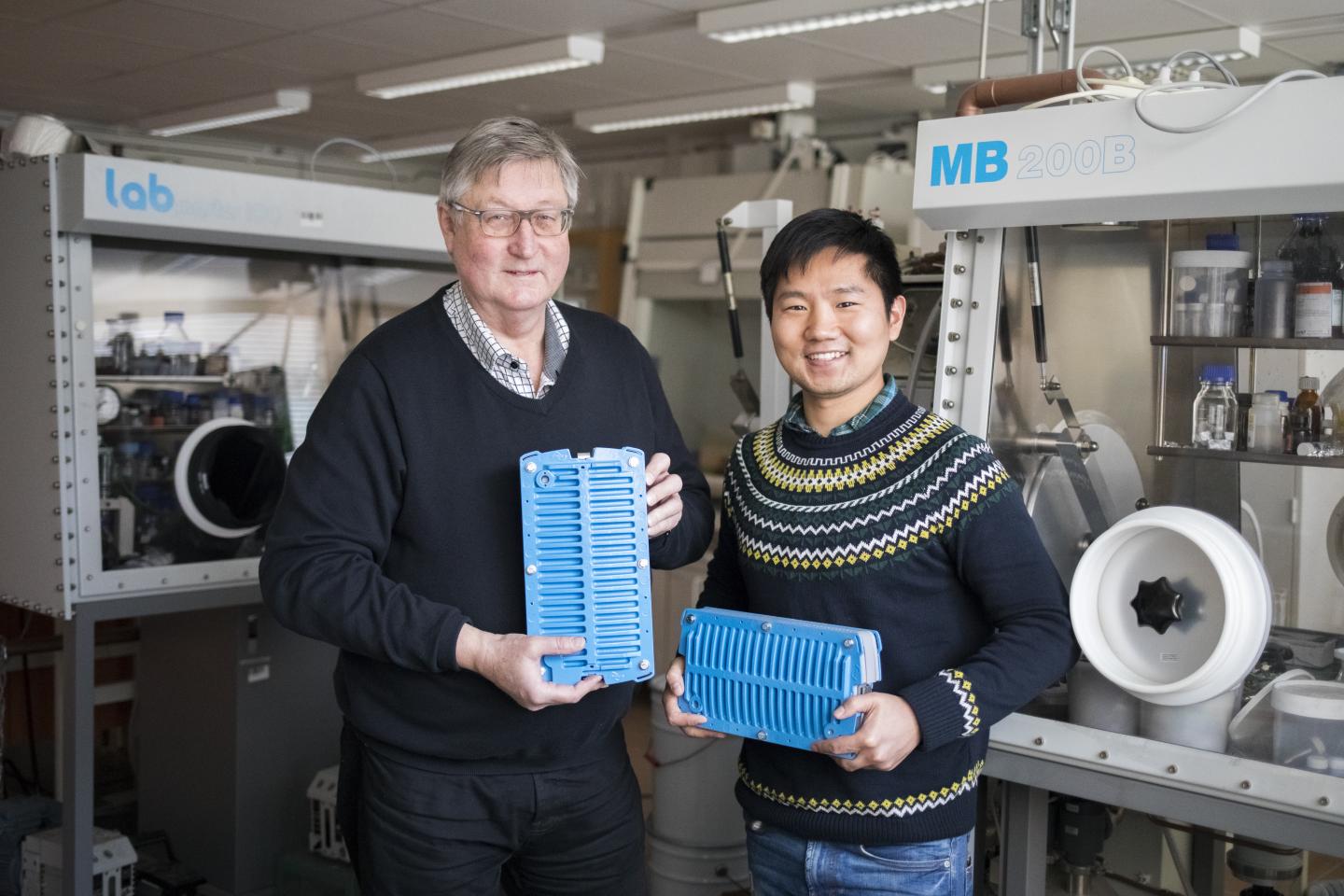
Credit: Niklas Björling / Stockholm University


Researchers at Stockholm University have developed a method to multiply the lifespan of nickel-metal hydride batteries. This means that the batteries can handle a great many more charging cycles without losing capacity. The new method also means that the batteries can easily be restored once they have begun to wear out, unlike other rechargeable batteries that must be melted down for recycling.

Most rechargeable batteries are based on either lead, nickel-cadmium (NiCd) or various combinations with lithium. Batteries based on nickel-metal hydride (NiMH) with an aqueous electrolyte are both eco-friendly and safe. The NiMH battery is developed from the nickel-hydrogen battery (NiH2). It has long been known that (NiH2) batteries have a superior lifespan compared to other battery types. This is why they are (for example) used in satellites in orbit in space, where the batteries must function for decades without servicing. The Hubble space telescope is one example, but NiH2 batteries are also spinning around our neighboring planets. However, these structures of the batteries are impractically large, because the hydrogen is stored in gas tanks. NiMH batteries can be made much more compact, because the hydrogen is stored in a metal alloy/metal hydride with a hydrogen density equivalent to that of liquid hydrogen. Researchers at Stockholm University has now developed a technique by which to achieve the same long lifespan for NiMH batteries as in the large NiH2 batteries.

The inspiration for the new technology came from a new NiMH battery manufactured by Nilar AB in Gävle.

In a NiMH battery, hydrogen is bound in the metal alloy. This solution is effective, but the battery ages because it dries out as the alloy slowly corrodes and consumes its water-based electrolyte. The corrosion also interferes with the internal balance between the electrodes in the battery. The breakthrough came when the research group discovered that they could counteract the aging process almost completely by adding oxygen, which restores the lost electrode equilibrium and replaces the lost electrolyte. This can be easily done in Nilar’s battery construction, because all cells share the same gas space. With the right balance of oxygen and hydrogen, a lifespan is achieved which exceeds all of today’s common battery types.

“The electrification of society, not least of all future electric cars, places new demands on distribution networks. This battery type is very well suited to evening out the load on the power grid at all levels over a long period of time, something which is a prerequisite for a fossil-free society in which intermittent solar and wind power will be connected to the network,” says Professor Dag Noréus of Stockholm University, who has extensive experience with NiMH development.

“New battery technology is a major step along the way. Right now Sweden is a world leader in the segment of rechargeable NiMH batteries,” says Dr. Yang Shen, whose thesis Development of metal hydride surface structures for high power NiMH batteries – extended cycle-life and lead to more effective recycling methods was presented on December 10 of this year and has been a central element of the work.

###

Toyota’s Prius hybrid car is one of the better-known applications for NiMH batteries at the consumer level.

Read more about Dr. Yang Shen’s thesis here
http://su.diva-portal.org/smash/get/diva2:1194626/FULLTEXT01.pdf

The research project has been supported by the Swedish Energy Agency, Höganäs AB, Nilar AB and Scania CV AB.

Contact information: Professor Dag Noréus of Stockholm University: [email protected]

Media Contact
Dag Noreus
[email protected]

Original Source

https://www.su.se/english/research/research-news/swedish-research-multiplies-the-life-of-rechargeable-nimh-batteries-1.418740

Tags: Biomedical/Environmental/Chemical EngineeringChemistry/Physics/Materials SciencesElectrical Engineering/ElectronicsElectromagneticsEnergy/Fuel (non-petroleum)Industrial Engineering/ChemistryMaterials
Share12Tweet8Share2ShareShareShare2

Related Posts

From Complexity to Clarity: Unraveling the “Topological Laws” Governing Cell Death — Biology

From Complexity to Clarity: Unraveling the “Topological Laws” Governing Cell Death

May 11, 2026
New Classification Framework Identifies Tumor-Associated Bacterial Effectors as Crucial Drivers of Tumor Biology and Immune Response — Biology

New Classification Framework Identifies Tumor-Associated Bacterial Effectors as Crucial Drivers of Tumor Biology and Immune Response

May 11, 2026

HIV-1 Strains Reveal Varied Paths to Antibody Escape

May 11, 2026

CRISPRi Screening Identifies Fungal-Specific Drug Targets

May 11, 2026
Please login to join discussion

POPULAR NEWS

  • Research Indicates Potential Connection Between Prenatal Medication Exposure and Elevated Autism Risk

    841 shares
    Share 336 Tweet 210
  • New Study Reveals Plants Can Detect the Sound of Rain

    728 shares
    Share 290 Tweet 182
  • Salmonella Haem Blocks Macrophages, Boosts Infection

    62 shares
    Share 25 Tweet 16
  • Breastmilk Balances E. coli and Beneficial Bacteria in Infant Gut Microbiomes

    57 shares
    Share 23 Tweet 14

About

We bring you the latest biotechnology news from best research centers and universities around the world. Check our website.

Follow us

Recent News

Humans and Zebra Finches Share Similar Speech Learning Techniques #ASA190

New Study Uncovers How Fungal Parasites Attack Strawberries and Raspberries

City of Hope Researchers to Present Groundbreaking Immunotherapy and Precision Medicine Advances Across Multiple Cancer Types at ASCO 2026

Subscribe to Blog via Email

Enter your email address to subscribe to this blog and receive notifications of new posts by email.

Join 82 other subscribers
  • Contact Us

Bioengineer.org © Copyright 2023 All Rights Reserved.

Welcome Back!

Login to your account below

Forgotten Password?

Retrieve your password

Please enter your username or email address to reset your password.

Log In
No Result
View All Result
  • Homepages
    • Home Page 1
    • Home Page 2
  • News
  • National
  • Business
  • Health
  • Lifestyle
  • Science

Bioengineer.org © Copyright 2023 All Rights Reserved.