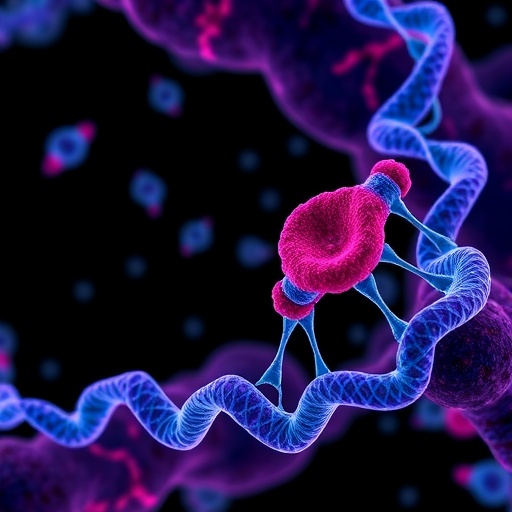

Credit: Kris Hanning
TUCSON, Ariz. – Cancer used to be thought of as a disease of the anatomy, but these days it increasingly is understood as a disease of the genes — one that theoretically can be treated with drugs engineered to target the genetic mutations driving a patient's cancer.
Melanoma, a type of skin cancer, is the fifth-most common cancer in the United States. When it spreads to other parts of the body (metastasizes), it becomes more difficult to treat. About 47,000 new cases of metastatic melanoma are diagnosed in the United States each year. About half of metastatic melanoma patients have mutations in the BRAF or MEK genes, and if the cancer reaches their brains they face a serious prognosis, with a median survival of less than 6 months.
"Most of the time, survival is short, and the cancer gets worse," said Hani Babiker, MD, associate director of the Early Phase Clinical Trials Program at the University of Arizona Cancer Center. "Treatment options include BRAF and MEK inhibitors, immunotherapy, radiation and surgery, but a need exists for treatments that more effectively increase survival and decrease risk of recurrence."
Therefore, in partnership with Spirita Oncology, LLC, Dr. Babiker and the Early Phase Clinical Trials Program have opened a clinical trial for patients with brain metastases from BRAF- or MEK-mutated melanoma (NCT03332589). Participants will receive an investigational MEK inhibitor called E6201, a "targeted" drug.
Although other MEK inhibitors are on the market, Dr. Babiker is especially excited about E6201, which already has been tested in a trial of 55 patients with a variety of tumor types, including 22 melanoma patients with the BRAF mutation. Nine of these melanoma patients had brain metastases, and two of them achieved remarkable clinical responses lasting for more than four years. One patient has been taking the drug for more than eight years with a continued near-complete response. Dr. Babiker hopes to administer E6201 to more patients to learn if these positive results were more than just a lucky coincidence.
"Seeing a patient get a response like that means the world. When patients develop a remission, especially in an aggressive, brain-metastatic disease, that is a signal," he said. "When you notice a signal, you want to move it forward. We hope we can help other patients."
E6201 also has shown promise in the laboratory, where studies comparing it to other MEK inhibitors found it was especially effective at crossing the blood-brain barrier, a "gate" that allows important nutrients to enter the brain but protects it from potentially dangerous substances. Many drugs are too "bulky" to cross this barrier or may be tossed back through the gate by the body's defenses, making brain diseases more challenging to treat.
"E6201 is a relatively small molecule, and its unique structure may enhance its brain penetration," said Linda J. Paradiso, DVM, chief development officer of Spirita Oncology. "In animals, E6201 has demonstrated brain-to-blood concentrations 266 percent higher in the brain than in the blood. Other MEK or BRAF inhibitors tested in this setting demonstrate much lower drug concentrations in the brain than in the blood, indicating E6201 is capable of getting into the brain and to the tumor more effectively and more extensively than other MEK or BRAF inhibitors."
The quest for targeted therapies has driven research in precision medicine, which emphasizes the idea that treatments can be specific to a patient's genetic profile rather than administered using a "one-size-fits-all" approach. A targeted drug takes aim at a component of a "signaling pathway," in which different genes are activated in succession, setting off a domino effect that results in cell growth and division. The BRAF and MEK genes are "dominoes" in this pathway, and under normal circumstances they help regulate healthy cells. When mutated, however, they potentially can cause normal cells to go awry, leading to cancer. Drugs that target these mutated genes can, in theory, slow cancer growth.
Dr. Babiker hopes that if the first phase of this trial is successful it can expand beyond Tucson to include more patients. Future trials will help investigators continue to learn about the safety and effectiveness of the drug. If these trials are successful, E6201 someday may receive approval from the U.S. Food and Drug Administration.
"We're going to look at safety, tumor regression, survival and progression-free survival. The next step might be comparing it to another drug or combining it with another drug in a larger study," Dr. Babiker said. "To go from the lab to FDA approval is a marathon run."
Drs. Babiker and Paradiso describe the drug as "well tolerated," with the most common side effects being nausea (in 17 percent of participants), low potassium levels (in 9 percent of participants) and fatigue (in 7 percent of participants), all low-grade. No severe toxicities have been observed.
###
The Early Phase Clinical Trials Program at the UA Cancer Center is one of the largest of its kind in the Southwest, providing innovative new therapies to patients using a multidisciplinary and personalized approach to care, helping to improve cancer treatment and advance the field's understanding of cancer. For more information about the E6201 trial, please call 520-694-1231.
About the University of Arizona Cancer Center
The University of Arizona Cancer Center is the only National Cancer Institute-designated Comprehensive Cancer Center with headquarters in Arizona. The UA Cancer Center is supported by NCI Cancer Center Support Grant No. CA023074. With primary locations at the University of Arizona in Tucson and at Dignity Health St. Joseph's Hospital and Medical Center in Phoenix, the UA Cancer Center has more than a dozen research and education offices throughout the state, with more than 300 physicians and scientists working together to prevent and cure cancer. For more information: uacc.arizona.edu
Media Contact
Anna C. Christensen
[email protected]
520-626-6401
http://uahs.arizona.edu/
Original Source
https://uahs.arizona.edu/