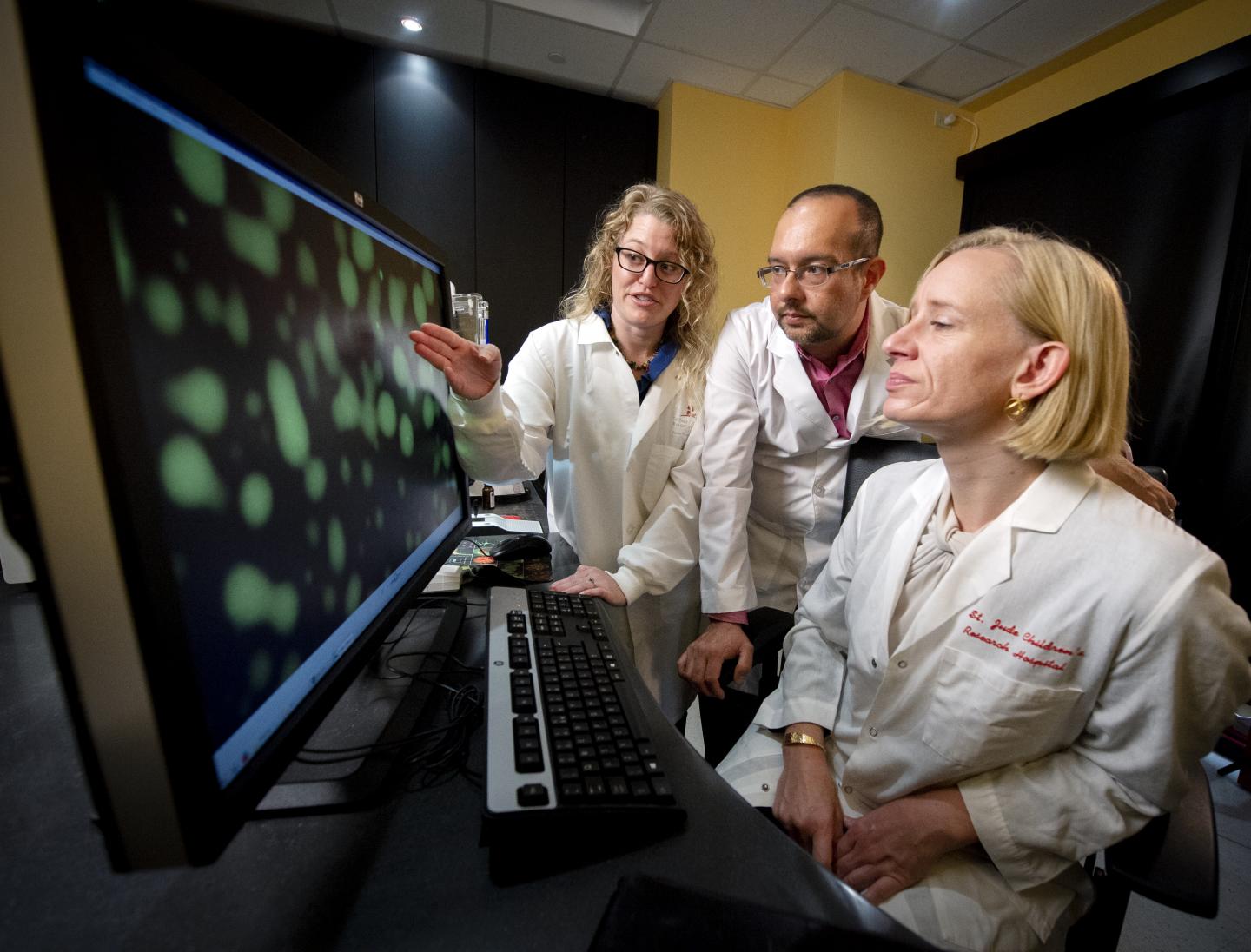
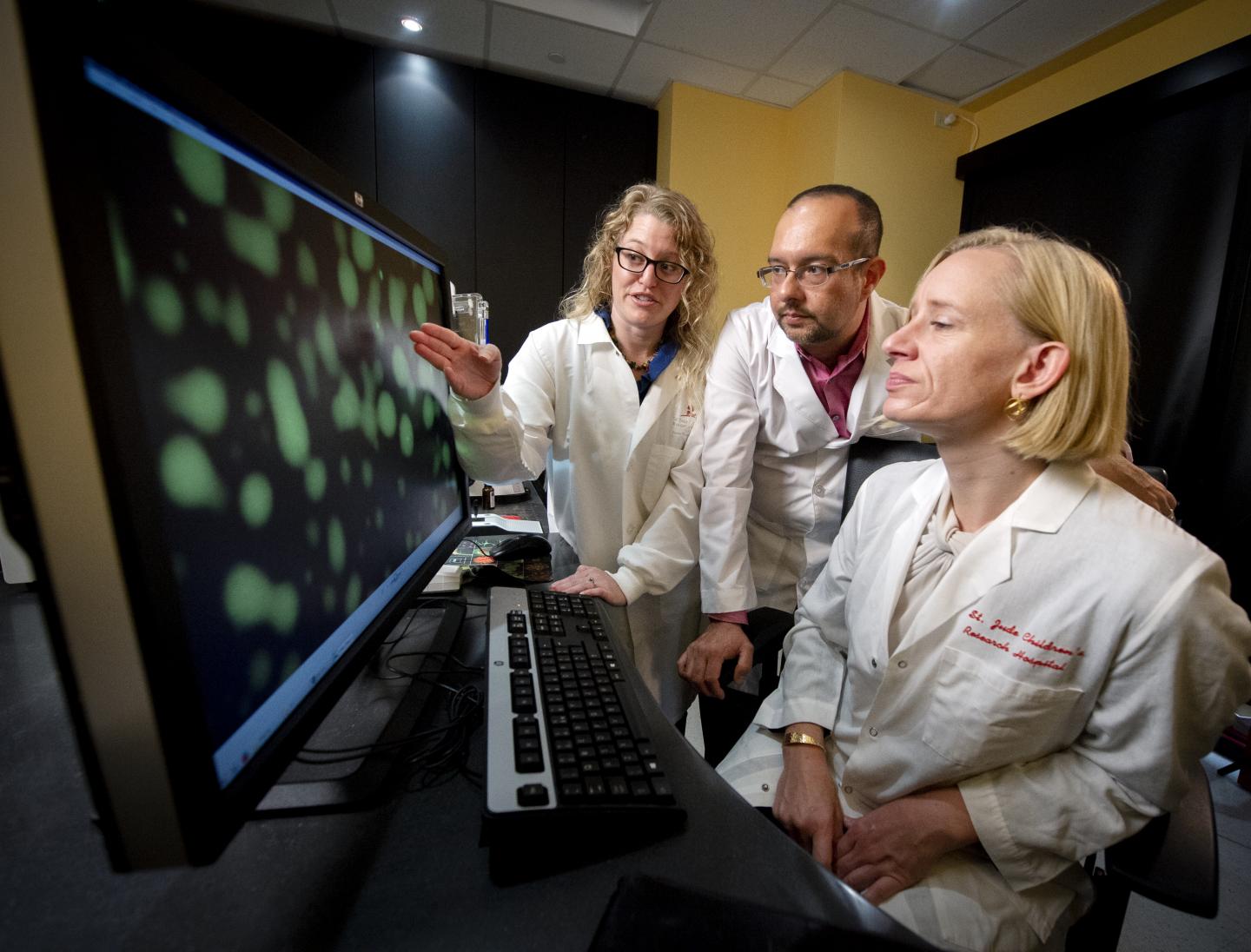
Credit: St. Jude Children's Research Hospital / Ann Margaret Hedges
Researchers led by St. Jude Children's Research Hospital scientists have identified another way the process that causes oil to form droplets in water may contribute to solid tumors, such as prostate and breast cancer. The findings appear today in the journal Molecular Cell.
Researchers found evidence that mutations in the tumor suppressor gene SPOP contribute to cancer by disrupting a process called liquid-liquid phase separation. Liquid-liquid phase separation is seen often in nature and is the reason why oil and vinegar separate in salad dressing.
SPOP is the most frequently mutated gene in prostate cancer and is altered in other solid tumors. The SPOP protein is part of the cell's protein-recycling machinery. SPOP binds unneeded or unwanted proteins so they can be chemically tagged for destruction. Mutations in SPOP were known to disrupt binding and lead to a buildup of cancer-promoting proteins in sensitive cells. St. Jude research suggests that is not the whole story.
"This study shows for the first time that tumor-suppressor function can be influenced by phase separation and that mutations in the tumor suppressor, in this case SPOP, disrupt phase separation," said corresponding author Tanja Mittag, Ph.D., an associate member of the St. Jude Department of Structural Biology.
New chapter
The research comes amid growing interest among cell biologists in liquid-liquid phase separation and its role in cellular function, aging and disease, including cancer and neurodegenerative disorders.
Research published in the past five years indicates that cells rely on liquid-liquid phase separation to maintain their equilibrium under changing conditions. Evidence suggests the process works by concentrating or sequestering molecules in borderless compartments. The compartments, called membraneless organelles, are found throughout the cell. While many such compartments have been known for decades, Mittag said recent advances have expanded our understanding of their role in cellular organization and launched a new era in cell biology. "Some have called it biology 2.0," she said.
Complicated story
Mittag and her colleagues were studying SPOP initially to better understand its role in the mechanism of protein degradation. "The story turned out to be more complicated," she said. That's because SPOP can recognize and bind molecules with multiple binding sites rather than one, a quality known as multi-valency. Those molecules included cancer-promoting proteins like DAXX and androgen receptor, which researchers used in this study.
Researchers showed that when the proteins were expressed together in cells in a laboratory dish, DAXX could trigger liquid-liquid phase separation with SPOP. That caused SPOP and DAXX to move from their location in separate membraneless organelles in the nucleus and rendezvous to form their own border-less compartment.
Enzyme activity
Investigators also reported that enzymatic activity occurred inside the newly formed membraneless organelle. The activity was an indication SPOP was fulfilling its role as a tumor suppressor and tagging DAXX for destruction. "The big question for the field has been what is going on inside these compartments," said co-first author Joel Otero, Ph.D., of the St. Jude Structural Biology department. "This research showed the membraneless organelles are actually promoting a reaction by bringing together SPOP and its substrate, in this case DAXX, so the reaction can take place."
Liquid-liquid phase separation did not occur when DAXX and mutant SPOP were expressed together in the laboratory. Instead of a shared membraneless organelle, mutant SPOP and DAXX remained isolated in separate compartments. Researchers also found fewer DAXX molecules were chemically tagged (ubiquitinated) for destruction. /p> The results were similar when mutant and normal SPOP were expressed with androgen receptor, another SPOP binding partner that is associated with cancer promotion./p>
Activity not just storage
"A lot of previous research has shown cells use membraneless organelles to sequester molecules until they are needed," said first author Jill Bouchard, Ph.D., a St. Jude postdoctoral fellow in the Structural Biology department. "This study showed that activity also occurs inside membraneless organelles." Bouchard explained that without phase separation the process for maintaining protein balance is disrupted. That allows substrate levels, in this case DAXX levels, to increase with potentially catastrophic results.
###
The other authors are Daniel Scott, Erik Martin, Nafiseh Sabri and Melissa Marzahn, all of St. Jude; Elzbieta Szulc and Xavier Salvatella, both of Barcelona Institute of Science and Technology, Spain; Daniele Granata and Kresten Lindorff-Larsen, both of University of Copenhagen; and Brenda Schulman of St. Jude and the Max-Planck Institute of Biochemistry, Munich.
The research was funded in part by a V Foundation Scholar Grant; grants (GM112846, GM069530), from the National Institutes of Health; and ALSAC, the fundraising and awareness organization of St. Jude.
Media Contact
Michael Sheffield
[email protected]
901-595-0221
@StJudeResearch
http://www.stjude.org
Original Source
http://www.stjude.org/spop-mutation http://dx.doi.org/10.1016/j.molcel.2018.08.027