

• HOME
  • NEWS
  • EXPLORE
    • CAREER
      • Companies
      • Jobs
    • EVENTS
    • iGEM
      • News
      • Team
    • PHOTOS
    • VIDEO
    • WIKI
  • BLOG
  • COMMUNITY
    • FACEBOOK
    • INSTAGRAM
    • TWITTER
Saturday, February 7, 2026
BIOENGINEER.ORG
No Result
View All Result
  • Login
  • HOME
  • NEWS
  • EXPLORE
    • CAREER
      • Companies
      • Jobs
        • Lecturer
        • PhD Studentship
        • Postdoc
        • Research Assistant
    • EVENTS
    • iGEM
      • News
      • Team
    • PHOTOS
    • VIDEO
    • WIKI
  • BLOG
  • COMMUNITY
    • FACEBOOK
    • INSTAGRAM
    • TWITTER
  • HOME
  • NEWS
  • EXPLORE
    • CAREER
      • Companies
      • Jobs
        • Lecturer
        • PhD Studentship
        • Postdoc
        • Research Assistant
    • EVENTS
    • iGEM
      • News
      • Team
    • PHOTOS
    • VIDEO
    • WIKI
  • BLOG
  • COMMUNITY
    • FACEBOOK
    • INSTAGRAM
    • TWITTER
No Result
View All Result
Bioengineer.org
No Result
View All Result
Home NEWS Science News Cancer

Cell mechanism regulating protein synthesis in stress conditions discovered

Bioengineer by Bioengineer
September 19, 2018
in Cancer
Reading Time: 2 mins read
0
Share on FacebookShare on TwitterShare on LinkedinShare on RedditShare on Telegram
IMAGE

Credit: UAB

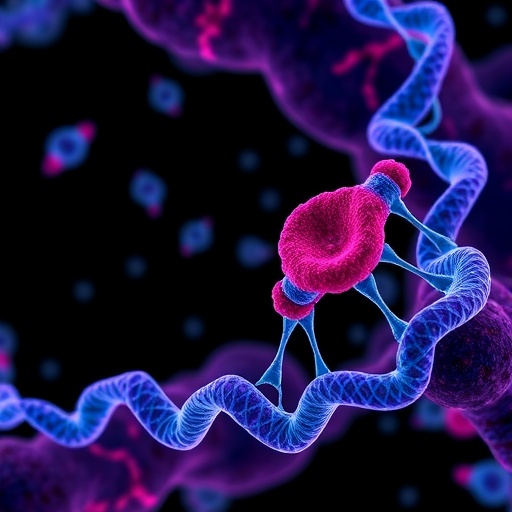
The different genes within the genome must be expressed in precise levels and in the exact moment if the complex balance regulating cell activity is to be maintained. The messenger RNA (mRNA) conveys genetic information from DNA to ribosomes, where proteins are synthesised through the union of amino acids. These amino acids are supplied by fragments of transfer RNA (tRNA), which decode the information contained within the mRNA codons (group of three bases sequencing each amino acid) in order to chain them correctly and synthesise each protein.

The study headed by researchers Marc Torrent from the Department of Biochemistry and Molecular Biology of the Universitat Autònoma de Barcelona, and Madan Babu from the Medical Research Council Cambridge, United Kingdom, for the first time describes the mechanism used by cells to optimise the production of proteins in stressful situations by altering tRNA abundance.

The research, conducted with Saccharomyces cerevisae yeast, suggests that the mRNAs coded by proteins needed in times of stress prefer a different set of codons. This is correlated to the changes produced in the relative abundance of the different tRNAs.

These observations suggest that the cell is capable of regulating the abundance of different tRNAs and adjusting the level of protein expression while adapting to the new conditions. Thus, the change in abundance in different tRNAs is an independent mechanism of regulation allowing a selective modification of translation rates and, therefore, can increase or diminish the relative abundance of the proteins needed in different conditions of stress.

These observations have very notable implications. On the one hand, the regulation mechanism is important because the alteration of tRNA abundance can cause diverse cell dysfunctions. For example, a deregulation of tRNA levels could provoke an abnormal progression of the cell cycle, giving way to proliferative diseases such as cancer: In fact, other studies already observed that the overexpression of the transfer RNA iMet and Brf1, a transcription factor of the complex RNA polymerase III, causes the formation of tumours in vivo. On the other hand, the tRNA is also related to apoptosis, programmed cell death which halts the proliferation of tumours. It has been demonstrated that the tRNA can join the cytochrome complex and prevent the activation of caspases, protease enzymes playing essential roles in programmed cell death.

Therefore, the levels of tRNA in cell also can play a relevant role in the ability of cells to respond to apoptotic stimuli related to the proliferation of tumours.

###

Media Contact

Marc Torrent
[email protected]
34-935-814-147
@UAB_info

http://www.uab.es

Related Journal Article

http://dx.doi.org/10.1126/scisignal.aat6409
Share13Tweet8Share2ShareShareShare2

Related Posts

Deep Learning Uncovers Tetrahydrocarbazoles as Potent Broad-Spectrum Antitumor Agents with Click-Activated Targeted Cancer Therapy Approach

February 7, 2026

Newly Discovered Limonoid DHL-11 from Munronia henryi Targets IMPDH2 to Combat Triple-Negative Breast Cancer

February 7, 2026

New Discovery Reveals Why Ovarian Cancer Spreads Rapidly in the Abdomen

February 6, 2026

New Study Finds Americans Favor In-Clinic Screening Over At-Home Tests for Cervical Cancer

February 6, 2026
Please login to join discussion

POPULAR NEWS

  • Robotic Ureteral Reconstruction: A Novel Approach

    Robotic Ureteral Reconstruction: A Novel Approach

    82 shares
    Share 33 Tweet 21
  • Digital Privacy: Health Data Control in Incarceration

    63 shares
    Share 25 Tweet 16
  • Study Reveals Lipid Accumulation in ME/CFS Cells

    57 shares
    Share 23 Tweet 14
  • Breakthrough in RNA Research Accelerates Medical Innovations Timeline

    53 shares
    Share 21 Tweet 13

About

We bring you the latest biotechnology news from best research centers and universities around the world. Check our website.

Follow us

Recent News

Evaluating Pediatric Emergency Care Quality in Ethiopia

TPMT Expression Predictions Linked to Azathioprine Side Effects

Improving Dementia Care with Enhanced Activity Kits

Subscribe to Blog via Email

Success! An email was just sent to confirm your subscription. Please find the email now and click 'Confirm' to start subscribing.

Join 73 other subscribers
  • Contact Us

Bioengineer.org © Copyright 2023 All Rights Reserved.

Welcome Back!

Login to your account below

Forgotten Password?

Retrieve your password

Please enter your username or email address to reset your password.

Log In
No Result
View All Result
  • Homepages
    • Home Page 1
    • Home Page 2
  • News
  • National
  • Business
  • Health
  • Lifestyle
  • Science

Bioengineer.org © Copyright 2023 All Rights Reserved.