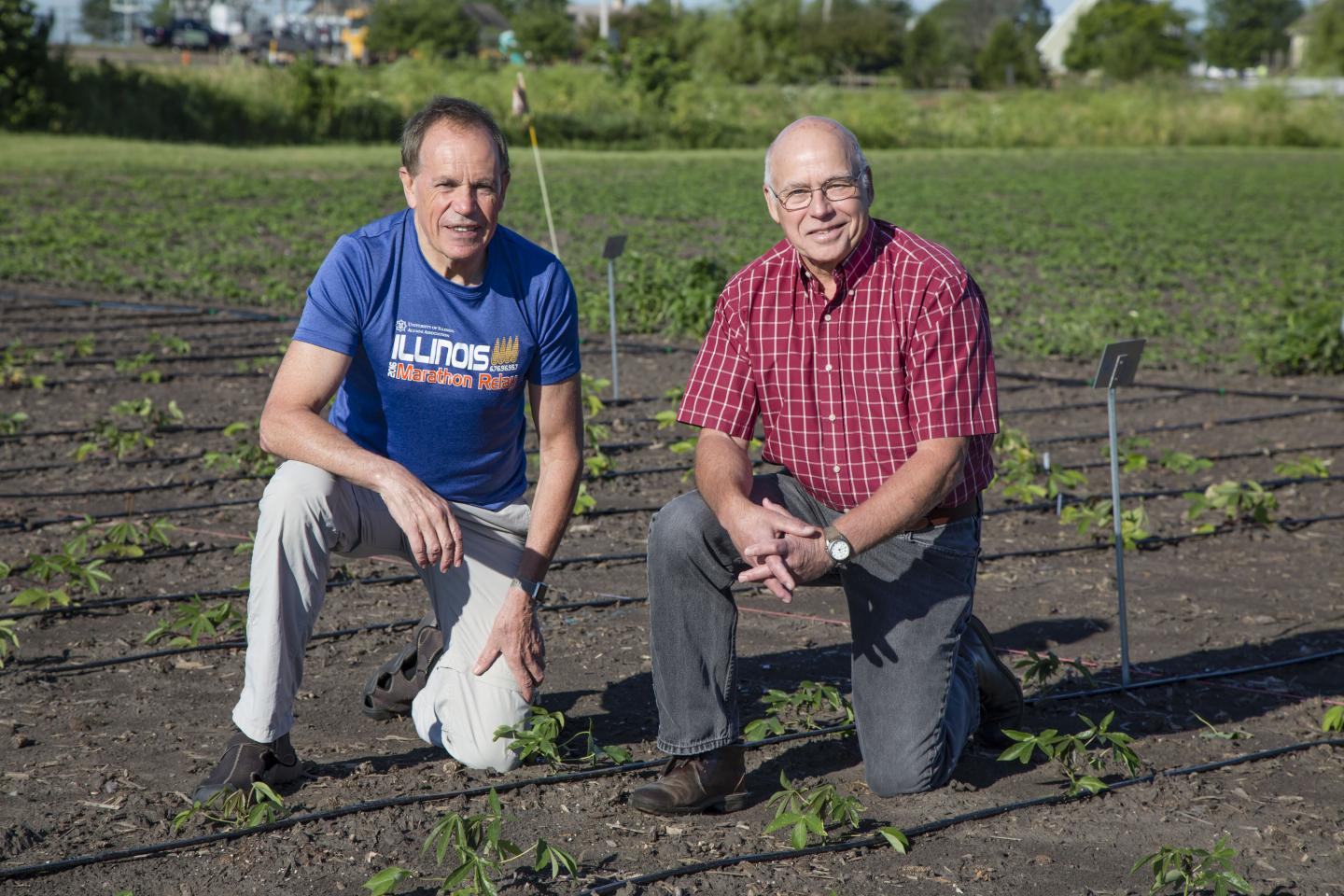
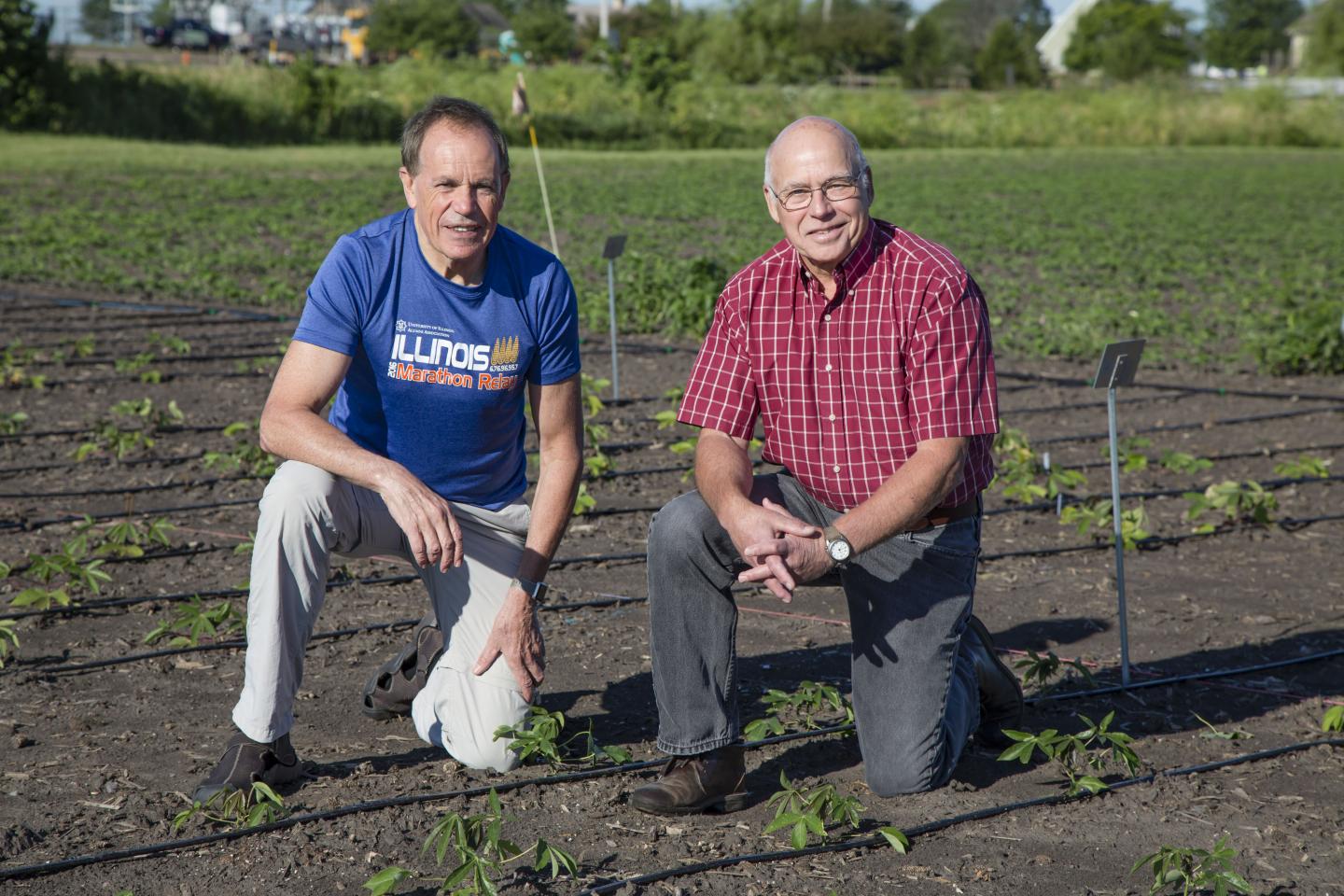
Credit: Brian Stauffer/University of Illinois
Political and agricultural leaders gathered at the University of Illinois today to see transformative work by Realizing Increased Photosynthetic Efficiency (RIPE) that has increased yields by 20 percent. The research project announced that it will continue work to address the global food challenge with the support of a $45 million, five-year reinvestment from the Bill & Melinda Gates Foundation (BMGF), the Foundation for Food and Agriculture Research (FFAR), and the U.K. Department for International Development (DFID).
"Today's report on world hunger and nutrition from five UN agencies reinforces our mission to work doggedly to provide new means to eradicate world hunger and malnutrition by 2030 and beyond," said RIPE Director Stephen Long, Gutgsell Endowed Professor of Crop Sciences and Plant Biology at the Carl R. Woese Institute for Genomic Biology at the University of Illinois. "This investment is timely–annual yield gains are stagnating and means to achieve substantial improvement must be developed now if we are to provide sufficient food by 2030 and beyond for a growing and increasingly urban world population when food production must also adapt sustainably to a changing climate."
"While no single strategy is going to get us there, our successes in redesigning photosynthesis are exciting," said RIPE Deputy Director Don Ort, USDA/ARS Photosynthesis Research Unit and Robert Emerson Professor in Plant Biology and Crop Sciences at Illinois. "RIPE has validated that photosynthesis can be engineered to be more efficient to help close the gap between the trajectory of yield increase and the trajectory of demand increase."
Half a century of photosynthesis research, with several landmark discoveries at Illinois through state and federal partnerships, enabled RIPE to simulate the 170-step process of photosynthesis from the inner workings of enzymes to interactions between neighboring plants in the field. RIPE used these models to identify seven potential pipelines to improve photosynthesis, and with the support of an initial $25 million, five-year grant from the Gates Foundation, began work in 2012 to try to turn their ideas into sustainable yield increases.
Last year, RIPE published work in Science that one of these pipelines could increase crop productivity by 20 percent – a dramatic increase compared to typical annual yield gains of just one percent or less. Two other RIPE pipelines have now shown even greater yield improvements in greenhouse and preliminary field trials.
"Our modeling predicts that several of these improvements can be combined to achieve additive yield increases, providing real hope that a 50 percent yield increase in just three decades is possible," said Long. "With the reinvestment, a central priority will be to move these improved photosynthesis traits into commodity crops of the developed world, like soybeans, as well as crops that matter in the developing world, including cassava and cowpeas."
RIPE and its funders will ensure their high-yielding food crops are globally available, particularly in Sub-Saharan Africa and Southeast Asia, and affordable for smallholder farmers to help feed the world's hungriest and reduce poverty.
But we still have a long road ahead of us: it takes about fifteen years from discovery until crops with these transformative biotechnologies are available for farmers. It will therefore be well into the 2030s before such superior crops are seen at scale in farmers' fields.
###
Realizing Increased Photosynthetic Efficiency (RIPE) is engineering staple food crops to more efficiently turn the sun's energy into food to sustainably increase worldwide food productivity with support from the Bill & Melinda Gates Foundation, the Foundation for Food and Agriculture Research, and the U.K. Department for International Development.
RIPE is led by the University of Illinois in partnership with the USDA/ARS, University of Essex, Lancaster University, Australian National University, Chinese Academy of Sciences, Commonwealth Scientific and Industrial Research Organisation, University of California, Berkeley, and Louisiana State University.
Media Contact
Claire Benjamin
[email protected]
217-244-0941
@IGBIllinois
http://www.igb.uiuc.edu
Original Source
http://ripe.illinois.edu/news/the-time-is-ripe-to-transform-agriculture-and-feed-the-world