In fully autonomous apomixis, plants can generate clonal seeds without fertilization, a strategy that could stabilize hybrid vigour in crop breeding. Yet while fertilization-independent embryo formation is relatively well characterized, the molecular logic that governs autonomous endosperm development has remained elusive. A new study in Nature Plants identifies a maternal “brake” that prevents endosperm from initiating when the paternal genome is absent.
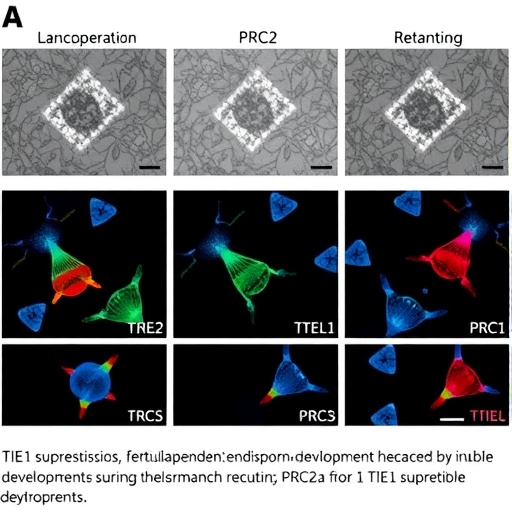
The work centers on a family of TIE genes and a key maternal factor, TIE1. The researchers report that disrupting multiple TIEs—by combining four members into a tie1 tie2 tie3 tie4 mutant set, termed tieQ—induces autonomous endosperm development. Crucially, the mutant phenotype mirrors that of fis class mutants, which also display fertilization-independent endosperm formation.
Mechanistically, TIE1 is described as a maternally expressed transcriptional repressor. That maternal bias is not incidental: the authors show that TIE1 undergoes genomic imprinting akin to MEDEA (MEA), a well-known component of the FIS–POLYCOMB REPRESSIVE COMPLEX 2 (FIS–PRC2). PRC2 is a chromatin-modifying system that establishes repressive epigenetic states to silence developmental programs at the right time.
How does TIE1 communicate with PRC2? The study provides evidence that TIE1 recruits FIS–PRC2 to a subset of its target loci. By tethering PRC2, TIE1 enables transcriptional silencing of genes that would otherwise become activated and trigger endosperm development under fertilization-independent conditions.
This maternal repression model positions TIE1 as a functional counterweight to endosperm-inducing signals. Without TIE1-mediated silencing, the embryo/endosperm developmental system becomes permissive, allowing endosperm to develop autonomously. The “brake” is therefore both spatially and temporally controlled through maternal imprinting and epigenetic repression.
From a broader apomixis perspective, the findings refine a regulatory cascade: maternal expression patterns, imprinting, and PRC2-associated chromatin repression converge to block premature endosperm initiation. By defining a concrete repression mechanism, the work moves apomixis biology beyond phenomenology toward targetable molecular control.
The results also open a synthetic avenue. Engineering crops to modulate TIE1–PRC2 recruitment—or to recreate equivalent imprinting states—could, in principle, help design apomictic lines that maintain heterosis by producing clonal, hybrid-like seeds.
For breeders and developmental geneticists alike, this study offers a clear framework: to prevent inappropriate endosperm, plants rely on an imprinting-based maternal repressor that partners with PRC2 to keep endosperm fate genes locked in an inactive chromatin configuration.
Subject of Research: Maternal control of fertilization-independent endosperm development in apomixis
Article Title: TIE1 acts as a maternal brake on fertilization-independent endosperm development by associating with PRC2 to enforce imprinting.
Article References: Zhang, Z., Wang, X., Yuan, R. et al. TIE1 acts as a maternal brake on fertilization-independent endosperm development by associating with PRC2 to enforce imprinting. Nat. Plants (2026). https://doi.org/10.1038/s41477-026-02344-2
Image Credits: AI Generated
DOI: https://doi.org/10.1038/s41477-026-02344-2
Keywords: apomixis; autonomous endosperm; TIE1; maternal imprinting; PRC2; FIS–MEDEA; FIS–POLYCOMB REPRESSIVE COMPLEX 2; synthetic apomixis
Tags: autonomous seed formationepigenetic regulation of endospermfertilization-independent endosperm developmentFIS–PRC2 complex recruitmentgene silencing in plant reproductionhybrid vigor stabilizationmaternal genomic imprintingmolecular mechanisms of apomixisPRC2 chromatin-modification complexsuppression of endosperm initiationTIE gene family in plantsTIE1 transcriptional repressor