• HOME
  • NEWS
  • EXPLORE
    • CAREER
      • Companies
      • Jobs
    • EVENTS
    • iGEM
      • News
      • Team
    • PHOTOS
    • VIDEO
    • WIKI
  • BLOG
  • COMMUNITY
    • FACEBOOK
    • INSTAGRAM
    • TWITTER
Thursday, March 26, 2026
BIOENGINEER.ORG
No Result
View All Result
  • Login
  • HOME
  • NEWS
  • EXPLORE
    • CAREER
      • Companies
      • Jobs
        • Lecturer
        • PhD Studentship
        • Postdoc
        • Research Assistant
    • EVENTS
    • iGEM
      • News
      • Team
    • PHOTOS
    • VIDEO
    • WIKI
  • BLOG
  • COMMUNITY
    • FACEBOOK
    • INSTAGRAM
    • TWITTER
  • HOME
  • NEWS
  • EXPLORE
    • CAREER
      • Companies
      • Jobs
        • Lecturer
        • PhD Studentship
        • Postdoc
        • Research Assistant
    • EVENTS
    • iGEM
      • News
      • Team
    • PHOTOS
    • VIDEO
    • WIKI
  • BLOG
  • COMMUNITY
    • FACEBOOK
    • INSTAGRAM
    • TWITTER
No Result
View All Result
Bioengineer.org
No Result
View All Result
Home NEWS Bioengineering

New light-controlled gel makes big strides in soft robotics

Bioengineer by Bioengineer
October 29, 2013
in Bioengineering, Headlines
Reading Time: 2 mins read
0
Share on FacebookShare on TwitterShare on LinkedinShare on RedditShare on Telegram

Inspired by the way plants grow toward light sources, a phenomenon known as phototropism, bioengineers from the University of California, Berkeley have created a hydrogel that could be manipulated by light.
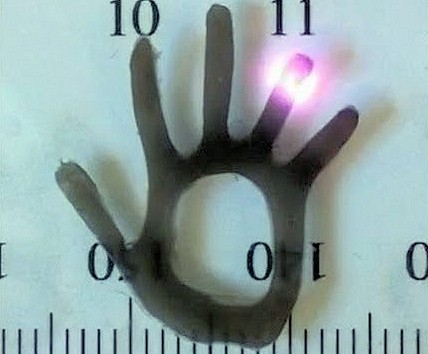
gel

The new hydrogel, described earlier this month in the journal Nano Letters, could have future applications in the emerging field of soft robotics, which takes a cue from squishy creatures in nature, like starfish, squids and octopuses, to create flexible components.

“Shape-changing gels such as ours could have applications for drug delivery and tissue engineering,” said study principal investigator Seung-Wuk Lee, associated professor of bioengineering.

Researchers combined synthetic, elastic proteins with sheets of graphene, one-atom thick carbon sheets that stack to form graphite. Graphite is the same material used in pencil lead. The graphene sheets generate heat when exposed to near infrared light. That heat affects the synthetic proteins, which absorb water when cooled and release it when hot.

The two materials together formed the nanocomposite biopolymer, or hydrogel, which was designed so that one side was more porous than the other. The side that was more porous allowed a faster absorption and release of water than the other side.

“By combining these materials, we were able to mimic the way plant cells expand and shrink in response to light in a much more precisely controlled manner,” said Lee. “Because the gels shrank unevenly, the material bent when the light hit it. We used these bending motions to demonstrate a hand-shaped hydrogel that exhibited joint-like articulation when exposed to light.”

Other study authors are Eddie Wang and Malav Desai, both graduate students in bioengineering.

Story Source:

The above story is reprinted from materials provided by News Berkeley University, Sarah Yang.

Share13Tweet8Share2ShareShareShare2

Related Posts

Why is the first Turkish bioengineering promotion website, Biyomuhendislik.com, so important?

February 4, 2023

Chlorinated lipids predict lung injury and death in sepsis patients

January 31, 2018

Major research initiative explores how our bones and muscles age, new ways to block their…

January 31, 2018

Gene that enables memories, sense of direction produces schizophrenia-like symptoms when mutated

January 31, 2018
Please login to join discussion

POPULAR NEWS

  • blank

    Revolutionary AI Model Enhances Precision in Detecting Food Contamination

    96 shares
    Share 38 Tweet 24
  • Imagine a Social Media Feed That Challenges Your Views Instead of Reinforcing Them

    1003 shares
    Share 397 Tweet 248
  • Uncovering Functions of Cavernous Malformation Proteins in Organoids

    54 shares
    Share 22 Tweet 14
  • Promising Outcomes from First Clinical Trials of Gene Regulation in Epilepsy

    51 shares
    Share 20 Tweet 13

About

We bring you the latest biotechnology news from best research centers and universities around the world. Check our website.

Follow us

Recent News

In-Sensor Cryptography Links Physical Process to Digital Identity

Can Psychosocial Factors Influence Cancer Risk?

Depression Factors in Elderly: Pre vs. Post-COVID Analysis

Subscribe to Blog via Email

Success! An email was just sent to confirm your subscription. Please find the email now and click 'Confirm' to start subscribing.

Join 78 other subscribers
  • Contact Us

Bioengineer.org © Copyright 2023 All Rights Reserved.

Welcome Back!

Login to your account below

Forgotten Password?

Retrieve your password

Please enter your username or email address to reset your password.

Log In
No Result
View All Result
  • Homepages
    • Home Page 1
    • Home Page 2
  • News
  • National
  • Business
  • Health
  • Lifestyle
  • Science

Bioengineer.org © Copyright 2023 All Rights Reserved.