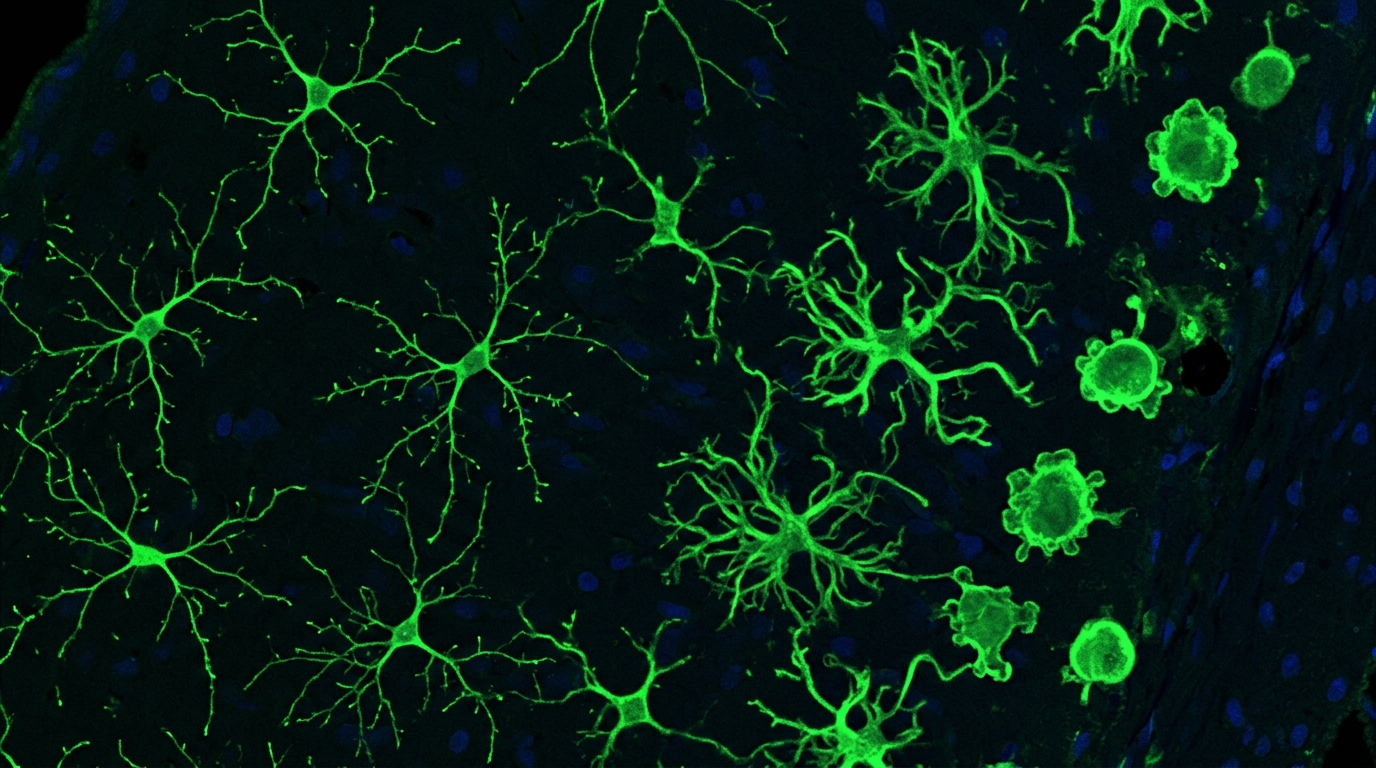
A computational and laboratory investigation integrating single-cell and bulk transcriptomic data has characterized a distinct microglial subpopulation marked by dual activation of inflammatory and senescence-associated gene programs in rodent models of ischemic stroke. Published in Discover Medicine, the multi-stage study evaluated brain tissue profiling datasets alongside an in vitro hypoxia-reoxygenation model to clarify the transcriptomic landscape of post-ischemic microglia. Beyond delineating the molecular features of this specialized cell cluster, termed disease-inflammatory microglia, the investigative team applied high-dimensional network co-expression modeling and machine learning algorithms to prioritize five candidate genes showing concordant upregulation across independent datasets. These candidate molecules, comprising Lgals1, Emp1, Dab2, Hmox1, and Cd151, exhibited robust positive correlations with interleukin-6 and its receptor, providing a computational framework for exploring the interface between chronic neuroinflammation and cellular senescence in cerebral ischemic pathophysiology.
Ischemic stroke constitutes approximately eighty-five percent of all stroke cases worldwide and represents a leading contributor to long-term neurological disability and mortality. While recanalization interventions such as endovascular mechanical thrombectomy and thrombolysis have expanded clinical reperfusion capabilities, therapeutic success remains constrained by narrow temporal treatment windows, elevated risks of hemorrhagic transformation, and subsequent ischemia-reperfusion injury. In the central nervous system, microglia function as the primary resident innate immune cells, orchestrating the complex balance between pro-inflammatory tissue damage and anti-inflammatory restorative repair. Concurrently, post-ischemic brain tissue demonstrates hallmarks of cellular senescence, including prolonged cell-cycle arrest, elevated cyclin-dependent kinase inhibitor expression, and the release of senescence-associated secretory phenotype components. Despite recognizing that immune-related signaling and cellular senescence can mutually reinforce tissue pathology, the specific microglial subsets and transcriptional drivers coordinating these intertwined biological processes have remained incompletely defined.
To explore these cellular dynamics, the researchers compiled multiple publicly accessible transcriptomic repositories from the Gene Expression Omnibus database, combining single-cell RNA sequencing with bulk gene expression profiles across mouse and rat models. The primary discovery cohort for single-cell profiling consisted of GSE174574, comprising six mouse brain tissue specimens divided equally between middle cerebral artery occlusion surgical models and sham-operated controls. For bulk transcriptomic analyses, the investigators utilized GSE137482, which encompassed twenty-four mouse brain specimens subjected to middle cerebral artery occlusion or control conditions, and GSE97537, containing twelve rat brain samples spanning ischemic and sham procedures. Additionally, GSE23160, capturing cortical transcriptomes from sixteen mice subjected to ischemia-reperfusion injury, served as a supplementary dataset to evaluate expression consistency. Defined reference sets comprising 1,793 immune-related genes from ImmPort and 1,259 cellular senescence-related genes from CellAge were mapped against the expression matrices to assess pathway enrichment.
Following quality control filtering that excluded low-coverage droplets and high mitochondrial gene fractions, 57,834 individual cells were retained from the single-cell cohort, comprising 27,039 cells from control brains and 30,795 cells from ischemic specimens. Unsupervised clustering resolved eleven broad brain cell types, including endothelial cells, microglia, astrocytes, oligodendrocytes, pericytes, and infiltrating immune populations. Sub-clustering within the microglial compartment resolved four reproducible subpopulations: disease-inflammatory microglia, ribosome microglia, homeostatic microglia, and activated microglia. In control tissues, homeostatic microglia predominated, accounting for 87.5 percent of the microglial pool compared to 46.8 percent in ischemic tissues. Conversely, disease-inflammatory microglia underwent pronounced enrichment after ischemic injury, rising from 5.5 percent of microglia in controls to 39.2 percent in ischemic samples. Animal-level comparisons utilizing pseudobulk calculations confirmed that this expansion of disease-inflammatory microglia reached statistical significance across biological replicates, establishing a clear link between stroke induction and cluster accumulation.
Phenotypic characterization of the disease-inflammatory microglial subpopulation demonstrated coordinated upregulation across immune and senescence dimensions. Computational scoring using five distinct algorithm suites revealed that disease-inflammatory microglia achieved the highest combined scores for immune-related and senescence-related gene signatures among all microglial clusters. Animal-level pseudobulk evaluations confirmed significant intergroup alterations for both programs in disease-inflammatory, ribosome, and homeostatic microglial subsets. At the individual marker level, the canonical senescence indicators Cdkn1a and Lmnb1 showed elevated expression within disease-inflammatory cells, whereas Cdkn2a and Glb1 did not exhibit discernible subtype specificity. Differentiation potential modeling via CytoTRACE2 predicted the relatively highest developmental plasticity in disease-inflammatory microglia, and computational trajectory reconstruction positioned these cells predominantly toward the terminal positions of post-stroke pseudotime progression. Furthermore, ligand-receptor interaction modeling inferred enhanced communications between disease-inflammatory microglia, monocyte-derived cells, and neutrophils, alongside significant enrichment in inflammatory, metabolic, and epithelial-mesenchymal transition pathways.
To identify the primary gene regulatory structures underpinning this microglial response, the researchers executed high-dimensional weighted gene co-expression network analysis on single-cell transcriptomes aggregated into metacell units. Selecting a soft-thresholding power of beta equals eight, the dynamic tree cut procedure parsed the microglial network into four distinct co-expression modules. Evaluation of module eigengene correlations against stroke status revealed two modules significantly associated with disease-inflammatory microglia: a blue module inversely correlated with stroke and a yellow module positively correlated with ischemic insult, which together encompassed 276 module-defining genes. Concurrently, differential expression analysis on the bulk RNA sequencing cohort GSE137482 identified 2,176 differentially expressed genes, with 2,052 upregulated and 124 downregulated in stroke specimens. Overlapping the 276 single-cell network module genes with the 2,176 bulk differential genes yielded an intersection set of 137 genes, which demonstrated substantial functional enrichment in neuroinflammatory responses, collagenous extracellular matrix organization, and lysosomal biogenesis pathways.
To refine the 137 intersection genes into prioritized candidate markers, the authors applied two complementary supervised machine learning workflows. Least absolute shrinkage and selection operator regression utilizing three-fold cross-validation retained nine non-zero coefficient predictors from a logistic model tracking disease state. Concurrently, the Boruta random forest wrapper algorithm, which measures variable importance against permuted shadow features, identified 126 important predictor genes. The intersection of these two feature-selection methods isolated nine consensus genes: Lgals1, Emp1, Dab2, Hmox1, Bin2, Pdlim4, Cd151, Rnaset2a, and Lpl. Cross-dataset validation in the mouse sequencing cohort GSE137482 and the rat microarray cohort GSE97537 subsequently demonstrated that five of these nine genes—Lgals1, Emp1, Dab2, Hmox1, and Cd151—achieved statistically significant and concordant upregulation across both species platforms, thereby establishing them as the final candidate gene panel for detailed characterization.
Extending their computational screening to pathway associations, the authors performed single-gene gene set enrichment analysis across the bulk transcriptomic background. All five candidate genes shared statistically significant top enrichment in four fundamental pathways: interferon-gamma response, epithelial-mesenchymal transition, inflammatory response, and E2F cell-cycle targets. This commonality suggests shared involvement in inflammatory signaling, structural membrane dynamics, and cellular proliferation checkpoints. At the same time, specific functional distinctions emerged among individual candidates. Epithelial membrane protein 1 uniquely demonstrated significant enrichment in tumor necrosis factor-alpha signaling mediated through nuclear factor-kappa B. Conversely, allograft rejection pathways were enriched among four candidate molecules but excluded Emp1. Furthermore, non-parametric correlation analyses revealed that transcript levels for all five candidate genes correlated positively with interleukin-6 and interleukin-6 receptor subunit alpha, linking each molecule to canonical post-stroke inflammatory signaling cascades.
Evaluation within the supplementary ischemia-reperfusion cortical dataset GSE23160 provided partial external corroboration for the candidate panel. Among the five nominated genes, only Disabled Homolog 2 demonstrated statistically significant upregulation in the reperfusion cohort, while the remaining four candidates did not achieve statistical significance under that specific injury protocol. The individual candidate genes carry established yet nuanced biological roles in cerebral and vascular biology. Heme oxygenase 1 encodes a stress-inducible enzyme catalyzing heme degradation into biliverdin, iron, and carbon monoxide, functioning as a metabolic sensor whose sustained activation has been tied to senescence phenotypes and iron-mediated oxidative stress. Galectin-1, encoded by Lgals1, participates in immune modulation, with its upregulation potentially reflecting counter-regulatory neuroprotective responses. Dab2 functions as an endocytic adaptor protein implicated in macrophage polarization and cellular aging, whereas Cd151 encodes a tetraspanin membrane organizer governing endothelial barrier integrity and leukocyte adhesion dynamics.
To examine candidate gene expression in a controlled cellular environment, the investigators subjected the BV2 murine microglial cell line to an in vitro oxygen-glucose deprivation model. Cells were exposed to six hours of mimetic hypoxia followed by twelve hours of reoxygenation, with normoxic cultures serving as baseline controls. Quantitative reverse transcription polymerase chain reaction assays revealed elevated relative mRNA levels for Lgals1, Emp1, Dab2, and Hmox1 in oxygen-glucose deprivation conditions compared to controls, whereas Cd151 exhibited no apparent transcript induction. Because Emp1 displayed the most uniform upregulation across computational datasets and the strongest statistical correlation with interleukin-6 signaling components, it was selected for Western blot protein validation. Densitometric evaluation normalized to glyceraldehyde-3-phosphate dehydrogenase demonstrated an increase in Emp1 protein band intensity in the model group, corroborating the observed transcriptomic trends at the translational level.
The authors underscored several methodological limitations governing the interpretation of their computational and experimental findings. Because the discovery single-cell analysis relied on six animals, network co-expression modules and pseudotime trajectories remain exploratory hypotheses requiring confirmation in larger single-cell cohorts. Similarly, the feature selection procedures were constrained by a small sample size relative to gene variables, carrying risks of statistical overfitting. The in vitro assays utilized within-batch technical replicates from an immortalized microglial cell line rather than primary microglia, rendering the cell culture measurements descriptive observations rather than inferential or functional proof. Furthermore, the single-cell senescence features were inferred primarily from transcriptomic scoring and marker correlations rather than direct functional assays. Consequently, the authors conclude that while this integrative analysis nominates a disease-inflammatory microglial subtype and highlights five correlated candidate genes, establishing their diagnostic relevance, causal regulatory mechanisms, and therapeutic viability will require prospective validation in primary cellular systems, conditional knockout animal models, and clinical human cohorts.
Subject of Research: Integrative single-cell and bulk transcriptomic characterization of inflammatory and senescence-associated microglia in ischemic stroke models
Article Title: Integrative single-cell and bulk transcriptomic analysis identifies candidate genes associated with inflammatory and senescence-related microglial signatures in ischemic stroke
Article References: Fang, M., Ling, Y., Chu, X., Yao, L., Yu, E., Ji, X., Lan, J., & Wu, C. (2026). Integrative single-cell and bulk transcriptomic analysis identifies candidate genes associated with inflammatory and senescence-related microglial signatures in ischemic stroke. Discover Medicine. https://doi.org/10.1007/s44337-026-00757-8
Image Credits: AI Generated
DOI: 10.1007/s44337-026-00757-8
Keywords: ischemic stroke, microglia, single-cell RNA sequencing, bulk transcriptomics, cellular senescence, neuroinflammation, hdWGCNA, DIM subtype, Emp1, Lgals1, Dab2, Hmox1, Cd151, oxygen-glucose deprivation, BV2 microglial cells, machine learning, LASSO regression, Boruta algorithm
News Source: Cassandra Pierce. (November 28, 2026). Transcriptomic Analysis Identifies Microglial Subtype and Five Candidate Genes in Ischemic Stroke. Scienmag.