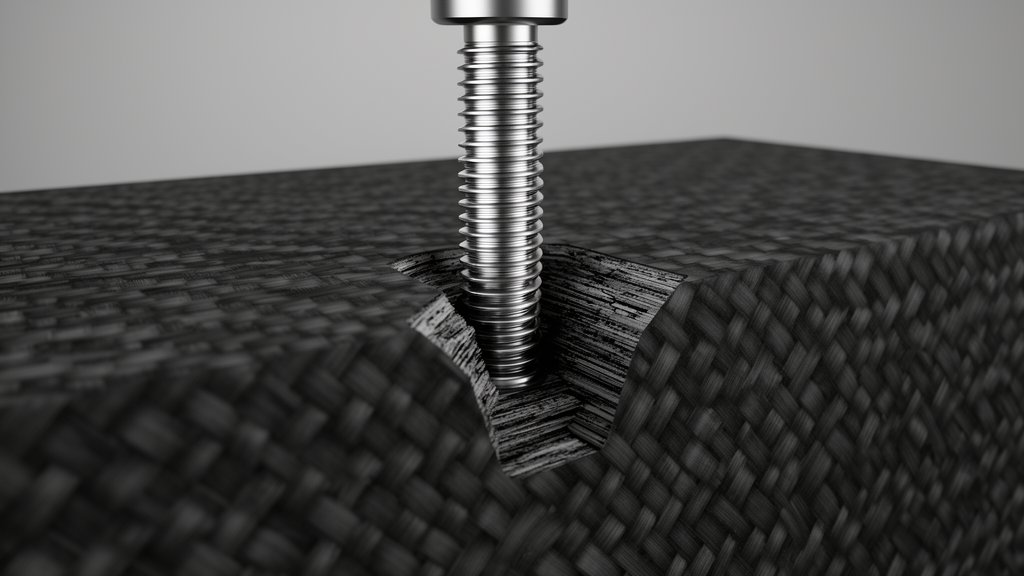
In an experimental investigation evaluating fastener integration strategies for structural composites, researchers systematically compared seven different threaded insert configurations embedded in carbon fiber–reinforced polymer laminates under static and cyclic loading. The study, conducted using twenty-ply plain-weave carbon prepreg panels, revealed that co-cured embedded inserts delivered the greatest static pull-out capacity, whereas tapping inserts combined with an epoxy adhesive demonstrated the highest durability under flexural fatigue. Directly cutting threads into composite laminates has long presented challenges in load-bearing engineering applications due to the material’s inherent weakness across interlaminar resin layers. When mechanical joints require one-sided blind installation or hardware disassembly where through-bolting is impractical, engineers frequently rely on metallic inserts to distribute operational loads. However, comparative data evaluating different commercial and experimental insert concepts under standardized coupon geometries, identical laminate layups, and uniform testing procedures have historically remained sparse.
To establish a rigorous baseline across competing joint concepts, the research team examined seven specific fastening configurations: a direct-threaded laminate without metallic hardware, a barbed insert, a screw-to-expand insert, a self-tapping insert, a tapping insert reinforced with adhesive, an embedded brass insert placed during layup, and an embedded aluminum block tapped after panel cure. Except for the solid metal block, the metallic hardware evaluated consisted of brass inserts engineered with internal metric M4 by 0.7 threads. The direct-threaded control specimens were prepared by tapping identical M4 threads directly into the cured composite laminate. Throughout all testing specimens, insert heights were carefully aligned so that the bottom surface of each fastener sat flush with the bottom surface of the composite coupon, ensuring equivalent mechanical contact boundaries across the comparative pull-out evaluations.
Laminate fabrication followed strict manufacturing protocols using AS4/NB321 plain-weave prepreg material. The coupons were arranged in a symmetric, balanced twenty-ply sequence of [0/90]s5 and consolidated in an autoclave at 177 degrees Celsius for 120 minutes under a sustained consolidation pressure of 552 kilopascals. This controlled cure cycle yielded finished carbon composite panels measuring approximately 5 millimeters in thickness. To extract individual test coupons measuring 38.1 millimeters square for static evaluations and 44.45 by 152.4 millimeters for fatigue screening, the researchers employed abrasive waterjet cutting. The preparation of initial pilot holes in composite substrates presents a notable technical challenge, as conventional drilling operations can induce localized peel-up delamination on the drill entry face and push-out delamination on the exit face due to high axial thrust forces and tool geometry interactions.
To isolate the mechanical performance of the inserts from pre-existing manufacturing defects, the team conducted a preliminary machining comparison between traditional high-speed steel twist drilling and a spiral-path pocketing process using a 3.175-millimeter diamond cutting tool. Optical microscopy and quantitative image analysis of cross-sectioned boreholes revealed that standard drilling caused extensive interlaminar lifting and microcracking, resulting in a quantified damage area of 0.2 percent relative to the laminate cross-section. In contrast, the diamond spiral pocketing method produced clean ply terminations with no measurable delamination, registering zero percent damage. Consequently, diamond pocketing was implemented as the standardized hole-making method for all subsequent mechanical test coupons, accompanied by a sacrificial backing plate during machining to eliminate exit-face breakout.
Microscopic inspection of the installed insert interfaces highlighted pronounced differences in installation-induced laminate damage across the seven configurations. Direct-threaded specimens, prepared by tapping a 3.30-millimeter pocketed hole, exhibited clean internal thread roots and zero measurable installation damage. In press-fit configurations, barbed inserts installed into 5.2-millimeter holes using an arbor press showed 0.4 percent damage area, with localized matrix microcracking under the flange. Screw-to-expand inserts, expanded radially via an internal screw inside 5.6-millimeter holes, produced 0.5 percent damage area, primarily characterized by push-out delamination near the coupon bottom. Standard tapping inserts required notable procedural adjustments; manufacturer recommendations called for self-cutting into a 5.56-millimeter pilot hole, but initial trials generated severe delamination and excessive driving torque. A 6.10-millimeter pilot hole pre-tapped to a one-quarter-inch twenty-eight thread was ultimately required, generating 0.7 percent damage in dry installations and 0.8 percent damage when installed with Araldite 2011 two-part epoxy adhesive.
The two co-cured insert geometries exhibited completely divergent installation integrity. The embedded brass insert, originally designed as a heat-set fastener for thermoplastic resins, was integrated into a cutout pocket during prepreg layup and co-cured within the autoclave. Resin flow during the cure cycle completely encapsulated the external retention geometry, producing smooth ply curvature, void-free bonding, and zero percent installation damage. In stark contrast, the embedded aluminum 6061 cube measuring 6.35 millimeters per side exhibited severe internal failure. Although sandblasted prior to layup to enhance adhesion, the ductile aluminum block expanded plastically during post-cure pilot drilling and thread tapping. This internal metal deformation exerted severe outward out-of-plane pressure against the surrounding cured composite plies, creating widespread interlaminar separation, ply lifting, and an extensive damage area of 4.7 percent.
Monotonic static pull-out testing, conducted on a universal testing machine at a constant crosshead displacement rate of 2 millimeters per minute, quantified significant variations in ultimate tensile retention and interfacial stiffness. Specimens were secured within a specialized dual-plate steel fixture featuring a 12.7-millimeter central opening to restrain global laminate bending and isolate interfacial shear and peel stresses. The co-cured embedded insert achieved the highest mean static pull-out capacity at 5,555 newtons with a standard deviation of 244 newtons, representing 122 percent of the direct-threaded laminate control baseline. The tapping insert with adhesive ranked second, achieving 4,601 newtons with a standard deviation of 349 newtons, or 101 percent of the control. The dry direct-threaded laminate demonstrated an average pull-out capacity of 4,548 newtons with a standard deviation of 121 newtons, whereas a single tested dry tapping insert sustained 4,063 newtons, representing 89 percent of the control.
Conversely, press-fit and post-machined block configurations displayed substantially degraded mechanical strength under static axial extraction. The screw-to-expand insert sustained an average pull-out capacity of 1,363 newtons with a standard deviation of 69 newtons, corresponding to 30 percent of the direct-threaded baseline. The barbed insert reached an average of 1,223 newtons with a standard deviation of 90 newtons, retaining only 27 percent of the baseline strength. The embedded aluminum block performed the worst among all evaluated configurations, reaching an ultimate capacity of just 991 newtons with a standard deviation of 84 newtons, or 22 percent of the control. This marked loss of capacity reflected the severe delamination generated during post-cure thread tapping, along with poor mechanical interlocking between the smooth planar metal faces and the composite laminate interface.
Elastic response metrics closely mirrored the ultimate strength hierarchy, confirming that joint stiffness depends heavily on interface cohesion. The co-cured embedded insert recorded the highest initial stiffness, averaging 16,230 newtons per millimeter with a standard deviation of 1,574 newtons per millimeter. The tapping insert with adhesive exhibited an average stiffness of 12,962 newtons per millimeter with a standard deviation of 1,381 newtons per millimeter, outperforming the direct-threaded laminate at 10,861 newtons per millimeter with a standard deviation of 1,047 newtons per millimeter. The dry tapping insert achieved 10,491 newtons per millimeter, whereas press-fit concepts showed significantly lower values: 9,366 newtons per millimeter for barbed inserts, 5,656 newtons per millimeter for screw-to-expand inserts, and 2,112 newtons per millimeter for the embedded aluminum block. Notably, the barbed insert displayed high stiffness variability, with a standard deviation of 4,290 newtons per millimeter, attributed to manual seating variations during arbor press assembly.
To evaluate long-term durability under cyclic operational stresses, the researchers subjected four selected configurations to flexural pull-out fatigue testing using a custom three-point bending arrangement. Applying a tension-only sinusoidal displacement waveform at a constant frequency of 2 hertz, the testing protocol implemented a stepped-deflection staircase increasing from 1.00 millimeter to 4.00 millimeters in 0.25-millimeter increments every 1,000 cycles. Joint failure was defined as the cycle at which normalized stiffness decayed by 20 percent relative to the beginning of that deflection block. In these screening trials, the tapping insert with adhesive demonstrated exceptional durability, surviving through the 3.75-millimeter deflection block and failing only in the final 4.00-millimeter block at a cumulative fatigue life of 12,581 cycles. The dry tapping insert similarly exhibited robust behavior, resisting stiffness loss across lower blocks before reaching the 20 percent failure threshold at 3.75 millimeters after 11,065 cycles.
In marked contrast to their high static capacity, both the direct-threaded laminate and the co-cured embedded insert demonstrated premature failure during cyclic fatigue testing. Both configurations suffered rapid stiffness degradation at moderate bending deflections, failing within the 2.75-millimeter displacement block at cumulative fatigue lives of 7,421 cycles and 7,661 cycles, respectively. Post-test optical microscopy revealed the underlying physical mechanisms driving this rapid wear. In the direct-threaded laminate, cyclic micro-slip between the rigid steel loading bolt and the brittle composite wall caused extensive abrasive wear, largely obliterating the thread geometry and producing a localized damage area of 6.7 percent. Conversely, the tapping insert specimens retained their metallic thread profiles, with the insert moving as a unified body with the laminate, yielding a reduced post-fatigue damage area of 2.9 percent. In the adhesive-assisted tapping configuration, the cured epoxy layer filled microscopic thread clearances, suppressing interfacial micro-slip and delaying the onset of fatigue-induced matrix cracking.
The experimental findings demonstrate that while co-cured embedded inserts maximize monotonic static pull-out strength in carbon fiber laminates, externally threaded tapping inserts bonded with structural adhesive provide superior resistance against cyclic fatigue and progressive interfacial wear. Furthermore, the results indicate that press-fit designs such as barbed or expansion fasteners cannot reliably support significant axial extraction loads in composite structures. The authors also noted that the evaluated brass inserts were selected based on commercial availability and that galvanic coupling between electrochemically noble carbon fibers and active brass could cause long-term environmental degradation in humid or marine settings. For extended operational service in aggressive environments, the researchers recommend employing corrosion-resistant alloys such as stainless steel or titanium, or incorporating non-conductive epoxy barrier layers to prevent galvanic interactions across the fastener-laminate boundary.
Subject of Research: Pull-out strength and fatigue performance of threaded insert configurations in carbon fiber composite laminates
Article Title: Comparative Performance of Threaded Inserts in Fiber-Reinforced Composite Laminates under Static and Fatigue Pull-Out Loading
Article References: Kim, G., Lee, H., Pammi, R., Kulkarni, S., Denos, B., & Jung, A. (2026). Comparative Performance of Threaded Inserts in Fiber-Reinforced Composite Laminates under Static and Fatigue Pull-Out Loading. Applied Composite Materials, 33(3), Article 88. https://doi.org/10.1007/s10443-026-10473-2
Image Credits: AI Generated
DOI: 10.1007/s10443-026-10473-2
Keywords: composite materials, carbon fiber reinforced polymers, threaded inserts, fasteners, pull-out strength, cyclic fatigue, mechanical testing, adhesive bonding, machining, structural integrity, delamination, laminate joints, materials science, structural engineering, microscopy
News Source: Denise Maddox. (November 26, 2026). Study Evaluates Threaded Fastener Performance in Carbon Fiber Composite Panels. Scienmag.