Metabolic engineering provides a foundational biological platform for synthesizing valuable chemicals, therapeutic proteins, and advanced biopolymers directly from renewable resources, yet broad industrial implementation remains constrained by inefficient biosynthetic pathways, suboptimal enzyme kinetics, and prolonged design-build-test-learn cycles. In an authoritative review published in Frontiers in Bioengineering and Biotechnology, researchers Youngjoon Lee, Seung-Goo Lee, and colleagues from the Korea Research Institute of Bioscience and Biotechnology and affiliated academic institutions systematically evaluated how artificial intelligence algorithms can be coordinated with high-throughput biofoundries. Their survey assesses recent advances spanning biosynthetic pathway design, protein and enzyme engineering, and genome-scale metabolic modeling from an operational input-output perspective, comparing practical computational capabilities against experimentally demonstrated biological outcomes. The authors emphasize that while computational algorithms can prioritize actionable genetic designs, transforming predictive models into high-titer production strains depends on systematic experimental evaluation and standardized data generation.
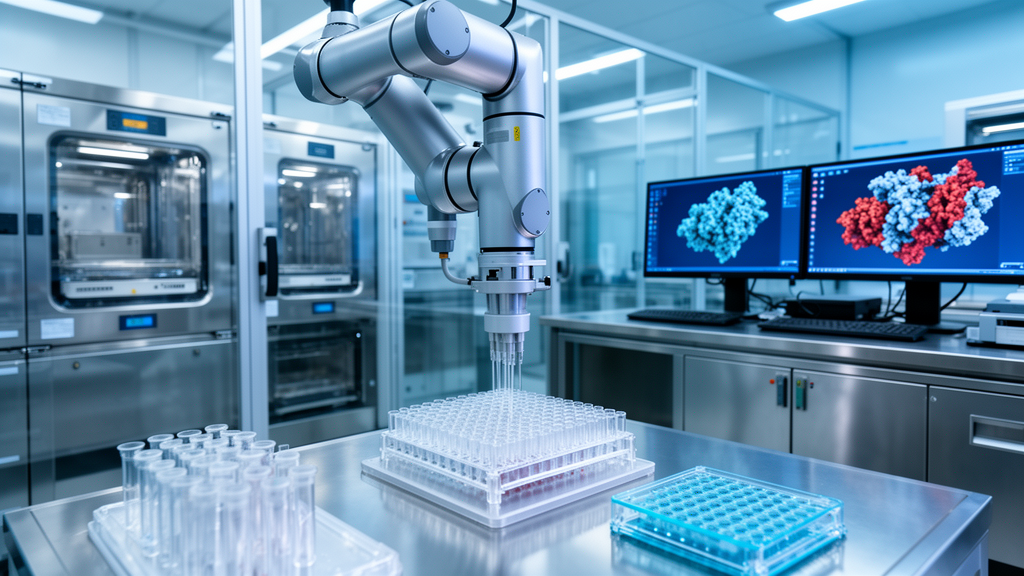
The central obstacle confronting artificial intelligence in metabolic engineering stems from the contextual complexity of biological systems, creating challenges distinct from structural biology where deep sequence databases and physical constraints enabled rapid breakthroughs. Cellular phenotypes emerge from intricate, non-linear interactions connecting heterologous pathway enzymes, endogenous host regulatory networks, dynamic metabolic fluxes, and precise cultivation environments. Because enzyme activities and metabolic behaviors are sensitive to shifting growth conditions, publicly available datasets are frequently scarce, heterogeneous, and difficult to reproduce across disparate laboratories. To resolve this persistent data bottleneck, the authors examine the integrating role of biofoundries, which combine automated liquid handling, robotic cultivation, and laboratory information management systems to execute standardized experimental workflows. By standardizing unit operations and experimental tracking, these automated facilities generate the consistent, high-throughput measurements required to train, validate, and iteratively refine predictive machine learning models.
Within the domain of pathway engineering, computational methods operate across two principal tasks: retrobiosynthetic route generation and specialized enzyme discovery. Traditional retrosynthesis algorithms such as BNICE and RetroPath2.0 explore expansive reaction spaces using generalized rules, while modern machine learning implementations score and prioritize the resulting candidates. For instance, the machine-learning-enhanced Galaxy-SynBioCAD platform incorporates an XGBoost classifier that analyzes chassis organisms, reaction free energy, target flux, and enzyme availability to rank predicted pathways, recovering literature-supported or expert-selected routes among its top ten candidates in 83 percent of test cases compared with 58 percent using additive scoring. In parallel, deep learning models such as BioNavi and READRetro assemble complex chemical transformations from molecular line notations and graph representations, with READRetro attaining a 93.2 percent search success rate across 368 plant natural product pathways. However, as illustrated by an engineered syringic acid pathway in yeast that yielded upstream intermediates but no final product, computational predictions still require experimental validation to confirm in vivo enzymatic feasibility.
Complementing retrobiosynthesis, machine learning classifiers and language models accelerate enzyme discovery by annotating candidate sequences for uncharacterized pathway steps. Support vector machine models trained on numerical sequence features successfully identified previously unrecognized aromatic acetaldehyde synthase and phenylpyruvate decarboxylase activities, allowing researchers to construct an alternative pathway branch in Escherichia coli that produced 356 micromolar norcoclaurine, 240 micromolar N-methylcoclaurine, and 74.9 micromolar reticuline. Similarly, the Yeast-MetaTwin framework applied deep learning classifiers to uncover two uncharacterized genes catalyzing missing reactions in geranial biosynthesis. Moving beyond homology searches, transformer architectures such as a RoBERTa-based model trained on protein-domain tokens have treated biosynthetic gene clusters as linguistic sequences, accurately predicting missing domain types and suggesting accessory genes that enabled Streptomyces albus to produce a novel cyclooctatin derivative isomer.
In the field of enzyme engineering, computational strategies enhance directed evolution by learning sequence-function relationships from limited experimental observations, substantially narrowing the variant libraries requiring physical screening. Using an automated cell-free platform, augmented ridge regression models guided the evolution of amide synthetases across six small-molecule pharmaceuticals, securing 1.6-fold to 34-fold improvements in relative product yield. Pretrained protein language models such as ESM-2 extract generalizable sequence patterns through masked language objectives, providing zero-shot mutation rankings before experimental screening begins. An autonomous platform combining ESM-2, EVmutation, and low-N regression iterated through automated biofoundry cycles to optimize Arabidopsis thaliana halide methyltransferase, delivering a 16-fold increase in ethyltransferase activity and a 90-fold shift in substrate preference toward ethyl iodide within four weeks, while simultaneously optimizing a phytase variant to achieve a 26.3-fold improvement in specific activity.
Structure-guided computational design has similarly advanced through deep learning structure prediction frameworks including AlphaFold2, AlphaFold3, and RoseTTAFold, which provide three-dimensional coordinates to guide rational mutagenesis. Researchers used an AlphaFold3 model of an (R)-selective amine transaminase alongside Rosetta refinement and docking to identify active-site residues, ultimately isolating a point mutation that doubled catalytic efficiency and enabled asymmetric synthesis of a chiral amine intermediate at greater than 99.9 percent enantiomeric excess. In another application, the MutComputeX deep neural network prioritized active-site substitutions in norbelladine 4-prime-O-methyltransferase, boosting alkaloid titer by 60 percent, doubling the turnover number, and reducing off-pathway byproducts threefold. However, the authors caution that structure prediction confidence metrics do not correlate with mutational effects on catalytic activity or cellular stability, making direct experimental testing indispensable.
Generative artificial intelligence has introduced de novo enzyme design, creating functional catalysts without relying on natural sequence scaffolds. Generative models such as ESM3 and ProGen have synthesized functional proteins, including an artificial fluorescent protein with 58 percent sequence identity to natural counterparts and active lysozymes sharing as little as 31.4 percent identity with known sequences. Family-wide structural hallucination using deep neural networks generated artificial luciferases with no sequence or structural homology to natural enzymes, yielding the synthetic catalyst LuxSit-i, which demonstrated native-like catalytic efficiency and high substrate specificity in living mammalian cells. Nonetheless, the authors note that designing fully de novo enzymes for complex metabolic pathways remains difficult because intracellular catalysis requires sub-angstrom positioning of transition states alongside sustained stability in crowded cytoplasmic environments containing competing endogenous metabolites.
At the whole-cell scale, genome-scale metabolic models provide stoichiometric representations of cellular networks, predicting metabolic phenotypes, growth constraints, and genetic intervention targets through flux balance analysis. Data-driven tools such as CarveMe, ModelSEED, and GPRuler have automated network reconstruction and gene-protein-reaction curation, while language models and multimodal extractors like EBPI recover biochemical pathway logic directly from scientific literature text and published figures. Neural network architectures also assist network refinement; for instance, CLOSEgaps treats network gap-filling as a hypergraph edge prediction problem, predicting missing reactions with over 96 percent accuracy in benchmark evaluations. Kinetic parameter predictors such as DLKcat, TurNuP, and UniKP further augment constraint-based modeling by predicting turnover numbers and Michaelis constants directly from sequence and substrate descriptors, which are subsequently integrated into enzyme-constrained models to evaluate proteome allocation and metabolic flux.
Pairing genome-scale models with machine learning classifiers and generative optimization algorithms substantially accelerates strain engineering for target chemical overproduction. In Saccharomyces cerevisiae, integrating flux balance simulations with machine learning prioritized succinate dehydrogenase knockouts that increased ethanol production by up to 27.9 percent when combined with glycerol-3-phosphate dehydrogenase deletions. The literature-informed deep learning framework D2Cell extracted tens of thousands of engineering designs to predict genetic interventions across multiple chassis, discovering that ENO2 overexpression and SDH1 deletion improved growth-corrected geraniol yields by two-fold and four-fold, respectively. In Pseudomonas putida, the Automated Recommendation Tool employed probabilistic machine learning ensembles and active learning across six automated biofoundry cycles, evaluating more than 400 combinatorial CRISPR interference designs from a theoretical space of 800,000 to achieve a fivefold increase in isoprenol titer, reaching 580 milligrams per liter.
Despite these notable computational milestones, the review underscores that a pronounced gap remains between computational designs and commercially viable biomanufacturing metrics. Most published studies evaluate artificial intelligence models primarily through in silico benchmark scores, and experimentally validated strains frequently demonstrate relative improvements over parent strains while remaining below the absolute titers, yields, and volumetric productivities required for industrial deployment. Furthermore, training algorithms solely on intended genetic designs without verifying in vivo biological consequences, such as protein knockdown efficiency or unexpected cellular stress, risks learning misleading genotype-phenotype correlations. The authors conclude that realizing autonomous, self-driving biofoundries requires standardized unit operations, comprehensive data repositories like the Experiment Data Depot, rigorous negative-result tracking, and international coordination through organizations like the Global Biofoundry Alliance to iteratively cycle high-quality experimental evidence back into predictive algorithms.
Subject of Research: Integration of artificial intelligence and automated biofoundries in metabolic engineering
Article Title: AI and biofoundries in metabolic engineering: linking biological data, predictions, and experimental validation
Article References: Lee, Y., Kim, H., Kwon, M. S., Kwon, K. K., Gwon, D.-A., Lee, D.-H., & Lee, S.-G. (2026). AI and biofoundries in metabolic engineering: linking biological data, predictions, and experimental validation. Frontiers in Bioengineering and Biotechnology, 14, Article 2013853. https://doi.org/10.3389/fbioe.2026.2013853
Image Credits: AI Generated
DOI: 10.3389/fbioe.2026.2013853
Keywords: metabolic engineering, biofoundries, artificial intelligence, machine learning, enzyme engineering, pathway design, genome-scale metabolic models, design-build-test-learn cycle, protein language models, retrobiosynthesis, active learning, directed evolution, AlphaFold, flux balance analysis, automated experimentation, biomanufacturing, synthetic biology
News Source: Blake Davidson. (November 23, 2026). Automated Biofoundries Link Artificial Intelligence Predictions to Experimental Microbial Engineering. Scienmag.