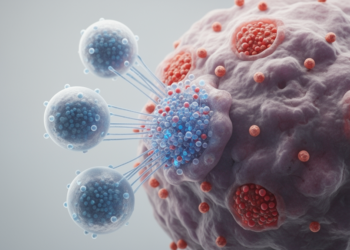
Chimeric antigen receptor cellular therapies have achieved transformative outcomes in selected hematologic malignancies, yet treating solid tumors remains severely constrained by biological and anatomical obstacles. In a comprehensive review published in Immunity and Inflammation, researchers Jia Li and Yanhong Shi analyze how combining chimeric antigen receptor effector cells with engineered oncolytic viruses creates an integrated therapeutic circuit capable of bypassing solid tumor resistance. The authors document that adoptive cell therapies face four primary bottlenecks in solid tumors: target antigen heterogeneity, restricted physical access, functional effector cell exhaustion, and safety limitations. Single-antigen targeting frequently leads to therapeutic failure through Darwinian clonal selection, wherein tumor cells lacking the target antigen survive and expand. Oncolytic viruses provide a biologically distinct, complementary mechanism that selectively infects and lyses tumor cells, releases immunogenic danger signals, and alters the immunosuppressive microenvironment to support chimeric receptor function.
The foundational synergy between oncolytic viruses and chimeric antigen receptor platforms functions through a coordinated multistep process. In the initial phase, oncolytic viruses selectively infect neoplastic cells and trigger immunogenic cell death, debulking the tumor mass and releasing tumor-associated antigens alongside danger-associated molecular patterns such as adenosine triphosphate, high mobility group box 1, and calreticulin, as well as pathogen-associated molecular patterns including viral nucleic acids. The release of these inflammatory signals activates local antigen-presenting cells, including dendritic cells and macrophages, which stimulates the endogenous production of type I interferons, inflammatory cytokines, and chemokine gradients. This coordinated immune remodeling converts an immunologically cold, suppressive microenvironment into an active site of immune amplification. Consequently, transferred effector cells exhibit enhanced trafficking and infiltration into previously impenetrable tumor regions, establishing an engineered circuit where viral oncolysis and targeted cell-mediated cytotoxicity mutually reinforce one another.
To overcome native target antigen scarcity and clonal heterogeneity, investigators are developing synthetic antigen delivery platforms that utilize oncolytic viruses to install artificial targets directly on tumor cells. This strategy decouples tumor selectivity from target antigen selectivity: viral tropism governs where the transgene is delivered, while the chimeric antigen receptor directs cytotoxicity against infected cells. Preclinical studies demonstrated that an oncolytic vaccinia virus carrying a truncated CD19 transgene could uniformly mark solid tumors, rendering them susceptible to clinically validated CD19-directed chimeric antigen receptor T cells. Extending this framework, Li and Shi highlight an engineered vector termed OVDual, which delivers both CD19 and epidermal growth factor receptor variant III antigens into glioblastoma cells. When paired with bispecific effector cells capable of recognizing both targets, this dual-delivery architecture substantially widens target visibility and diminishes the probability of single-antigen escape.
Beyond delivering artificial target antigens, modern oncolytic vectors are engineered to express potent immunomodulatory payloads directly within the tumor microenvironment. Systemic administration of immunostimulatory cytokines often causes severe toxicities, including vascular leak syndrome and cytokine release syndrome, but viral encoding confines payload expression to infected malignant tissue. Researchers have integrated genes for interleukin-7, interleukin-12, interleukin-15, interleukin-21, and granulocyte-macrophage colony-stimulating factor, as well as chemokine ligands such as CCL5, CXCL9, CXCL10, and CXCL11. For instance, an armed oncolytic adenovirus expressing interleukin-7 enhanced B7-H3 CAR-T cell performance in brain tumor models, while vectors expressing CXCL11 established chemokine gradients that improved effector cell homing. Similarly, a membrane-bound cytokine module termed OVmIL15/21 was shown to promote the survival, proliferation, and cytotoxic activity of both bispecific CAR-T and CAR-NK cells while activating brain-resident innate immune compartments, as evidenced by elevated CD68 and IBA1 marker staining.
Viral engineering has also been expanded to deliver localized immune engagers and checkpoint-blocking payloads that modify the local tumor synapse. Oncolytic viruses can act as localized biofactories producing bispecific T-cell engagers, which physically tether effector T cells to neighboring tumor cells independent of the primary chimeric receptor specificity. This transgene expression triggers bystander clearance of antigen-negative tumor variants that might otherwise escape cytotoxic elimination. Concurrently, viral delivery of checkpoint-inhibiting molecules, including antibodies targeting programmed cell death protein 1, programmed death-ligand 1, cytotoxic T-lymphocyte-associated protein 4, and transforming growth factor-beta inhibitors, relieves regional immunosuppression without provoking widespread systemic autoimmune toxicity. Preclinical trials combining bispecific engagers with localized cytokine expression and checkpoint blockade illustrate that single viral vectors can coordinate multifaceted immunological interventions within dense solid masses.
Glioblastoma serves as an informative case study for evaluating oncolytic virus and chimeric cell combination strategies because it embodies the most severe biological hurdles seen in solid cancers. Glioblastoma is characterized by high spatial invasiveness, dense stromal architecture, low baseline lymphocyte infiltration, and pronounced antigen loss. Clinical trials testing CAR-T cells directed against native targets such as interleukin-13 receptor subunit alpha 2, human epidermal growth factor receptor 2, and epidermal growth factor receptor variant III demonstrated initial homing and transient biological responses, but tumors inevitably relapsed through the selective emergence of antigen-negative subclones. Pairing these cell therapies with oncolytic platforms addresses glioblastoma by inducing immunogenic debulking, installing synthetic targets to mitigate antigen escape, and providing local cytokine support to sustain effector function within the suppressive intracranial niche.
While chimeric antigen receptor T cells dominate contemporary research, natural killer cells engineered with chimeric antigen receptors offer unique advantages for solid tumor therapy. Natural killer cells possess intrinsic activating receptors that enable the recognition and lysis of stressed or antigen-low neoplastic cells independent of chimeric receptor binding, reducing the risk of immune escape. Furthermore, allogeneic CAR-NK therapies present a substantially lower clinical risk of inducing graft-versus-host disease or high-grade cytokine release syndrome compared to T-cell platforms. Utilizing off-the-shelf CAR-NK cells derived from human pluripotent stem cells, embryonic stem cells, umbilical cord blood, or established cell lines provides standardized, scalable cellular products that eliminate the logistical delays associated with patient-specific autologous cell manufacturing. However, because natural killer cells exhibit shorter in vivo persistence, pairing them with cytokine-armed oncolytic viruses that supply localized survival signals, such as membrane-bound interleukin-15 and interleukin-21, becomes essential to maintain durable antitumor activity.
Despite the conceptual promise of synthetic antigen delivery, the authors emphasize that clinical translation exposes distinct nongenetic resistance mechanisms. Monotherapeutic chimeric receptor approaches fail primarily through Darwinian clonal selection of pre-existing antigen-negative mutants. In contrast, viral antigen painting trades genetic escape for spatial and immunological exclusion. High interstitial fluid pressure and dense extracellular matrices often restrict viral propagation to the tumor periphery, leaving uninfected inner niches where neoplastic cells continue proliferating free from immune pressure. Concurrently, host humoral immunity poses a formidable barrier: circulating neutralizing antibodies can clear viral vectors before sufficient intratumoral spreading or transgene transcription takes place. If host viral neutralization outpaces effector cell trafficking, the synthetic target coat is lost prior to effective tumor debulking, thereby narrowing the therapeutic window.
The sequence and timing of administration represent critical operational variables that govern combination efficacy. Administering an oncolytic virus 48 to 72 hours before effector cell transfer allows sufficient time for viral infection, replication, and robust transgene expression to establish localized chemotactic gradients. Conversely, simultaneous coadministration risks triggering acute waves of type I interferons that suppress chimeric T-cell proliferation and promote premature effector apoptosis. Protracted delays between interventions allow neutralizing antibodies to prematurely extinguish viral replication, aborting target antigen maintenance. To navigate these complex nonlinear kinetics, investigators utilize ordinary differential equation systems and spatial mathematical modeling to map tumor architecture, viral replication rates, and cytokine decay dynamics, enabling rational scheduling optimization prior to early-phase clinical trial implementation.
Systemic delivery of oncolytic viruses introduces additional translational challenges that researchers are actively countering through biomaterial and cellular engineering. Intravenous administration is frequently compromised by hepatic and splenic sequestration, complement activation, and pre-existing antibody neutralization. To shield viral particles, investigators are testing chemical modifications like polymer coatings, lipid nanoparticles, liposomes, and extracellular vesicles. Cell-mediated transport represents an especially promising modality: mesenchymal stem cells, neural stem cells, macrophages, and even chimeric antigen receptor T cells themselves can serve as carrier vehicles. In this carrier-cell paradigm, effector cells physically transport shielded virions directly into malignant tissue, whereupon viral release remodels the microenvironment to support subsequent cellular cytotoxicity, establishing a mutually reinforcing system.
Safety considerations remain paramount because combining living viral vectors with engineered cellular therapeutics introduces overlapping inflammatory risks that exceed conventional toxicity frameworks. Clinical protocols must actively manage the potential for cytokine release syndrome, immune effector cell-associated neurotoxicity syndrome, off-target viral replication, and severe localized edema, particularly within the closed intracranial compartment in glioblastoma. To mitigate off-target replication, viral vectors incorporate tumor-selective promoters, microRNA detargeting sequences like miR-122 or miR-124, and virulence gene deletions. On the cellular side, multiantigen logic gates, synNotch circuits, affinity tuning, and inducible suicide switches provide tight external control over effector cell activation, ensuring that immune amplification remains confined to malignant tissues.
Ultimately, clinical translation requires robust biomarker guidance and standardized toxicity assessment using established frameworks like the American Society for Transplantation and Cellular Therapy consensus grading criteria. Longitudinal biopsies, circulating tumor DNA, viral shedding evaluations, and spatial transcriptomics will be vital to verify viral replication, transgene transcription, and effector persistence. As an alternative to live replicative vectors, nonreplicative mRNA-loaded lipid nanoparticles are emerging as programmable virus-mimetic systems that transiently express immunomodulatory payloads without provoking neutralizing antiviral immunity. Moving forward, the successful clinical realization of oncolytic virus and chimeric receptor combinations will depend on matching specific modular viral and cellular platforms to the dominant biological barriers of individual solid tumors.
Subject of Research: Engineering strategies combining oncolytic viruses with chimeric antigen receptor therapies for solid tumors
Article Title: When oncolytic viruses get on CAR: a synergic approach for solid tumor immunotherapy
Article References: Li, J., & Shi, Y. (2026). When oncolytic viruses get on CAR: a synergic approach for solid tumor immunotherapy. Immunity & Inflammation, 2(1), Article 36. https://doi.org/10.1007/s44466-026-00055-z
Image Credits: AI Generated
DOI: 10.1007/s44466-026-00055-z
Keywords: Oncolytic Viruses, CAR-T Therapy, CAR-NK Cells, Solid Tumors, Glioblastoma, Antigen Escape, Immunogenic Cell Death, Synthetic Antigens, Cytokines, Chemokines, Bispecific T-Cell Engagers, Tumor Microenvironment, Immunosuppression, Carrier Cells, Translational Medicine, Antiviral Immunity
News Source: Isaac Sutton. (November 17, 2026). Oncolytic Viruses Engineered to Overcome Key Solid Tumor Barriers in CAR Therapy. Scienmag.