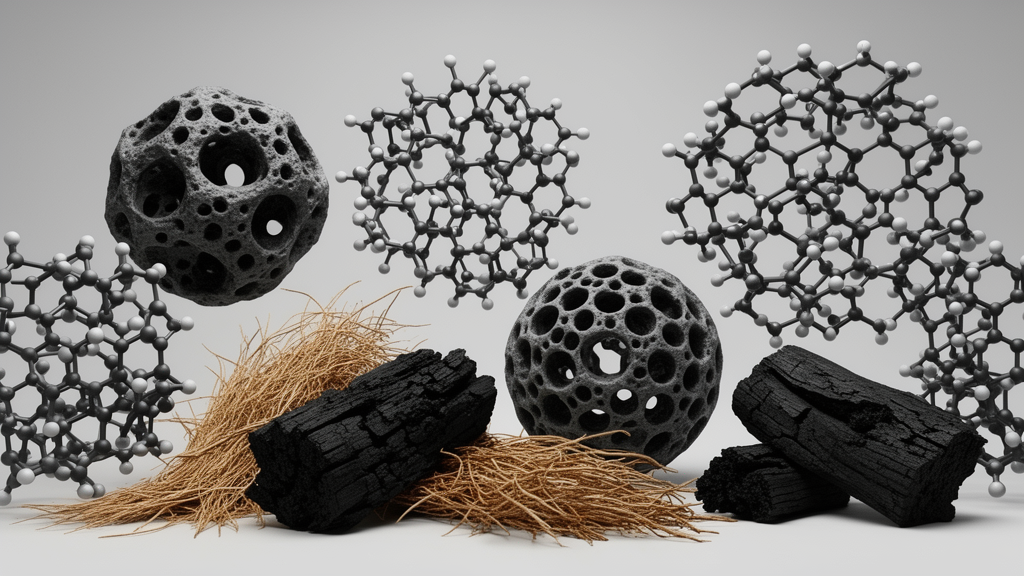
A comprehensive critical review published in Biochar by Noor Ul Huda Altaf, Muhammad Ayyaz, Chanatip Samart, Minyi He, Faizan Ahmad, and Yaning Zhang establishes that biomass-derived carbon nanomaterials cannot be evaluated as uniform substances. While biomass provides an abundant, low-cost alternative to petroleum precursors for energy conversion, energy storage, catalysis, and environmental remediation, researchers face persistent challenges in predicting material performance and establishing reproducible structure-property relationships. The authors demonstrate that the functional behavior of biochar-based carbon nanomaterials does not depend on isolated carbonization parameters or single post-synthesis metrics like total surface area. Instead, material outcomes are governed by an integrated precursor-process-structure-performance framework. The review emphasizes that intrinsic precursor variability directly dictates thermal decomposition pathways, volatile release, and microstructural evolution, requiring systematic standardization across future studies.
The foundational driver of inconsistency in biomass-derived carbon nanomaterials stems from chemical heterogeneity across feedstocks. Lignocellulosic biomass generally contains 35 to 50 percent cellulose, 20 to 35 percent hemicellulose, and 10 to 30 percent lignin, yet these relative proportions vary substantially between woody biomass, herbaceous residues, shells, and agro-industrial wastes. Because each biopolymer follows a distinct pyrolytic degradation pathway, precursor composition determines carbonization chemistry. Thermal decomposition data indicate that hemicellulose-derived xylose degrades across 173 to 690 degrees Celsius, cellulose decomposes between 291 and 395 degrees Celsius, and lignin decomposes across 170 to 835 degrees Celsius while promoting aromatized solid residues. Consequently, feedstocks rich in cellulose and hemicellulose undergo higher devolatilization and generate extensive pore networks, whereas lignin-rich feedstocks yield higher quantities of solid char with condensed aromatic structures.
Beyond major biopolymer fractions, minor constituents and inorganic ash species introduce profound variations in carbonization kinetics and structural rearrangement. Ash composition differs according to plant species, tissue type, geographical origin, soil conditions, cultivation techniques, and post-harvest handling. The presence of inorganic species, particularly alkali and alkaline-earth metals, exerts catalytic or inhibiting effects on thermal degradation, alters tar cracking pathways, influences pore development, and modulates graphitization and defect formation. These mineral constituents cause herbaceous residues and agricultural wastes to carbonize differently from woody feedstocks, despite sharing broadly similar organic contents. Neglecting ash composition leads to misleading structure-property correlations, causing performance gains in adsorption or electrocatalysis to be improperly attributed to the carbon framework rather than the underlying inorganic constituents.
Physical heterogeneity across diverse length scales constitutes another major source of experimental discrepancy. Variations in cell-wall ultrastructure, vascular organization, particle morphology, bulk density, and internal porosity alter heat and mass transfer during carbonization. Particle size and moisture distribution are especially critical variables. In conventional heating, increasing particle size slows heat and mass transfer, generating internal temperature gradients that delay devolatilization and promote secondary char formation. Conversely, in microwave-assisted heating, particle size influences electromagnetic penetration depth. For example, corn-stover particles between 0.5 and 4 millimeters display similar volatile yields under microwave irradiation, whereas particles larger than the penetration depth suffer uneven conversion. Similarly, moisture alters dielectric properties through dipolar polarization, initially increasing microwave absorption in tobacco stems up to approximately 30 percent moisture before water evaporates near 100 degrees Celsius.
Pretreatment protocols and upstream processing steps further magnify experimental variability by altering precursor reactivity prior to thermal carbonization. Preparatory operations such as drying, milling, washing, acid leaching, and hydrothermal conditioning induce measurable transformations in the lignocellulosic matrix. Mechanical milling reduces particle size and enhances heat and mass transfer, improving pore connectivity and increasing specific capacitance by approximately 220 to 350 farads per gram under otherwise comparable processing conditions. Chemical demineralization through acid washing removes alkali and alkaline-earth metals, creating more uniform carbon frameworks and shifting specific surface areas by 20 to 30 percent. Furthermore, hydrothermal pretreatment promotes oxygen-containing functional groups that facilitate subsequent activation, producing hierarchical porous carbons with surface areas exceeding 2000 square meters per gram, demonstrating that conditioning protocols directly shape product properties.
Synthesis pathways strongly govern structural evolution, yet their outcomes remain tightly coupled to the thermal history and chemical nature of the precursor. In conventional pyrolysis under oxygen-limited atmospheres, operating temperature controls devolatilization, aromatization, and electrical conductivity at the expense of solid carbon yield. Increasing pyrolysis temperature from 400 to 900 degrees Celsius in reported systems decreased biochar yield by approximately 19 percent while increasing specific surface area by 17 percent and carbon content by 4.84 percent. At 500 degrees Celsius, wheat straw showed carbon enrichment from 46.16 to 73.01 weight percent, with primary decomposition occurring between 250 and 400 degrees Celsius. In templating strategies, rigid templates such as magnesium oxide produce hierarchical porous carbons with surface areas reaching 1260 to 2684 square meters per gram, while soft-templating copolymers construct mesoporous architectures.
Microwave-assisted pyrolysis provides an advanced conversion route characterized by rapid, selective volumetric heating that converts electromagnetic energy directly into heat. Unlike conventional heating where heat transfers gradually through conduction, microwave processing relies on dielectric properties defined by the loss tangent, where values above 0.5 indicate strong absorbers. Because dry biomass exhibits poor dielectric absorption, susceptors such as biochar, activated carbon, graphite, or silicon carbide are often added to initiate heating. Microwave processing can drive rapid temperature increases, reaching approximately 800 degrees Celsius within 110 seconds, accelerating devolatilization to yield gas fractions up to 73.4 percent with hydrogen yields reaching 190.6 milliliters per gram. However, spatial variations in moisture, minerals, and electric fields can generate localized hotspots, microplasmas, thermal runaway, and pore collapse, highlighting the need for detailed reporting of operating parameters.
To overcome the inherently low surface areas of direct biomass chars, physical and chemical activation strategies are deployed alongside heteroatom doping. Physical activation relies on carbon dioxide or steam gasification, resulting in carbon yields between 8.7 and 18 percent. Chemical activation using potassium hydroxide, phosphoric acid, or zinc chloride promotes condensation-dominated pathways, retaining 30.9 to 43.6 percent solid carbon while yielding surface areas between 1073 and 1145 square meters per gram. Microwave-assisted potassium hydroxide activation at approximately 35 degrees Celsius per minute produced porous carbons with surface areas of 2453.8 square meters per gram, delivering a capacitance of 340 farads per gram and 97.1 percent retention after 20,000 cycles. Furthermore, incorporating heteroatoms like nitrogen, sulfur, or phosphorus redistributes charge, reduces charge-transfer resistance to approximately 0.21 ohms, and achieves reflection losses of minus 63.2 decibels.
In electrochemical energy storage systems such as supercapacitors and batteries, device performance depends on the synergistic coupling of hierarchical pore networks, surface functional groups, and electrical conductivity. Hierarchical porosity optimizes charge storage by providing micropores for ion adsorption and interconnected mesopores or macropores for rapid ion transport. Two-step potassium hydroxide activation of palm kernel shells achieved a specific surface area of 2521 square meters per gram, representing a 47 percent increase over single-step activation, yielding a capacitance of 360 farads per gram and an energy density of 11.38 watt-hours per kilogram in symmetric devices. Graphitic ordering also dictates charge transport; foxtail millet-derived carbon with an intensity ratio of 1.13 achieved 94.9 percent cycling stability after 5000 cycles, while basswood-derived electrodes attained enhanced conductivity at 766 square meters per gram.
For environmental remediation and adsorption, biomass-derived carbons exhibit pollutant-specific uptake mechanisms that cannot be predicted solely from Brunauer-Emmett-Teller surface area values. Adsorption efficiency depends on pore accessibility, pore-size matching, aromaticity, and surface functional groups. A super-activated carbon with 2648 square meters per gram achieved a benzene adsorption capacity of 1419 milligrams per gram. For heavy metals, uptake is governed by ion-specific affinities; an adsorbent derived from waste biomass captured 91.8 milligrams per gram of lead ions but only 20.5 milligrams per gram of copper ions under identical conditions. Similarly, carbon foam adsorbed 1822 milligrams per gram of tetracycline at 500 milligrams per liter concentration, removing 87 percent of tetracycline yet only 29 percent of azithromycin. Furthermore, bismuth tungstate combined with carbon quantum dots achieved 85 percent oxytetracycline degradation within 40 minutes, distinguishing equilibrium adsorption from catalytic degradation.
In catalysis and electrocatalysis, biomass-derived carbons serve as low-cost alternatives to noble metals for oxygen reduction, oxygen evolution, and hydrogen evolution reactions. Electrocatalytic performance involves non-linear trade-offs among hierarchical porosity, graphitic ordering, defect density, and active-site coordination. For oxygen reduction, a rice husk-derived silicon, iron, sulfur, and nitrogen-doped catalyst demonstrated a half-wave potential of 0.89 volts, an onset potential of 0.96 volts, durability exceeding 85 percent after 40,000 seconds, and a power density of 86.2 milliwatts per square centimeter in zinc-air batteries. For oxygen evolution, a rice husk-derived catalyst containing iron oxide exhibited a low overpotential of 260 millivolts at 10 milliamperes per square centimeter with a Tafel slope of 56.93 millivolts per decade. For hydrogen evolution, ruthenium nanoparticles supported on nitrogen-doped carbon dots achieved an overpotential of approximately 10 millivolts at 10 milliamperes per square centimeter.
To resolve these pervasive cross-study discrepancies, the authors advocate for standardized precursor characterization, operando diagnostics, and data-driven machine learning models. Conventional ex situ techniques such as nitrogen gas adsorption and Raman spectroscopy fail to capture dynamic operational changes, closed porosity, or pore connectivity. In sodium-ion battery anodes, closed-pore volume and interlayer spacing dictate sodium storage far more effectively than external surface area. Operando X-ray absorption and electrochemical impedance spectroscopy are necessary to track transient active structures during operation, especially in microwave-synthesized materials subject to localized heating. Furthermore, machine learning architectures, including random forests and neural networks, can integrate complex precursor properties and microwave processing parameters to uncover non-linear structure-performance relationships. Establishing minimum reporting standards that document proximate analysis, carbohydrate-to-lignin ratios, mineral speciation, particle size distributions, and dielectric metrics will enable the biocarbon field to transition toward predictive material design.
Subject of Research: Precursor variability and structure-property relationships in biomass-derived carbon nanomaterials
Article Title: Biochar-based carbon nanomaterials: precursor variability and structure-property heterogeneity for energy-environmental applications
Article References: Altaf, N. U. H., Ayyaz, M., Samart, C., He, M., Ahmad, F., & Zhang, Y. (2026). Biochar-based carbon nanomaterials: precursor variability and structure-property heterogeneity for energy-environmental applications. Biochar, 8(1), Article 141. https://doi.org/10.1007/s42773-026-00655-3
Image Credits: AI Generated
DOI: 10.1007/s42773-026-00655-3
Keywords: Biochar, Carbon Nanomaterials, Biomass Precursors, Pyrolysis, Microwave-Assisted Pyrolysis, Chemical Activation, Heteroatom Doping, Supercapacitors, Electrocatalysis, Oxygen Reduction Reaction, Hydrogen Evolution Reaction, Adsorption, Environmental Remediation, Pore Architecture, Graphitization, Standardized Characterization, Machine Learning
News Source: Charles Cole. (November 16, 2026). Biomass Precursor Variability Shapes Structure and Performance in Biochar Nanomaterials. Scienmag.