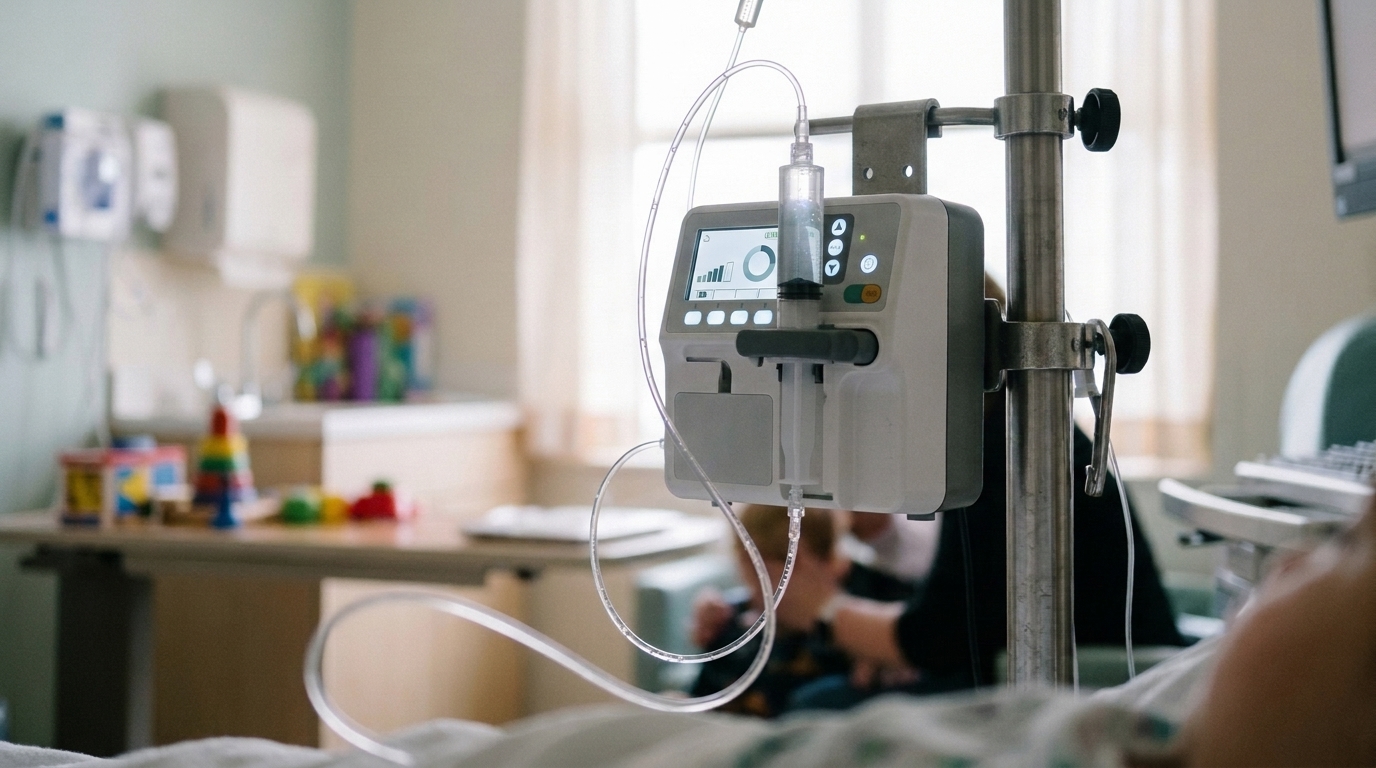
A prospective observational study conducted at Grenoble-Alpes University Hospital has revealed that administering time-dependent beta-lactam antibiotics via continuous infusion significantly reduces the total daily time nurses spend preparing and administering medications in a pediatric intensive care unit, even though it does not measurably alter bedside nurses’ subjective perceptions of their daily workload. Published in Intensive Care Medicine – Paediatric and Neonatal, the single-center before-and-after investigation monitored pediatric critical care operations over an eight-month evaluation window spanning August 2024 through March 2025. By transitioning standard administration pathways from intermittent boluses to continuous infusions for two widely prescribed intravenous antimicrobial agents—cefotaxime and piperacillin/tazobactam—the research team quantified direct operational minutes saved across twenty-four-hour care cycles. Concurrently, deterministic lifecycle and budgetary assessments demonstrated that the protocol cut single-use consumable equipment volumes, producing marked reductions in hospital-related greenhouse gas emissions and medical supply procurement expenditures.
The investigative team framed the protocol shift around the core pharmacological demands and complex pathophysiology encountered when treating severe pediatric infections and sepsis in critical care environments. In intensive care settings, beta-lactam antibiotics represent the leading therapeutic class utilized against severe bacterial pathogens. Because beta-lactams exhibit time-dependent bactericidal action, their clinical efficacy relies predominantly on sustaining unbound free drug plasma concentrations above the pathogen’s minimum inhibitory concentration for approximately forty to seventy percent of the total dosing interval. However, critical illness drastically alters pediatric pharmacokinetics through rapid fluid shifts, expanded volumes of distribution, augmented renal clearance, and variable organ dysfunction. Intermittent intermittent infusions, commonly delivered over thirty minutes, induce sharp peak-and-trough serum fluctuations that frequently cause drug levels to drop below therapeutic thresholds, potentially encouraging treatment failure, clinical deterioration, or the emergence of antimicrobial resistance.
Continuous administration has previously demonstrated clinical advantages in adult septic cohorts by achieving target plasma concentrations more rapidly and consistently, yet pediatric data have historically remained far more limited, typically confined to select populations such as patients with cystic fibrosis, febrile neutropenia, high-minimum-inhibitory-concentration isolates, or children undergoing extrarenal purification. Medication preparation and administration account for a substantial proportion of regular bedside nursing shifts and represent complex tasks where high cognitive and physical workloads can elevate the danger of preparation errors. The trial took place within the specialized sixteen-bed pediatric critical care unit at Grenoble-Alpes University Hospital, an academic center staffed by fifty registered nurses working twelve-hour shifts.
Before January 2025, the unit treated pediatric sepsis patients using intermittent beta-lactam regimens, administering thirty-minute intravenous infusions through programmable electric syringe pumps, specifically Fresenius Kabi Orchestra DPS devices. In January 2025, clinical leaders introduced a unit-wide continuous infusion protocol for cefotaxime and piperacillin/tazobactam, adjusting prescription regimens within the computerized CliniSoft version 6.2 prescribing software and notifying the nursing staff via targeted institutional emails. Intravenous line preparation remained strictly standardized, maintaining identical physical environments and preparation modalities throughout both phases. Because this retrospective evaluation utilized observational data gathered exclusively during customary patient care routines without introducing experimental patient interventions, French ethical authorities waived formal institutional review board approval and individual informed consent under national clinical research legislation.
To evaluate the operational impact on nursing workflows, investigators tracked thirty-six distinct, independent time measurements across various times of day, night, and different days of the week, capturing practical variations among diverse nurses and patients. Observers utilized a dedicated smartphone stopwatch application to record the precise durations of distinct procedural steps, which were subsequently averaged across approximately ten measurements per action. Reconstitution and administration phases were measured individually for each antibiotic, while pre-alarm handling, circuit purge setups, and end-of-infusion management were evaluated across medications. Researchers then multiplied the average completion time for a single administration cycle by the total required daily frequencies to calculate cumulative twenty-four-hour nursing time commitments. Continuous variables were summarized using median and interquartile ranges, and comparisons between administration methods were carried out using robust paired Student’s t-tests, adopting a two-sided alpha threshold of 0.05.
The stopwatch records demonstrated pronounced daily time savings when cefotaxime was administered continuously rather than intermittently. Under intermittent schedules requiring infusions every eight hours—equating to three daily doses—nurses spent an average of nineteen minutes and forty-five seconds managing the antibiotic across twenty-four hours. Continuous infusion decreased this daily requirement to twelve minutes and thirty-two seconds, yielding a statistically significant daily saving of seven minutes and thirteen seconds, or a 36.5 percent reduction in nursing time (p = 0.002). When compared against four-times-daily intermittent schedules delivered every six hours, where daily nursing management consumed twenty-six minutes and twenty seconds, continuous infusion eliminated thirteen minutes and forty-eight seconds of daily labor. This shift represented a 52.4 percent drop in dedicated nursing time (p < 0.001), substantially cutting cumulative hands-on infusion handling across twenty-four-hour periods.
For piperacillin/tazobactam, the observed time savings depended heavily on the baseline intermittent dosing frequency applied in the intensive care unit. When comparing continuous infusion against an intermittent schedule administered every eight hours, the difference between delivery methods did not achieve statistical significance, yielding a p-value of 0.08. Conversely, when compared against an intermittent schedule administered every six hours, continuous administration provided substantial and statistically significant efficiency advantages. Delivering piperacillin/tazobactam intermittently four times daily required twenty-eight minutes and twenty-five seconds of cumulative nursing attention across twenty-four hours. In contrast, continuous infusion required only fifteen minutes and twelve seconds, generating a net daily reduction of thirteen minutes and thirteen seconds, which corresponds to a 46.5 percent overall reduction in nursing manipulation time (p = 0.01).
Despite the chronometer-documented operational time savings, bedside healthcare workers did not perceive a tangible reduction in their daily subjective workload. The research team evaluated subjective staff experiences using an unvalidated four-item questionnaire administered via Google Forms in November 2024 prior to implementation, followed by a repeat assessment in February 2025, two months after the continuous protocol was initiated. The surveys had completion rates of 62 percent (thirty-seven nurses) pre-implementation and 55 percent (thirty-three nurses) post-implementation, recording responses on a zero-to-ten Likert scale. Average agreement with the assertion that antibiotic management represented a significant portion of nursing workload remained unchanged, shifting from 6.8 (standard deviation 2.1) before implementation to 6.7 (standard deviation 1.4) afterward (p = 0.65). Similarly, ratings regarding whether the protocol lightened physical workload averaged 6.1 before versus 6.3 after (p = 0.70).
Further survey metrics indicated no notable shift in perceived safety or administrative overhead among bedside critical care nurses. Perceptions of whether the protocol actively reduced medication error risks scored an average of 5.3 before implementation compared with 5.5 following the transition (p = 0.83). Ratings evaluating whether the continuous approach simplified electronic documentation and administrative tasks dropped slightly from 6.4 to 5.7, though this change did not reach statistical significance (p = 0.18).
Beyond procedural timing, the researchers evaluated the environmental consequences of transitioning administration strategies using the Carebone lifecycle assessment model from Assistance Publique – Hôpitaux de Paris and Ecovamed pharmaceutical greenhouse gas metrics. The model combined physical activity data, including syringe and tubing counts, with established emission factors aligned with ISO 14040/14044 standards to calculate global greenhouse gas impacts expressed in kilograms of carbon dioxide equivalent. Accounting for syringe pump electrical power demands ranging between ten and fifteen watts—active for four hours intermittently versus twenty-four hours continuously—the deterministic analysis demonstrated consistent carbon reductions. In sensitivity analyses varying emission factors by thirty percent, continuous administration maintained lower emissions across all scenarios, showing combined worst-case ranges of 2.16 to 4.00 kilograms of carbon dioxide equivalent compared with 4.45 to 8.26 kilograms for intermittent dosing every six hours. Piperacillin/tazobactam vials accounted for approximately sixty-five percent of overall carbon emissions.
Economic analyses based on institutional purchase prices mirrored the environmental results, showing clear cost savings under continuous infusion protocols. Deterministic sensitivity testing revealed that continuous delivery remained less expensive across every evaluation scenario, generating combined worst-case daily expenditure ranges of €2.95 to €5.48, compared with €6.06 to €11.25 for intermittent six-hourly administration. Drug vials represented approximately sixty percent of total expenditures, while fifty-milliliter bags of 0.09 percent normal saline diluent represented twenty-two percent. Although the authors cautioned that institutional purchasing contracts cannot be directly generalized to other health systems and that indirect expenses like waste logistics were omitted, the findings confirm distinct financial and ecological advantages alongside procedural time savings in pediatric critical care.
Subject of Research: Continuous versus intermittent beta-lactam antibiotic administration in pediatric critical care
Article Title: The impact of continuous vs. intermittent antibiotic administration on nursing workload, carbon footprint and costs in pediatric critical care
Article References: Guinamard, F., Dessel, M., Dransart, C., Arata-Bardet, J., Maisonneuve, E., & Mortamet, G. (2026). The impact of continuous vs. intermittent antibiotic administration on nursing workload, carbon footprint and costs in pediatric critical care. Intensive Care Medicine – Paediatric and Neonatal, 4(1), Article 33. https://doi.org/10.1007/s44253-026-00142-4
Image Credits: AI Generated
DOI: 10.1007/s44253-026-00142-4
Keywords: pediatric intensive care, continuous infusion, intermittent administration, beta-lactam antibiotics, cefotaxime, piperacillin-tazobactam, nursing workload, preparation time, carbon footprint, hospital costs, syringe pumps, pediatric sepsis, pharmacokinetics, Grenoble-Alpes University Hospital, environmental lifecycle assessment, healthcare sustainability
News Source: Harold Sullivan. (November 16, 2026). Continuous Pediatric Antibiotic Infusions Reduce Preparation Time Without Altering Perceived Workload. Scienmag.