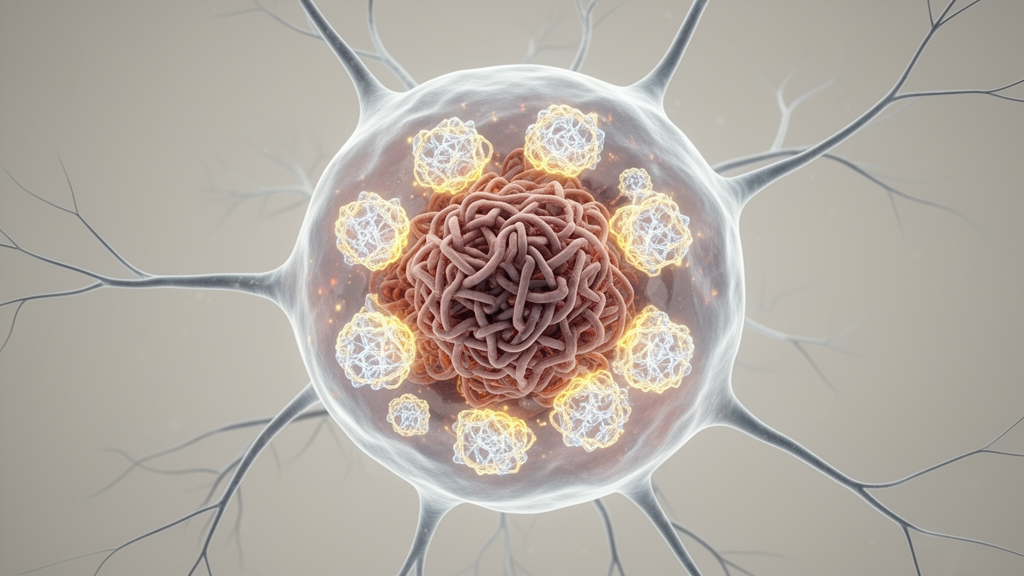
New research identifies a critical age-associated axis in human astrocytes that links the progressive loss of chromatin accessibility to the accumulation of non-canonical DNA structures known as G-quadruplexes. The study, published in Genome Biology, investigated the role of G-quadruplexes—stable, guanine-rich DNA and RNA structures—in the context of brain aging, where genome organization and transcriptional fidelity often decline.
The study employed advanced imaging techniques, including N-TASQ and BG4, to visualize and measure G-quadruplex abundance. Researchers consistently observed increased G4 signals in astrocytes sourced from older donors, which occurred in tandem with a measurable reduction in nuclear DDX5 expression. Using ATAC-seq profiling, the team mapped changes in chromatin accessibility across the genome. Their results demonstrated an age-associated decline in openness within intergenic, intronic, and promoter-proximal regions, suggesting that the aging process significantly restricts the chromatin landscape in these critical glial cells.
Further investigation using genome-wide mapping by G4 CUT&Tag identified that these G-quadruplexes are not distributed randomly but show focal enrichment at specific genetic loci in older astrocytes. This enrichment occurs in both accessible and less accessible chromatin regions. To explore the causal relationship between DDX5 and these structural changes, the researchers manipulated DDX5 levels in younger astrocytes. When DDX5 was depleted in these cells, they observed focal G4 accumulation, although this depletion did not fully replicate the comprehensive chromatin accessibility changes seen in natural aging. Conversely, overexpressing DDX5 in young astrocytes resulted in transcriptional shifts in pathways essential for chromatin organization, genome maintenance, stress signaling, and synaptic function.
By defining the axis linking reduced DDX5, focal G4 abundance, and progressive chromatin closure, the study provides a new candidate mechanism for understanding how aging disrupts astrocyte function at the molecular level.
Subject of Research: Molecular mechanisms of astrocyte aging and G-quadruplex regulation
Article Title: Human astrocyte aging couples chromatin closure to focal G-quadruplex accumulation
Article References: M. J., V. K., Escarcega, R. D., Wheeler, E., Tandon, N., Monchaud, D., Hartl, C., & Tsvetkov, A. S. (2026). Human astrocyte aging couples chromatin closure to focal G-quadruplex accumulation. Genome Biology. https://doi.org/10.1186/s13059-026-04330-5
Image Credits: AI Generated
DOI: 10.1186/s13059-026-04330-5
Keywords: Astrocyte, Aging, G-quadruplex, Chromatin, DDX5, Genome Biology, Epigenetics, Neurobiology, ATAC-seq, Transcriptional Fidelity, DNA Structure, Genome Organization, Cellular Senescence, Helicase, Gene Regulation
News Source: Beatrice Stafford. (November 16, 2026). Astrocyte Aging Linked to Chromatin Closure and G-Quadruplex Accumulation. Scienmag.