Aerospace engineering researchers have developed a novel physics-informed deep learning architecture, the Deep Lattice Cross Network, to predict unsteady aerodynamic forces on morphing aircraft while strictly maintaining physical monotonicity. Created by Jiachi Zhao, Lifang Zeng, Aoxue Lin, and Xueming Shao, the framework resolves a persistent limitation in data-driven aerodynamic modeling, where unconstrained neural networks produce unphysical fluctuations during flight transitions. By embedding mathematical monotonicity constraints into network layers, the team demonstrated that deep learning can rapidly forecast unsteady lift and drag coefficients without violating fluid mechanics principles. Published in Advances in Aerodynamics, the study demonstrates that enforcing monotonicity prevents non-physical predictions during wing unfolding while improving overall numerical accuracy across diverse operating conditions.
The foundational physical phenomenon motivating the investigation is the monotonic relationship between an aircraft’s lift coefficient and its angle of attack within the stalling range. In classical aerodynamics, aerodynamic lift consistently increases as the angle of attack rises prior to stall. While this represents an established physical trend, existing machine learning models applied to aerodynamic parameter estimation routinely overlook monotonicity constraints. When treated as standard unconstrained regression algorithms, deep networks frequently behave like opaque black boxes, yielding erratic outputs and lacking physical interpretability. For morphing aircraft whose surfaces alter configuration mid-flight, unphysical predictions compromise flight dynamics modeling and control system design, underscoring the necessity of embedding authentic physical laws directly into deep learning prediction pipelines.
To evaluate their approach on a demanding physical problem, the researchers examined a three-dimensional morphing aircraft designed for launch from a mother platform. The vehicle comprises a fixed fuselage, folding wings, and twin V-tails. During carriage, the wings remain folded under the fuselage belly. Following launch, the wings unfold rapidly in mid-air through an open V-style motion to establish steady flight. In low-speed regimes, the wings adopt a nearly straight posture with low sweep, whereas during high-speed cruise they morph into higher sweep angles according to velocity. Because aerodynamic forces and moments vary unsteadily throughout this wing transformation, establishing accurate dynamic models is essential for sizing actuators and designing flight control systems.
To generate a reference database, the team performed computational fluid dynamics simulations using ANSYS Fluent 2019 R1. Numerical calculations solved compressible Reynolds-Averaged Navier-Stokes equations using the finite volume method and the k-omega shear stress transport turbulence model. The dynamic unfolding was discretized using structured overset meshes containing 4.46 million cells distributed across five sub-blocks: one for the fuselage, two for the wings, and two for the tails. The domain featured an inner structured zone and an outer unstructured far-field region set to pressure far-field boundary conditions at Mach 0.4, with no-slip wall conditions on aircraft surfaces. Wind tunnel testing using a 50% scaled model under Mach 0.4 inflow at unfolding angles of 0°, 30°, 60°, and 90° under angles of attack of 4° and 8° validated the accuracy of the CFD method.
The simulation dataset captured 201 time points over a two-second morphing sequence using a temporal resolution of 0.01 seconds. The training set comprised nine flow cases at angles of attack of -4°, -2°, 1°, 2°, 4°, 6°, 8°, 10°, and 12°. To test interpolation accuracy, the researchers selected testing cases at 3° and 9°, while extrapolation capability was evaluated at -5° and 14°. In addition, two extreme negative angles of attack at -10° and -15° were evaluated to verify whether the models sustained physical monotonicity trends. The resulting dataset defined three input parameters for the deep learning model: angle of attack, morphing time, and wing unfolding angle. The network’s target outputs were the unsteady lift and drag coefficients recorded continuously across the unfolding transient.
Situating their methodology within physics-informed machine learning, the authors reviewed strategies for integrating physical laws into neural networks. Foundations established by Raissi and colleagues with physics-informed neural networks demonstrated that partial differential equations could serve as regularizers. In fluid mechanics, related works applied Bayesian methods, hidden fluid mechanics models for extracting velocity and pressure fields from images, and structured networks for flow simulations. Beyond differential equations, researchers emphasized embedding algebraic inequalities and physical constraints. Early monotonic architectures clamped weights to non-negative values, but this restricted expressiveness. Later innovations introduced monotonic linear embeddings, min-max pooling, and lattice regression tables with linear inequality constraints. Deep Lattice Networks subsequently combined linear embeddings, calibrators, and lattice ensembles, providing a foundation that the authors modified for aerodynamic modeling.
The resulting Deep Lattice Cross Network utilizes a Multi-Task Learning framework configured to reflect the physical divergence between aerodynamic coefficients. In the morphing aircraft flow field, the lift coefficient increases monotonically with angle of attack within the stalling range, whereas the drag coefficient exhibits complex non-monotonic variations. To capture these behaviors, the architecture separates inputs according to their physical roles. Morphing time and unfolding angle are processed through a shared bottom multilayer perceptron, designated NShare, which feeds intermediate representations into two task-specific shared towers: NCl for lift and NCd for drag. Meanwhile, the angle of attack is routed independently. For drag prediction, it enters a dedicated multilayer perceptron, Nalpha, before combining with NCd in a Cross Layer. For lift prediction, it is routed into a specialized Lattice Layer, whose outputs undergo an inner product operation with NCl features.
Monotonicity in lift prediction is preserved through three sequential modules within the Lattice Layer: the Monotonic Embedding Layer, the Calibration Layer, and the Ensemble of Lattices Layer. The Monotonic Embedding Layer contains no hidden layers or activation functions, applying linear mapping whose weight matrices are constrained to non-negative values. This layer projects the single angle of attack input into an expanded feature space. Subsequently, the Calibration Layer executes one-dimensional piecewise linear transformations bounded over normalized output ranges. Linear inequality constraints enforce that key-point values increase monotonically across adjacent coordinates. Finally, the Ensemble of Lattices Layer employs three-dimensional lattices that interpolate transformed features using multilinear interpolation over hypercube vertices. By constraining adjacent look-up table parameters to be strictly ascending, the partial derivative with respect to angle of attack remains strictly positive, ensuring unconditional monotonicity.
For the drag coefficient, where physical monotonicity does not apply, the architecture avoids monotonic restrictions and instead relies on the Cross Layer to model feature interactions under limited training data. The Cross Layer evaluates concatenated representations from Nalpha and NCd through an explicit formulation composed of a bilinear product component, a linear mapping component, and a scalar bias term. By computing pairwise feature products across concatenated vectors, this module effectively fuses external flow conditions with structural wing parameters while preventing sparse training data from causing severe overfitting. Maintaining an unconstrained formulation for the drag branch allows the neural network to preserve predictive adaptability where physical forces exhibit non-monotonic behavior, ensuring that monotonicity constraints are applied exclusively to aerodynamic parameters where physical theory rigorously justifies them.
To address optimization friction arising from divergent objective functions, the researchers developed a two-phase training strategy. Experimentation revealed that training both coefficients simultaneously made balancing loss functions difficult, as the drag coefficient required Mean Absolute Percentage Error to optimize relative error, while the lift coefficient converged best using Mean Absolute Error. In Phase 1, the model trained parameters associated with drag prediction—specifically the weights of NCd and NShare—using Mean Absolute Percentage Error. Once Phase 1 converged, those shared and drag parameters were frozen. In Phase 2, the network trained the remaining lift prediction weights within NCl and the Lattice Layer using Mean Absolute Error. Optimization was conducted using the Adaptive Moment Estimation algorithm in TensorFlow with a learning rate of 0.001, a batch size of 64, and Leaky ReLU activations across 1000 epochs.
Model validation on fifty random samples demonstrated close agreement between computational fluid dynamics simulations and Deep Lattice Cross predictions for both aerodynamic coefficients. Subsequent evaluations on unseen test datasets demonstrated low prediction errors across the complete unfolding sequence for interpolation cases at 3° and 9° and extrapolation cases at -5° and 14°. Comparative performance assessments compiled in Table 1 established that the Deep Lattice Cross Network achieved the highest accuracy among tested architectures. Specifically, the model reduced the summed Mean Absolute Percentage Error of lift and drag coefficients by approximately 1.3% compared to the Multi-Task Cross model, and by approximately 4% compared to a standard multilayer perceptron. Furthermore, at unfolding time nodes of 0.5, 1.0, and 2.0 seconds, the model accurately reproduced the variation of lift, drag, and lift-to-drag ratio K against angle of attack, predicting the maximum efficiency angle.
Extended monotonicity testing over a broader angle of attack spectrum down to -15° revealed the decisive advantage of the architectural constraints. Within the nominal training interval from -5° to 14°, both the proposed model and the unconstrained Multi-Task Cross model exhibited monotonic lift trends. However, in the unobserved negative regime between -15° and -5°, computational fluid dynamics confirmed that true aerodynamic lift maintained a monotonic increase. Under these conditions, the unconstrained baseline model displayed pronounced non-monotonic distortions during initial unfolding stages, whereas the Deep Lattice Cross Network maintained consistent physical monotonicity throughout. Despite this robustness, the authors noted an important limitation: generalization accuracy at extreme negative angles of attack of -10° and -15° requires further refinement. The researchers concluded that embedding physical monotonicity successfully bridges the gap between deep learning accuracy and aerodynamic credibility, offering an adaptable framework for multi-component aircraft design systems.
Subject of Research: Physics-informed deep learning for aerodynamic force prediction on morphing aircraft
Article Title: Deep learning prediction method for aerodynamic forces on morphing aircraft considering physical monotonicity
Article References: Zhao, J., Zeng, L., Lin, A., & Shao, X. (2025). Deep learning prediction method for aerodynamic forces on morphing aircraft considering physical monotonicity. Advances in Aerodynamics, 7(1), Article 7. https://doi.org/10.1186/s42774-024-00197-x
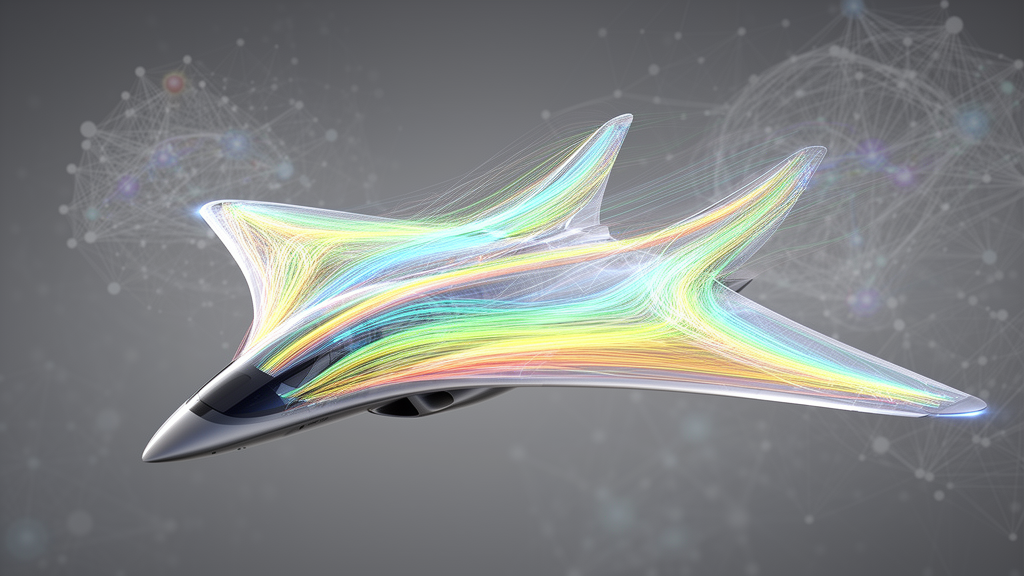
Image Credits: AI Generated
DOI: 10.1186/s42774-024-00197-x
Keywords: aerodynamic force prediction, morphing aircraft, Deep Lattice Cross Network, physical monotonicity, lift coefficient, drag coefficient, computational fluid dynamics, Reynolds-Averaged Navier-Stokes, k-omega SST, structured overset mesh, wind tunnel validation, multi-task learning, two-phase network training, Monotonic Embedding Layer, Calibration Layer, Ensemble of Lattices Layer, angle of attack
News Source: Blake Davidson. (November 14, 2026). Monotonic Deep Learning Model Accurately Predicts Unsteady Forces on Morphing Aircraft. Scienmag.