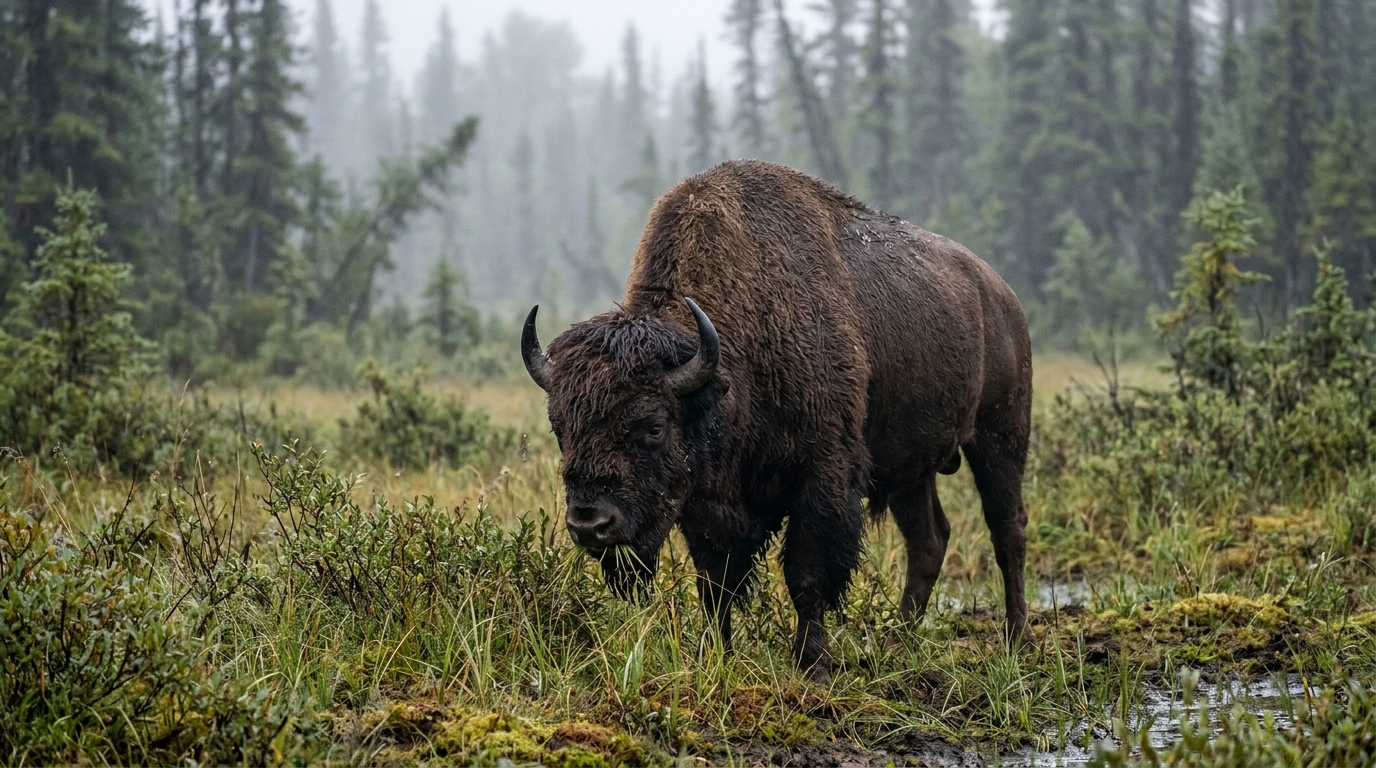
Hidden Markov models applied to animal tracking records performed no better than random guessing when classifying wood bison activity, according to an empirical validation study published in Movement Ecology. Researchers Peter R. Thompson, Lee J. Hecker, Scott E. Nielsen, and Mark A. Edwards tested the accuracy of behavioral states inferred by statistical models against direct field observations of wood bison (Bison bison athabascae). Their findings provide cautionary evidence regarding the common practice of relying on automated movement classifications to infer animal behaviors from tracking data.
Hidden Markov models are widely used as an important analytical tool for isolating animal behavior using location telemetry. A common application of these statistical models involves classifying the movements of tracked individuals into distinct behavioral states. In ecological research and management, the behavioral categories and conclusions derived from such models can have important management implications, particularly when different places visited by an animal are associated with different behaviors. However, potential methodological pitfalls can limit the reliability of these behavioral inferences.
To evaluate the reliability of these model-derived classifications against field evidence, the researchers examined telemetry data collected from wood bison in northern Alberta, Canada. The investigation utilized tracking data gathered from global positioning system collars deployed on forty-seven individual bison over a four-year period.
The research team established in-situ behavioral classifications by directly recording field observations of tracks and physical signs left by the collared bison in the study area. When coupled with the corresponding global positioning system tracks, these classifications enabled a direct comparison between the true behavior observed at a given location and the movement patterns identified independently by the hidden Markov models.
The comparative evaluation demonstrated that hidden Markov models were no better than random guessing at classifying the activity of the tracked wood bison. The authors noted that this modeling outcome had direct implications for behavior-specific habitat selection analyses that partitioned animal locations into presumed behaviors.
The authors reported that the indistinct nature of bison behaviors, as observed in tracking data with ninety-minute sampling intervals, likely explains why behavior classification by hidden Markov models was significantly lower than for many aquatic or aerial species.
The authors concluded that their work corroborates findings from existing studies on similar animals sampled at similar frequencies. By demonstrating that hidden Markov models failed to exceed random chance in classifying bison activity under these sampling conditions, the investigation raises important concerns about how hidden Markov models should be applied to animal movement data in ecological studies.
Subject of Research: Validation of hidden Markov models for animal behavior classification in wood bison
Article Title: Validating HMM-derived behavioral states against field observations in wood bison (Bison bison athabascae): cautionary evidence from tracking data
Article References: Thompson, P. R., Hecker, L. J., Nielsen, S. E., & Edwards, M. A. (2026). Validating HMM-derived behavioral states against field observations in wood bison (Bison bison athabascae): cautionary evidence from tracking data. Movement Ecology. https://doi.org/10.1186/s40462-026-00710-5
Image Credits: AI Generated
DOI: 10.1186/s40462-026-00710-5
Keywords: wood bison, Bison bison athabascae, hidden Markov models, animal tracking, GPS telemetry, behavioral classification, behavior-specific habitat selection, Movement Ecology, northern Alberta, telemetry data, sampling intervals, field observations, animal movement data, wildlife tracking collars, in-situ behavioral classification, habitat selection analysis
News Source: Drew Townsend. (November 17, 2026). Hidden Markov Models Match Random Guessing in Classifying Wood Bison Behavior. Scienmag.