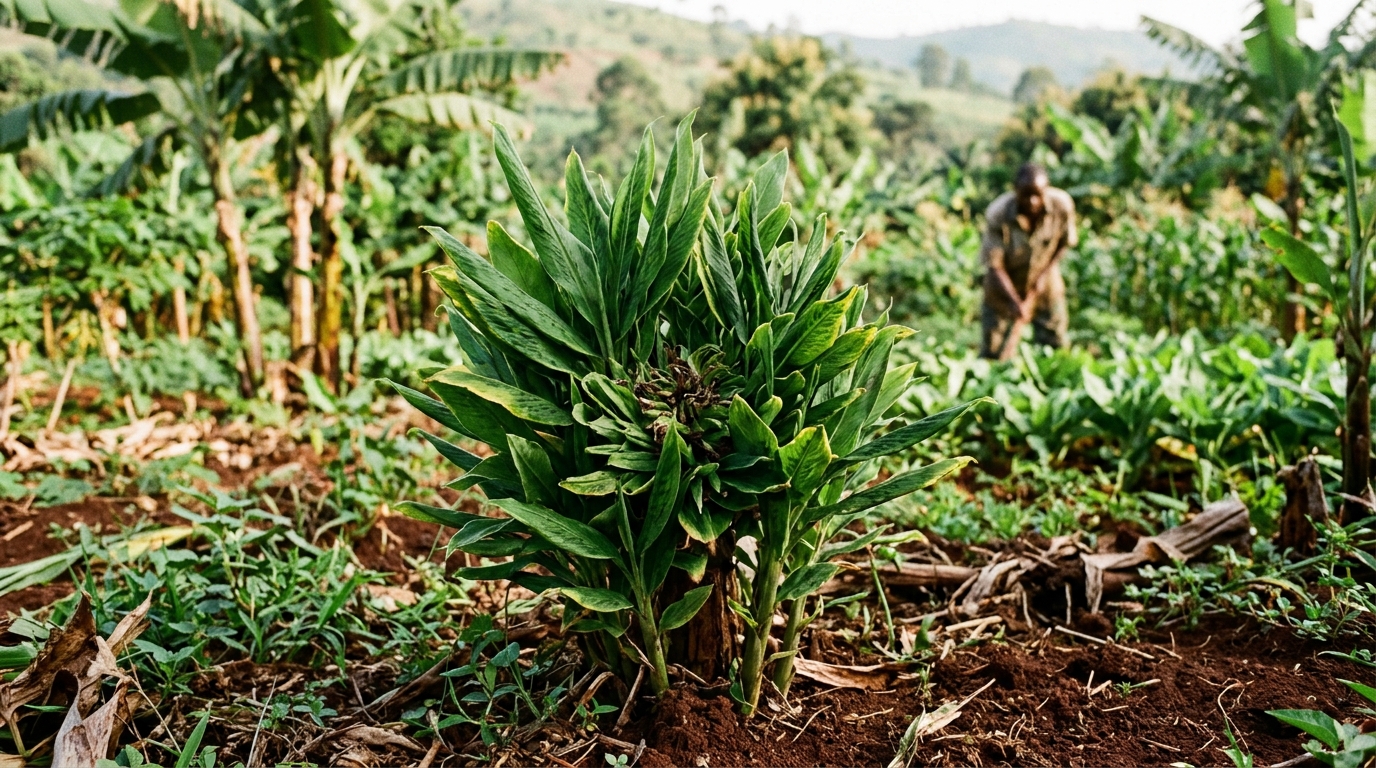
A cross-sectional investigation of smallholder farming communities in the Kigoma Region of western Tanzania has established that Banana Bunchy Top Disease inflicts catastrophic economic devastation, triggering an average annual income loss of approximately 1.3 million Tanzanian shillings per farming household, representing an approximate ninety percent collapse from pre-infection baseline revenues. Published in Discover Agriculture by a multidisciplinary research team led by Martin Komba, the study provides the first formal household-level economic quantification of the viral epidemic within an African smallholder agricultural system. While previous agronomic evaluations established that the pathogen routinely causes eighty to one hundred percent yield loss in affected crops, broader household economic impacts and farmer behavioral dynamics had remained unmeasured across regional supply chains. Drawing upon empirical surveys spanning 121 randomly selected smallholder households across two severely impacted district councils, the researchers revealed that the viral outbreak not only induces near-total income collapse among vulnerable rural households but also exposes a profound collective action failure in disease management.
Bananas serve as an indispensable staple crop across tropical regions, providing essential nutrition to approximately 400 million individuals globally while supplying crucial dietary potassium alongside vitamins A and C. In Tanzania, bananas rank among the top three staple foods, nourishing approximately thirty percent of the national population with an annual per-capita consumption of around 280 kilograms that delivers between 2,700 and 2,800 kilojoules daily per person. Despite this dietary centrality, productivity has suffered from a prolonged yield gap; while national banana acreage expanded significantly between the 1960s and 1990s, yields stagnated under five metric tons per hectare, falling far below potential limits of seventy tons per hectare. This shortfall has been intensified by pests, soil degradation, and fungal diseases. Recently, Banana Bunchy Top Disease, caused by the aphid-transmitted Banana Bunchy Top Virus within the genus Babuvirus, has emerged as an acute threat, spreading from its 2020 arrival in Kigoma into ten additional Tanzanian regions.
To explain how this plant epidemic reshapes household livelihoods and technology adoption under crisis, the researchers integrated four complementary economic frameworks. The household welfare and poverty dynamics framework conceptualizes disease incursions as exogenous negative income shocks that deplete production, testing whether asset-poor families without access to credit slip into persistent poverty traps. Concurrently, the Technology Acceptance Model, Theory of Reasoned Action, and Theory of Planned Behavior were applied to evaluate how farmer perceptions of usefulness, ease of application, attitudes, and behavioral control govern disease containment choices. Behavioral economics perspectives further illuminated how cognitive barriers, including loss aversion and time inconsistency, cause farmers to resist uprooting productive banana mats because upfront eradication costs outweigh distant future gains. Finally, the collective action framework accounted for positive externalities in viral management: because individual roguing suppresses the broader community inoculum pool, private adoption incentives often diverge from optimal village-level welfare, causing systematic underinvestment in disease prevention.
The study focused on Buhigwe and Kigoma District Councils in Kigoma Region along Lake Tanganyika, where the viral disease was first identified and reached epidemic intensity. Using a multistage sampling design based on Cochran’s formula and village agricultural registers, the researchers surveyed 121 randomly selected banana-farming households across six wards: Buhigwe, Mwayaya, and Muhinda in Buhigwe District, and Kalinzi, Nyarubanda, and Mkigo in Kigoma District. Quantitative household interviews were paired with twelve gender-separated Focus Group Discussions and six Key Informant Interviews with agricultural professionals. To minimize recall bias across multi-year reporting, enumerators utilized a structured recall protocol anchored to the 2020 COVID-19 movement restrictions as a shared temporal benchmark, cross-referencing pre-outbreak figures against official district statistics. Diagnostic precision was maintained by presenting visual photographic guides of bunchy top rosetting, petiole streaking, and leaf hooking to all participants, with visual identifications confirmed by plant pathologists at the Tanzania Agricultural Research Institute Maruku station.
To rigorously evaluate income differentials and behavioral choices, the authors implemented a two-step quantitative analytical strategy. First, changes in annual banana sales before and after the epidemic were examined using paired sample t-tests and corroborated through non-parametric Wilcoxon signed-rank tests to address non-normal data distributions. Because viral exposure was not assigned randomly across farms, the authors deployed Two-Stage Weighted Regression combining propensity score matching with weighted regression. The first stage utilized nearest-neighbor matching with replacement and a 0.05 caliper to balance observable baseline covariates between impacted and unimpacted households, successfully eliminating four off-support outliers and reducing mean covariate bias from 23.0 percent down to 2.8 percent. The subsequent weighted regression estimated the average treatment effect of the disease on sales changes. Finally, a Mixed Multinomial Logit model evaluated farmer adoption across four distinct options—no adoption, roguing alone, clean planting materials alone, and combined adoption—accounting for unobserved farmer heterogeneity.
The econometric results confirmed an overwhelming decline in farm revenue directly attributable to the virus. Paired sample tests indicated an average drop of 1,297,925 Tanzanian shillings per acre per season between pre-disease and post-disease periods (t = 3.5753, p < 0.001; Wilcoxon Z = -4.82, p < 0.001), indicating substantial economic loss. In the Two-Stage Weighted Regression, impacted growers experienced an estimated net reduction in banana sales of 401,277.10 Tanzanian shillings relative to unimpacted peers, holding other factors constant. The models demonstrated that human capital significantly mitigated these losses: each additional year of formal education increased banana sales by 197,128.42 Tanzanian shillings, while each additional year of farming experience contributed an average increase of 203,401.21 Tanzanian shillings. Geographic differences also proved statistically influential: farmers in Buhigwe District experienced a significantly steeper sales drop of 141,420.59 Tanzanian shillings compared to those in Kigoma District, reflecting the earlier introduction and higher local viral density.
The disease shock provoked marked reductions in land allocated to banana cultivation and generated pervasive dietary hardship across rural communities. Cultivated banana acreage dropped significantly by an average of 2.061 hectares in Buhigwe District and 1.992 hectares in Kigoma District, as farmers converted failing groves into annual staples such as maize and cassava. A striking 87.6 percent of surveyed households reported substantial dietary changes caused by banana shortages, substituting bananas with maize and cassava flour prepared as ugali. This staple substitution carries serious nutritional trade-offs, reducing caloric and micronutrient intake. Furthermore, an estimated 65 percent of households reduced food consumption, eating smaller portions and fewer meals daily, with children disproportionately affected. As losses deepened, affected families turned to damaging distress coping strategies, including liquidating productive farm assets, accumulating high-interest debt through informal borrowing, and withdrawing children from school, illustrating how localized crop failures undermine long-term household health, educational attainment, and economic stability.
Stratified welfare decomposition revealed that while proportional income losses were relatively uniform across income groups—ranging from 88 to 93 percent—the ultimate welfare consequences were distributed unevenly. For the poorest quartile of households, an annual revenue loss of 165,000 Tanzanian shillings from a baseline of 180,000 shillings caused an almost complete wipeout of income, plunging families into deep poverty traps where remaining earnings fall far beneath the international poverty threshold of 3.00 US dollars daily. However, the epidemic also severely compressed the broader income distribution: seventy-one percent of households in the highest income quartile fell below the poverty line following infection, alongside 89 to 97 percent across poorer quartiles. Landholding size served as a critical asset buffer, with micro-scale farms under 0.5 hectares facing near-total poverty entry, whereas larger farms retained modest residual revenues. Similarly, female-headed households experienced slightly higher post-outbreak poverty rates due to lower pre-existing baseline wealth rather than greater vulnerability to disease damage.
Analysis of disease management exposed a stark collective action failure: while 63.64 percent of farmers practiced roguing by uprooting infected mats, only 9.00 percent adopted clean planting materials, and 23.00 percent took no protective action. This 54.6 percentage point divergence reflects underlying behavioral dynamics: roguing secures immediate private benefits by clearing infected plots, whereas clean materials deliver positive externalities by suppressing community-wide viral reservoirs. Multinomial logit regressions indicated that female farmers were significantly more likely to adopt all control measures, implementing practices at two to three times the rate of male farmers despite representing only 21.49 percent of respondents. Adoption was also positively associated with formal education, available household labor, farm income, and extension visits by agricultural professionals. Conversely, larger household size was negatively associated with roguing, indicating that households heavily dependent on bananas face intense loss aversion, finding it difficult to destroy standing food plants despite long-term epidemiological recommendations.
They outline actionable recommendations for Tanzanian authorities, urging the Tanzania Agricultural Research Institute, the Tanzania Plant Health and Pesticides Authority, and extension agencies to expand community-based macro-propagation nurseries, deploy targeted training programs that leverage female farmers as high-return adoption leaders, and institute coordinated village surveillance networks. The authors note several methodological limitations, including the reliance on cross-sectional recall data, potential unobserved selection bias in propensity matching, and geographic focus on two initial outbreak districts. Nevertheless, their findings demonstrate that reversing the viral crisis in East African smallholder agriculture requires resolving economic poverty traps, behavioral loss aversion, and collective action barriers alongside plant pathology interventions.
Subject of Research: Economic impacts and behavioral drivers of banana viral disease management in Tanzania
Article Title: Economic impacts, household vulnerability, and behavioral determinants of Banana Bunchy Top Disease management among smallholders in Kigoma Region, Tanzania
Article References: Komba, M., Nkokelo, U., Kiruwa, F. H., Ouedraogo, R., Magomere, K., Lukosi, G., Joseph, S., & Shimwela, M. (2026). Economic impacts, household vulnerability, and behavioral determinants of Banana Bunchy Top Disease management among smallholders in Kigoma Region, Tanzania. Discover Agriculture, 4(1), Article 331. https://doi.org/10.1007/s44279-026-00794-y
Image Credits: AI Generated
DOI: 10.1007/s44279-026-00794-y
Keywords: Banana Bunchy Top Disease, Babuvirus, agricultural economics, smallholder farming, Tanzania, plant pathology, behavioral economics, collective action, crop disease management, Economic, impacts, household
News Source: Alan Morgan. (November 6, 2026). Banana Bunchy Top Virus Inflicts Severe Economic Losses on Tanzanian Farmers. Scienmag.