Textile factories around the world discharge some of the most stubborn pollutants in modern industry: synthetic dyes engineered to resist light, heat and chemical attack. A comprehensive review now maps how a copper-containing enzyme called laccase, when redesigned in the laboratory and anchored onto functional carrier materials, can break down these dye molecules more efficiently than ever before, while also warning that most of the evidence still comes from laboratory-scale experiments rather than real treatment plants.
The review, published in Bioresources and Bioprocessing, takes an unusual cross-scale perspective. Instead of treating enzyme discovery, protein engineering and immobilization as separate fields, it links dye molecular structure, laccase catalytic properties, engineered enzyme variants, immobilization microenvironments and actual wastewater performance into a single framework. The authors argue that this structure–function–process approach is what has been missing from earlier reviews, which tended to summarize laccase sources, catalytic mechanisms or individual immobilization technologies in isolation.
The stakes are considerable. Dye wastewater alters pH, dissolved oxygen, temperature, chemical oxygen demand and salinity in receiving waters, and the high salt concentrations in turn inhibit biodegradation. Dye constituents such as aromatic amines and heavy metals are recognized contributors to increased incidence of bladder and liver cancers and dermatological disorders. Yet the review stresses a crucial caveat: effective dye removal does not necessarily indicate compliance with wastewater discharge standards, and decolorization does not necessarily indicate complete degradation or mineralization. The disappearance of visible color may result from chromophore modification while aromatic intermediates or toxic transformation products remain in the treated effluent.
Laccases are multicopper oxidases that transfer electrons from organic substrates to molecular oxygen, forming water as the final reduction product. Their performance against dyes is governed by both the enzyme and the dye. Fungal laccases often show high redox potential and broad substrate affinity, making them effective against many aromatic dyes, but their application can be limited by production efficiency and sensitivity to pH or temperature. Bacterial laccases, in contrast, are highly resistant to high temperatures, acidity and alkalinity, yet exhibit low substrate affinity and are limited in oxidizing substrates with high redox potentials.
Different dye classes behave very differently under laccase oxidation. Azo dyes, which account for approximately 70 percent of all commercial dyes and feature the characteristic -N=N- bond, are generally the most susceptible. Laccase catalyzes single-electron transfer, generating unstable radical intermediates that initiate chain reactions leading to azo bond cleavage, although the detailed radical-mediated sequence remains a proposed mechanistic interpretation unless transient intermediates are directly detected. Anthraquinone dyes, built on a fused three-ring scaffold with two carbonyl groups, are resonance-stabilized and harder to fragment. Triphenylmethane dyes, with a central carbon atom bonded to three benzene rings, are often the most recalcitrant because their bulky trityl chromophore restricts access to the laccase active site and may show stronger mediator dependence.
Concrete examples illustrate these contrasts. A laccase from Bacillus drentensis degraded 50 ppm of the azo dye Acid Red 27 with 99.7 percent efficiency within 5 hours at room temperature, while Direct Blue 6 reached only 67.43 percent under the same conditions. Laccase from Oudemansiella canarii decolorized 80 percent of 50 mg/L Congo Red within 24 hours at 30 °C and pH 5.5. For anthraquinone dyes, laccase from Geobacillus stearothermophilus MB600 transformed Remazol Brilliant Blue R within 4 hours at 75 °C, and a MIL-68(Al)/PVA/Lac system removed 95.86 percent of Alizarin Green within 12 hours. The fungal laccase Lac37 II from Trametes trogii S0301 decolorized 25 mg/L malachite green and crystal violet by 100 percent and 99.1 percent respectively within 5 hours at 60 °C, while retaining approximately 50 percent residual activity after 12 hours at the same temperature.
Redox mediators extend the oxidative range of laccases beyond what direct enzyme–substrate electron transfer can achieve. For Trametes versicolor laccase, the azo dyes Orange G and Ponceau 4R showed only limited decolorization without mediators, but adding ABTS increased decolorization to more than 40 percent within 15 minutes at pH 4.0 and 25 °C, with corresponding kcat values increasing approximately 200-fold and 300-fold respectively. Natural phenolic mediators such as acetosyringone and syringaldehyde enabled more than 90 percent decolorization of multiple dyes within 4 hours at pH 4.0 and 60 °C when used at 0.1 mM. However, the review cautions that mediator cost, toxicity, secondary oxidation products, radical scavenging by wastewater constituents and mediator recovery remain important constraints on large-scale application.
Protein engineering offers a route to tailor laccases for specific dyes and conditions. Rational design has produced striking results: substitutions F162A/L164A in the T. versicolor lccβ laccase enlarged the substrate-binding pocket and enabled 72.5 percent mediator-free ethyl green decolorization, whereas the wild-type enzyme showed little activity under the same conditions. In Bacillus pumilus CotA, a T418K/Q442A mutant increased catalytic efficiency towards the azo dye Reactive Black 5 from 6.99 to 22.54 s⁻¹ mM⁻¹ and decolorized 52.64 percent of the dye at pH 10.0 and 37 °C within 24 hours without a mediator, compared with 11.88 percent for the wild type. Directed evolution using malachite green as the selection pressure yielded a Bacillus pumilus CotA variant whose specific activity increased from 33.22 to 100.66 U/mg, and which decolorized more than 96 percent of malachite green within 5 hours under alkaline conditions with ABTS, approximately 25 percent higher than the wild type.
Immobilization converts these soluble enzymes into recoverable catalytic platforms. Functionalized graphene oxide immobilized with T. versicolor laccase achieved 30.0 mg/g enzyme loading and 96.87 percent relative activity, decolorizing textile effluents by 71.25 to 88.65 percent, though activity declined to more than 40 percent after seven reuse cycles. Hierarchical chitin/graphene oxide porous beads improved this profile, retaining 77 percent activity after 10 cycles. Magnetic carriers simplify recovery: laccase@Fe3O4-MWCNT@SiO2 retained 87 percent activity after 10 ABTS oxidation cycles and decolorized Acid Red 88, Eriochrome Black T and Reactive Black 5 by 98, 99 and 66 percent respectively without a mediator. PersiLac1 immobilized on quinoa husk-derived nanocellulose increased malachite green removal from 54 to 98 percent and Congo Red removal from 12 to 60 percent compared with pristine nanocellulose, retaining 83 percent malachite green removal after 18 cycles and showing stronger application relevance because it was further tested in real textile effluent.
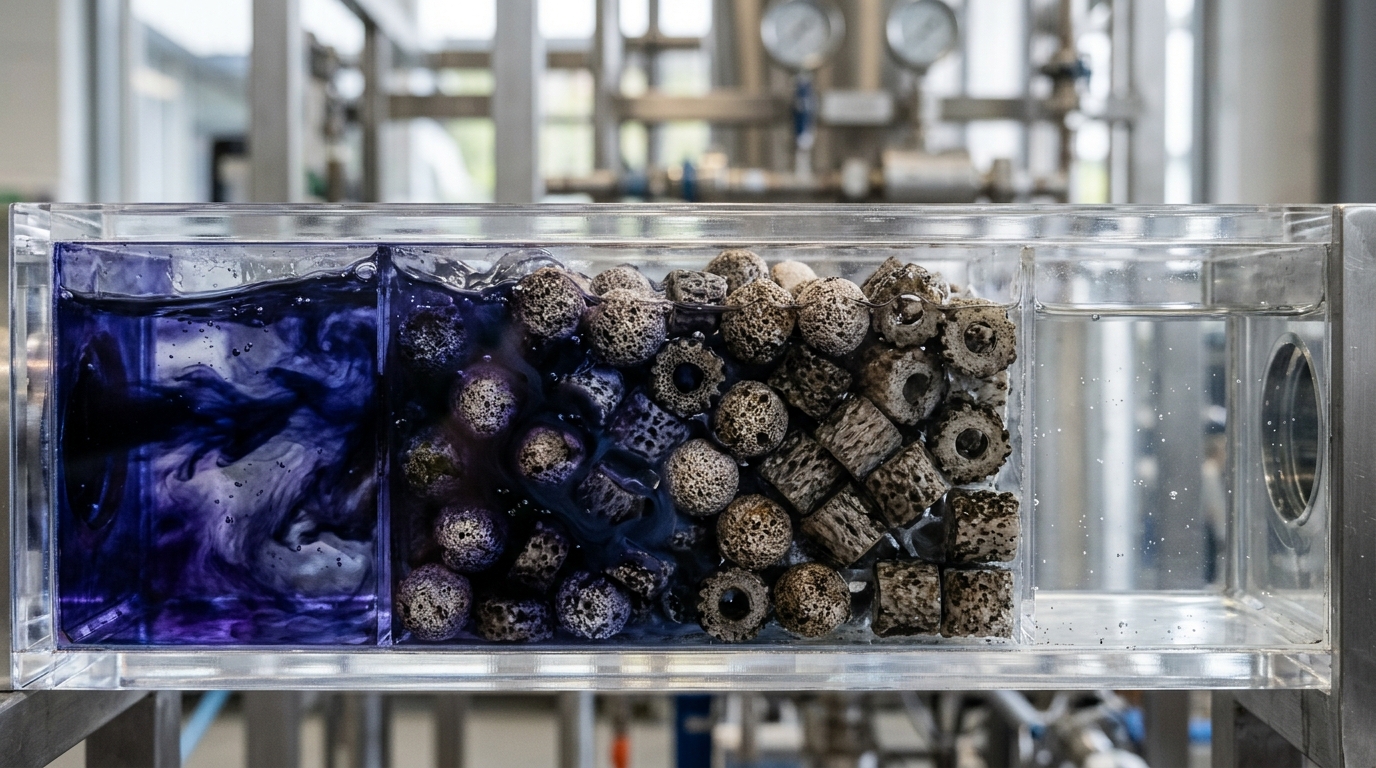
The most convincing demonstrations come from real wastewater and reactor operation. A Cyathus bulleri variant called LCC1-62 showed more than 50 percent higher decolorization efficiency in real textile wastewater without mediators than the wild type, and in an enzyme membrane reactor the system operated for more than 80 hours while maintaining approximately 95 percent color removal and achieving 96 percent mutagenicity reduction. A clay–chitosan filled-bed reactor with co-immobilized laccase and acetosyringone achieved 78 percent decolorization together with 87 percent COD and 91 percent BOD removal from real textile wastewater during 120 hours of uninterrupted operation. Yet the review concludes that most reported laccase-mediated dye degradation studies remain at the laboratory scale, using purified dyes or simulated wastewater under controlled conditions, and that improved decolorization efficiency under model conditions does not necessarily translate into successful industrial implementation. Future progress, the authors argue, will depend on long-term operational stability, enzyme and mediator economy, carrier durability, and more consistent evaluation of COD and TOC removal, toxicity reduction and wastewater-matrix effects, with pilot-scale validation essential for bridging the gap between laboratory innovation and industrial treatment.
Subject of Research: A review of engineered and immobilized laccase systems for degrading dye pollutants in textile wastewater
Article Title: Harnessing engineered laccase and functional carrier materials for efficient dye degradation: From mechanism to application
Article References: Zhang, Y., Yu, M., Zhang, Y., Chen, C., Yang, X., Kang, Y., Wu, S., Liu, Y., Zhou, Z., & Qian, L. (2026). Harnessing engineered laccase and functional carrier materials for efficient dye degradation: From mechanism to application. Bioresources and Bioprocessing, 13(1), Article 159. https://doi.org/10.1186/s40643-026-01148-8
Image Credits: AI Generated
DOI: 10.1186/s40643-026-01148-8
Keywords: laccase, dye degradation, textile wastewater, enzyme engineering, immobilization, azo dyes, anthraquinone dyes, triphenylmethane dyes, redox mediators, metal-organic frameworks, biochar, wastewater treatment
News Source: Gregory Coleman. (November 6, 2026). Engineered Laccase Enzymes and Smart Carrier Materials Turn Stubborn Textile Dyes Into Treatable Wastewater. Scienmag.