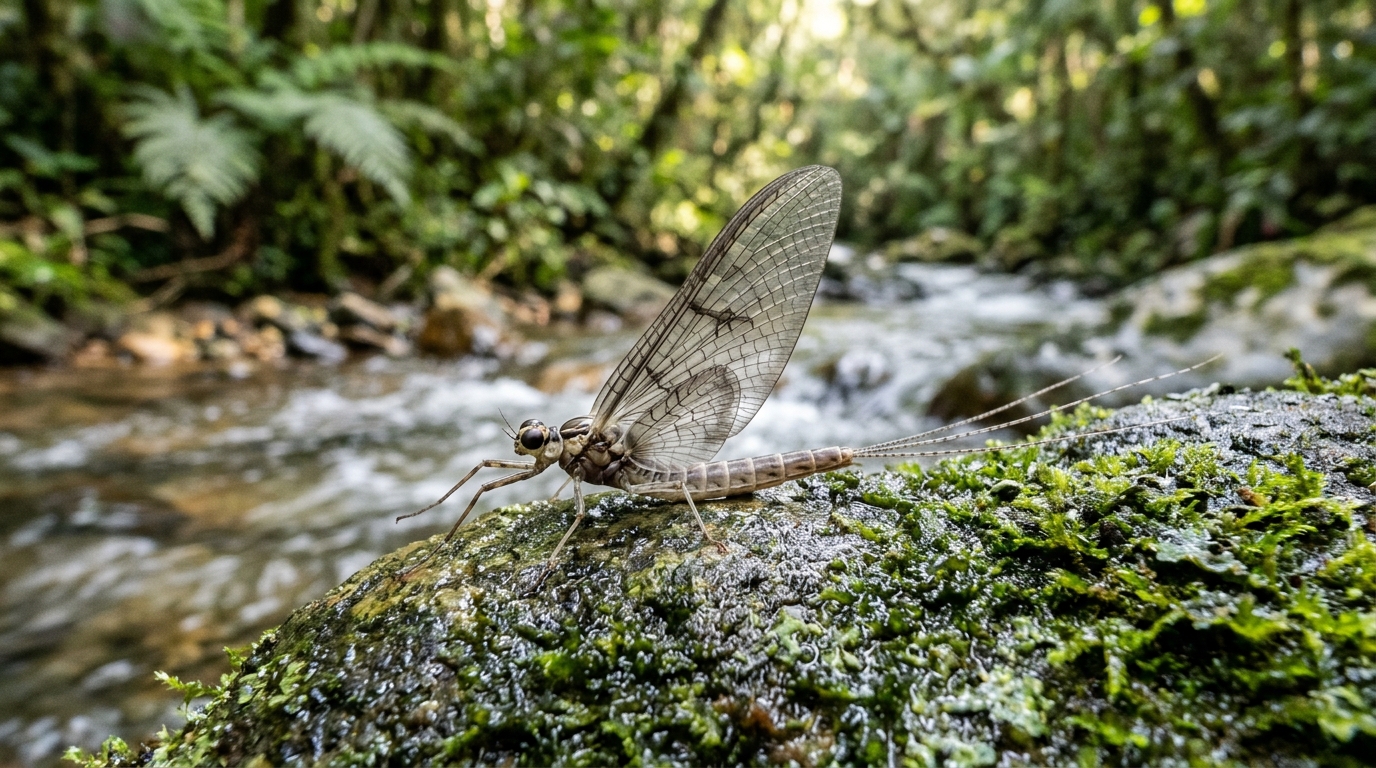
A rigorous taxonomic reassessment of the Neotropical mayfly genus Massartella has revealed that the aquatic insect diversity of Brazil’s montane Atlantic Forest was significantly underestimated. By employing an integrative taxonomic strategy combining mitochondrial DNA barcoding with multi-stage comparative morphology and scanning electron microscopy, researchers clarified decades of taxonomic ambiguity, officially revalidated a long-suppressed species, and formally described three previously unknown cryptic species. Previous classifications recognized only six valid species in the genus, divided between the northern Pantepui highlands and the southeastern Atlantic Forest.
The taxonomic foundation of Massartella dates back to 1930, when Jean-Auguste Lestage erected the genus based on Atalophlebia brieni, originally collected near a waterfall in Itatiaia at an elevation of 1,090 meters in southeastern Brazil. In 1943, Georg Ulmer described two additional Atlantic Forest species, Massartella alegrettae and Massartella fruhstorfferi, while supplementing the description of M. brieni using adult specimens from other Brazilian states. Subsequent revisions introduced substantial confusion into the group’s taxonomy. In 1955, Georges Demoulin designated junior synonyms, illustrated the female imago from the sole remaining syntype, and described the nymph of the genus for the first time from material collected at 2,600 meters in Itatiaia. Decades later, a 1990 revision by Michael Pescador and William Peters synonymized M. fruhstorfferi under M. brieni, arguing that differences in male genitalia and abdominal coloration reflected postmortem contractions of membranous penial tissues. This conservative classification stood until recent Bayesian phylogenetic studies showed M. brieni was polyphyletic, concealing multiple cryptic lineages.
To resolve these systematic conflicts, the research team conducted field expeditions across preserved mountain ranges and examined major museum collections. Targeted sampling took place in preserved watersheds across Minas Gerais, Rio de Janeiro, and Espírito Santo, including Itatiaia National Park, Serra da Canastra National Park, Serra do Cipó National Park, and Caparaó National Park. Nymphs were collected manually or via sieves and D-nets, while adults were captured using Pennsylvania traps, light sheets, Malaise traps, and aerial nets. Life cycle stages were linked primarily through rearing, maintaining mature nymphs with swollen, dark wing pads in field and laboratory containers until emergence into subimagos and imagos. Additional life cycle associations were established using locality data, coloration patterns, wing pad traits, abdominal gill counts, oological characters, and molecular sequencing. Specimens examined from the Federal University of Viçosa and the Federal University of Rio de Janeiro had delicate nymphal mouthparts, legs, and male genitalia cleared and slide-mounted in Euparal to reveal diagnostic structures.
The molecular analyses centered on a 624-base-pair alignment of the mitochondrial cytochrome c oxidase subunit I (COI) gene, incorporating 98 Massartella sequences alongside eight leptophlebiid outgroups from different subfamilies. Genomic DNA extracted from legs was amplified using standard primers, translated into amino acids to exclude pseudogenes, and verified against GenBank via BLAST before deposition. Maximum likelihood estimation carried out in IQ-TREE with codon partitioning models confirmed the correspondence between immature nymphs and adults within identical clades. Complementary ultrametric gene trees constructed in BEAST under a relaxed molecular clock were evaluated with three automated species delimitation algorithms: Assembling Species by Automatic Partitioning (ASAP), Generalized Mixed Yule Coalescent (GMYC), and Bayesian phylogenetically aware multirate Poisson tree processes (bPTP). These analytical tools identified between 15 (ASAP) and 21 (GMYC) distinct species across Massartella.
By examining fresh topotypic specimens collected at Cachoeira da Maromba within Itatiaia National Park at 1,090 meters, the authors established a rigorous redescription of Massartella brieni sensu stricto. In winged imagos, M. brieni is characterized by dark spots at the IRP, IMA, and IMP bifurcations of the hyaline forewing, an incrassate base of vein RP2, and 18 to 21 costal cross veins. The male imago displays a styliger plate with a wide, shallow posteromedian emargination, while its penial lobes feature a narrow, slightly truncated apical projection with a distinct dorsal groove. The newly described nymph presents 20 to 23 robust, pectinate setae on maxillary palp II, one to four pectinate setae on maxillary palp III, five spine-like setae on labial palp III, and 15 to 20 thick spatulate setae on the dorsal surface of the anterior femur. The nymph also possesses approximately 18 claw denticles and gills on abdominal segments I to VI. Scanning electron microscopy showed that eggs bear regular hexagonal chorionic ridges with few circular projections and uniformly distributed circular KCT attachment structures.
The authors formally reinstated Massartella fruhstorfferi Ulmer, 1943 as a valid species, providing the inaugural descriptions of its nymph and female imago. The team refuted previous claims that genital differences represented postmortem artifacts, demonstrating that the sclerotized lateral spine of the penis lobes remains constant in length even though lobe orientation varies postmortem. In male imagos, M. fruhstorfferi is distinguished by a narrow, U-shaped posteromedian styliger emargination, digitiform apical projections without a dorsal groove, 25 to 26 costal cross veins, and forewing pigmentation restricted to the IMA bifurcation. Mature nymphs possess 11 to 14 robust, pectinate setae on maxillary palp II, four spine-like setae on labial palp III, 11 to 14 spatulate setae on the dorsal anterior femur, 10 claw denticles, and gills on abdominal segments I to VI. Its eggs display irregular hexagonal chorionic ridges adorned with abundant circular projections. Morphological and molecular data confirm that M. fruhstorfferi possesses the widest geographical and altitudinal distribution in the genus, spanning Espírito Santo, Minas Gerais, and Rio de Janeiro from 710 to 2,250 meters.
The study formally described Massartella helenae sp. nov. based on imagos, subimagos, nymphs, and eggs collected in Serra do Cipó National Park and Mata do Limoeiro State Park in Minas Gerais. The species is named in honor of Helena de Lima Salles, daughter of co-authors Marcela Lima and Frederico Salles. Male imagos feature 24 to 25 costal cross veins, forewing spots restricted to the IMA bifurcation, a narrow, slightly concave styliger emargination, and wide, rounded penial apical projections lacking a dorsal groove. The mature nymph is characterized by abdominal gills present on segments I to VII, setting it apart from species with six gill pairs. Nymphs also bear four to five pectinate setae on maxillary palp I, 16 to 18 on maxillary palp II, six spine-like setae on labial palp III, 30 to 35 spine-like setae on the dorsal anterior femur, and 16 claw denticles. Scanning electron microscopy revealed oval eggs ornamented with irregular chorionic ridges in an alternating zigzag pattern, with circular projections positioned directly around and near the circular KCT attachment structures.
A second newly described species, Massartella demoulini sp. nov., was collected in high-altitude streams around Represa do Rebouças in Itatiaia National Park. The specific name commemorates Georges Demoulin, who in 1955 first described the nymph of Massartella from the same locality. Described from subimagos, mature nymphs, and eggs, M. demoulini subimagos display distinct spots at both the RA and IMA forewing bifurcations, 26 costal cross veins, a shallow styliger emargination, and moderately wide, rounded penial apical projections without a dorsal groove. Nymphs exhibit 20 to 21 robust, pectinate setae on maxillary palp II, four to five spine-like setae on labial palp III, 27 to 30 spine-like setae on the dorsal anterior femur, 16 claw denticles, and gills on abdominal segments I to VI. Under scanning electron microscopy, M. demoulini eggs exhibit a unique morphology lacking hexagonal or zigzag ridges, featuring instead poorly differentiated hemispherical projections irregularly distributed around circular KCT attachment structures.
The third novel taxon, Massartella bituca sp. nov., was described from Serra da Canastra National Park in Minas Gerais, named after renowned Brazilian singer Milton Nascimento, whose nickname is Bituca. Imagos of M. bituca lack forewing spots, have 26 to 30 costal cross veins, a shallow styliger emargination, and white penial lobes bearing dark-brown internal margins and rounded apical projections without a dorsal groove. Mature nymphs bear gills on abdominal segments I to VII, 13 to 14 robust, pectinate setae on maxillary palp II, 29 to 33 spine-like setae on the anterior femur, and 17 claw denticles. The eggs feature zigzag ridges whose circular projections do not sit adjacent to KCT attachment structures. In parallel, molecular analyses resolved the taxonomic placement of Massartella aurora, matching specimens from Caparaó National Park with type material from Serra do Brigadeiro. This expanded the known geographical distribution of M. aurora into Minas Gerais’s Caparaó range, while confirming that historical records under M. brieni comprised multiple distinct species.
The successful delimitation of species boundaries in Massartella demonstrates the indispensable value of integrative taxonomy in freshwater biodiversity research, highlighting how single-character morphology obscured evolutionary diversity for decades. Historical reliance on membranous male genitalia led researchers to misinterpret true evolutionary divergence as individual variation, masking cryptic species complexes beneath generalized taxon names. By combining adult wing venation, male genital morphology, nymphal mouthpart chaetotaxy, femoral setae counts, gill formulas, scanning electron microscopy of egg chorionic sculpturing, and mitochondrial COI sequencing, the investigators nearly doubled the recognized species richness of Atlantic Forest Massartella. This integrated approach not only rectified decades of taxonomic confusion and established definitive associations between life cycle stages, but also created an objective framework for future ecological and biogeographic investigations.
Subject of Research: Integrative taxonomy and species delimitation of Massartella mayflies in the Atlantic Forest
Article Title: Disentangling species boundaries in Massartella Lestage, 1930, from the Atlantic Forest: an integrative approach
Article References: Cortes, I. C. H., Lima, M. M., Takiya, D. M., Hoehne, L., Souto, P., Sarmento, F. R. P., & Salles, F. F. (2026). Disentangling species boundaries in Massartella Lestage, 1930, from the Atlantic Forest: an integrative approach. Frontiers in Insect Science, 6, Article 1972584. https://doi.org/10.3389/finsc.2026.1972584
Image Credits: AI Generated
DOI: 10.3389/finsc.2026.1972584
Keywords: Massartella, mayflies, Ephemeroptera, integrative taxonomy, Atlantic Forest, species delimitation, cytochrome oxidase I, scanning electron microscopy, Disentangling, species, boundaries, Lestage
News Source: Drew Townsend. (November 6, 2026). DNA and Morphology Reveal Hidden Mayfly Species in Brazil’s Atlantic Forest. Scienmag.