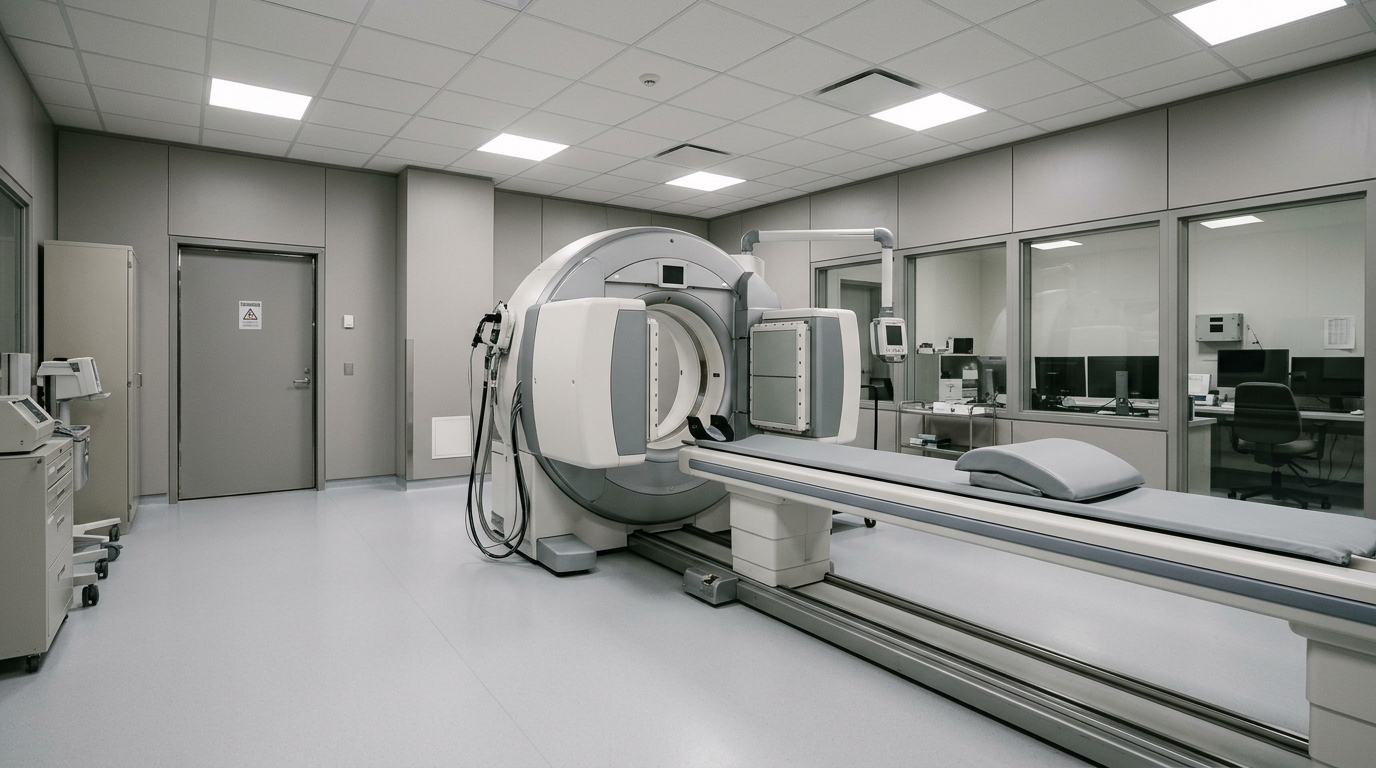
Yet a stubborn clinical problem persists: not every patient whose tumour carries a homologous recombination deficiency benefits from these drugs. That gap has pushed researchers to look for complementary tools that can identify, before therapy begins, which tumours actually overexpress the target. A new prospective study published in EJNMMI Research reports an early step in that direction, using a radiolabelled PARP-targeting tracer and single-photon emission computed tomography combined with computed tomography, known as SPECT/CT, to visualise PARP expression non-invasively in patients with several different cancers.
The cohort comprised one patient with cervical cancer, one with ovarian cancer, five with head and neck cancers, one with small cell neuroendocrine lung carcinoma and three with breast cancer. Some participants also received whole-body planar imaging at the one-hour time point.
Before any conclusions about tumours could be drawn, the investigators first mapped where the tracer travels in the body when no disease is present. Normal biodistribution was observed in the salivary glands, blood pool, bone marrow, liver, spleen, bowel and urinary system. For visual assessment, the team applied a simple rule: uptake of [123I]I-PARPi above the adjacent background was regarded as positive.
The imaging results showed that seven of the eleven patients demonstrated uptake of the tracer in their primary lesions. In the four patients who had lymph node metastases, positive uptake was also seen in the involved nodes.
To determine whether the images reflected genuine PARP expression, the researchers compared the SPECT/CT findings with immunohistochemistry performed on archival biopsy specimens from the primary lesions.
The central question was how often the two methods agreed. Overall, concordance between the SPECT/CT findings and the immunohistochemical findings was seen in six of the eleven patients. Among the five patients with discordant results, one patient showed positive SPECT/CT findings while immunohistochemistry showed no staining. The remaining four discordant cases were negative on imaging but showed weak positivity on immunohistochemistry.
The authors conclude that [123I]I-PARPi SPECT/CT shows diagnostic potential for evaluating PARP overexpression in different tumours and that the association they identified between PARP immunohistochemistry and PARP imaging indicates the tracer is a non-invasive marker of PARP expression.
The study has clear limitations that temper these conclusions. Eleven patients is a very small sample, and the cohort spans five different cancer types, so no firm cancer-specific conclusions can be drawn. The comparison used archival biopsy specimens rather than tissue obtained at the time of imaging, introducing the possibility that PARP expression changed between biopsy and scan. Visual assessment of uptake above background is a subjective criterion, and no quantitative uptake thresholds were reported. The authors themselves state that their findings warrant prospective, longitudinal and multi-centre clinical studies before the approach can move into routine practice.
Subject of Research: A prospective SPECT/CT imaging study correlating the PARP-targeted tracer [123I]I-PARPi with PARP immunohistochemistry in patients with cervical, ovarian, head and neck, lung and breast cancers.
Article Title: Association of [123I]I-PARPi SPECT/CT imaging and PARP immunohistochemical analysis in different cancers
Article References: Ndlovu, H., Lawal, I. O., Mzizi, Y. V., Disenyane, D., Bida, M., Corbert, C., Mokoala, K. M. G., & Sathekge, M. M. (2026). Association of [123I]I-PARPi SPECT/CT imaging and PARP immunohistochemical analysis in different cancers. EJNMMI Research. https://doi.org/10.1186/s13550-026-01531-8
Image Credits: AI Generated
DOI: 10.1186/s13550-026-01531-8
Keywords: PARP inhibitors, 123I-PARPi, SPECT/CT, molecular imaging, immunohistochemistry, precision oncology, cervical cancer, ovarian cancer, head and neck cancer, breast cancer, biomarker, nuclear medicine
News Source: Nathaniel Bowman. (November 6, 2026). SPECT/CT tracer [123I]I-PARPi mirrors PARP immunohistochemistry across cancers. Scienmag.