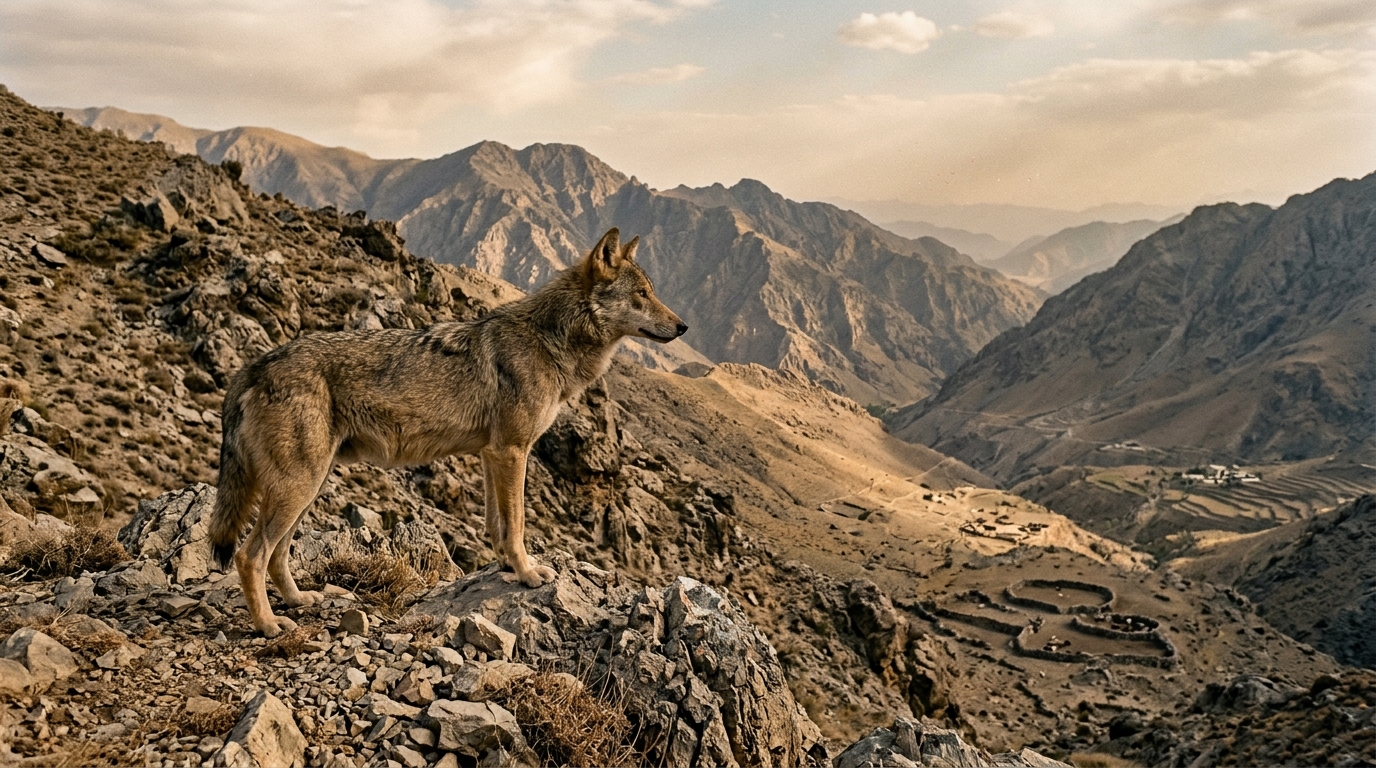
Grey wolves living in the rugged hills of Orakzai District in Khyber Pakhtunkhwa, Pakistan, derive most of their diet from wild prey, yet nearly every livestock-owning household surveyed in the area reported losing animals to wolf attacks, according to a year-long field study published in Frontiers in Conservation Science.
From 29 scats, the team recovered 30 identified prey occurrences spanning 15 prey species. Wild prey accounted for 17 occurrences, or 56.67 percent of the total, while domestic prey made up 13 occurrences, or 43.33 percent. Wild boar (Sus scrofa) was the most frequently detected prey species overall, followed by the Asiatic palm civet (Paradoxurus hermaphroditus), and cattle (Bos taurus) were the most frequently detected domestic prey.
Dietary diversity in the sample was high. The Shannon index reached H′ = 2.52, with prey species richness of 15 and evenness of 0.93, indicating that the wolves drew on a broad and relatively evenly used range of food sources rather than concentrating heavily on a single prey type. The authors caution, however, that these figures describe prey occurrences detected in scats only. Because prey availability in the landscape was not independently quantified, the results cannot be interpreted as evidence of prey preference or selection; a species that appears often in scats may simply be common in the environment.
As a result, all 123 respondents reported at least one livestock attack attributed to grey wolves, and the authors stress that these data do not represent a standardized depredation rate for the wider district. The sampling design means the survey captures the experiences of the most affected households rather than the average risk faced by any given farm.
The timing of reported attacks showed a clear pattern. Most incidents, 61.0 percent, occurred at night, followed by 35.0 percent in the evening, leaving only a small share in daylight hours. October recorded the highest frequency of reported attacks, accounting for 20.5 percent of incidents, a concentration that may reflect seasonal movements of livestock or wolves, though the study did not test underlying causes.
Attitudes toward the predator were overwhelmingly hostile. Overall, 80.5 percent of respondents expressed negative perceptions of grey wolves, a striking figure in a region where the species persists in human-dominated landscapes. To identify which factors were associated with these negative views, the researchers used Firth penalized logistic regression, a statistical method suited to small or unbalanced samples, modelling the odds of holding a negative rather than a neutral perception.
One variable stood out. The reported number of grey wolves killed during the previous 5 to 10 years was positively associated with the odds of a negative perception, with an odds ratio of 2.495 and a 95 percent confidence interval of 1.453 to 4.740, at P < 0.001. In other words, households that reported more wolves killed in their area were significantly more likely to view the species negatively. The association is cross-sectional, so the analysis cannot establish whether killing wolves deepens hostility or whether hostile communities kill more wolves; the two are plausibly entangled in a cycle of retaliation and resentment.
Equally informative were the factors that failed to reach statistical significance. Age, occupation, livestock holdings, wolf sightings, attack timing, and livestock injury were all not statistically significant predictors of negative perceptions in the model. That pattern suggests hostility toward wolves in Orakzai is not simply a function of how many animals a household owns or how often people see the predator, but is instead tied to the broader history of lethal conflict between the two.
The study’s limitations deserve emphasis. The scat sample of 29 specimens is modest, and the interview sample was purposively recruited rather than random, so neither component supports population-level estimates of depredation or attitude prevalence for the district as a whole. Prey availability was never measured directly, leaving the question of whether wolves in Orakzai prefer wild boar or merely encounter it more often unresolved. The authors argue that the findings nonetheless highlight substantial interaction between grey wolves and livestock-dependent communities, and they call for evidence-based conflict mitigation, improved livestock protection, and conservation strategies informed by prey availability and local ecological conditions.
For conservationists, the message is double-edged. Wolves in Orakzai appear to rely considerably on wild prey, which is encouraging for coexistence, yet the near-universal reporting of livestock attacks among the surveyed households and the strong link between past wolf killings and negative attitudes indicate a conflict dynamic that will not be resolved by ecology alone. Any strategy, the authors suggest, must pair better protection of herds with an honest accounting of the social history that shapes how these communities see an apex predator living in their midst.
Subject of Research: Grey wolf diet composition, livestock depredation and community perceptions in Orakzai District, Pakistan
Article Title: Diet pattern and human grey wolf conflict in Orakzai District, Pakistan
Article References: Hussain, S. A., Javed, M., Mahmood, T., & Mehmood, T. (2026). Diet pattern and human grey wolf conflict in Orakzai District, Pakistan. Frontiers in Conservation Science, 7, Article 1955584. https://doi.org/10.3389/fcosc.2026.1955584
Image Credits: AI Generated
DOI: 10.3389/fcosc.2026.1955584
Keywords: grey wolf, Canis lupus, Orakzai District, Pakistan, livestock depredation, scat analysis, diet composition, human-wolf conflict, community perceptions, Firth logistic regression, Khyber Pakhtunkhwa, wild boar
News Source: William Thompson. (November 6, 2026). Wolves in Pakistan’s Orakzai District Feed on Wild Boar but Kill Livestock, Survey Finds. Scienmag.