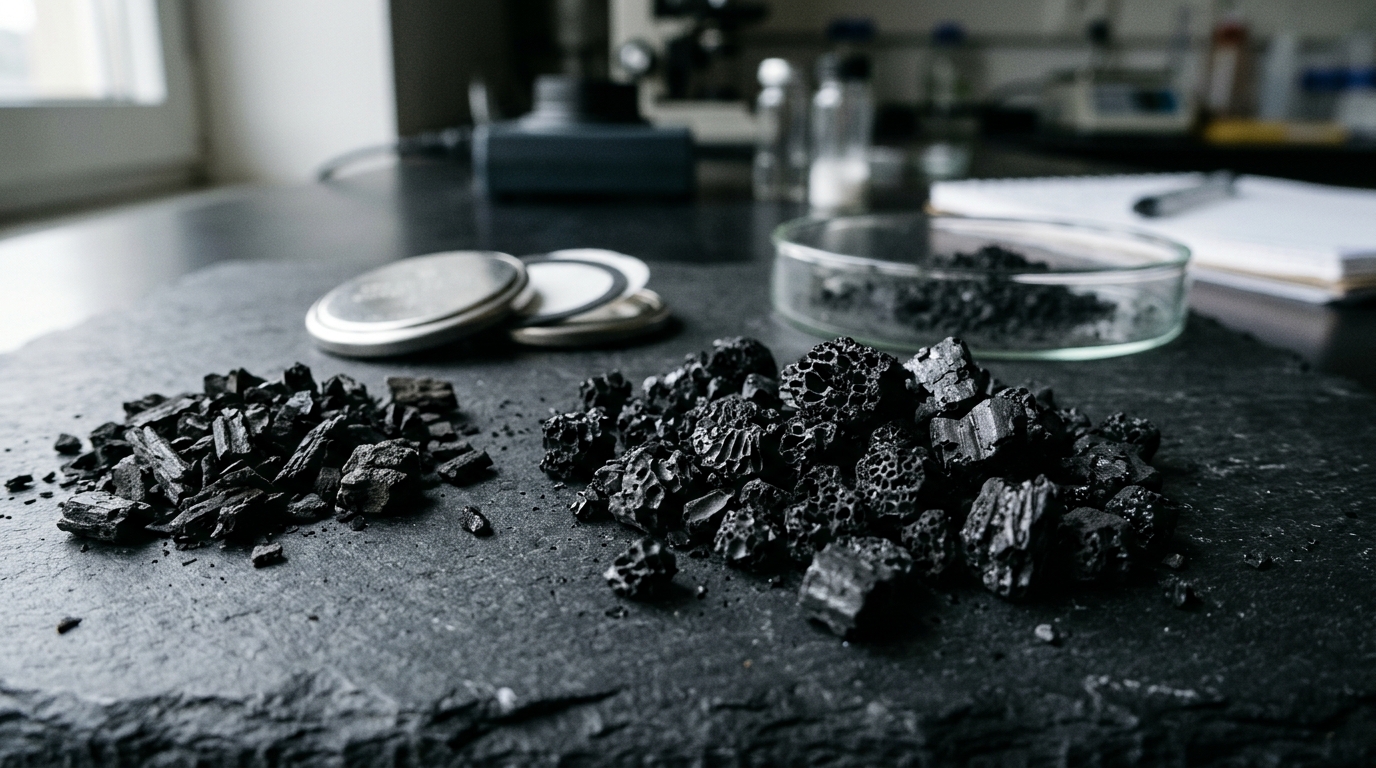
A comprehensive review published in Frontiers in Carbon evaluates the use of olive pomace, an abundant and chemically versatile agro-industrial lignocellulosic residue, as a sustainable feedstock for electrochemical energy-storage materials. The assessment examines how valorizing this agricultural waste can simultaneously address waste management, support resource recovery, and provide sustainable electrodes for advanced energy technologies. Focus is placed on establishing the fundamental relationships connecting feedstock composition and synthesis strategies with resultant structural properties, surface chemistry, and ultimate electrochemical performance.
The review analyzes the primary thermal and chemical conversion routes used to process olive pomace into functional carbons, specifically detailing pyrolysis, hydrothermal carbonization, physical activation, and chemical activation. In particular, chemical activation routes employing activating agents such as potassium hydroxide, zinc chloride, phosphoric acid, and potassium carbonate are evaluated for their specific influences on material characteristics. The authors trace how these distinct synthesis pathways govern porosity development, structural ordering, heteroatom functionality, and overall electrical conductivity in the final carbon products.
Different electrochemical applications impose distinct material requirements, which the review categorizes across electric double-layer capacitors, pseudocapacitive and hybrid systems, and battery anodes for lithium-ion and sodium-ion devices. The synthesis indicates that chemical activation methods generate highly porous carbons possessing competitive capacitance well-suited for capacitive mechanisms. In contrast, high-temperature carbonization routes favor the development of turbostratic hard-carbon structures, which provide the structural framework required for sodium storage in sodium-ion battery anodes.
A key analytical finding of the review is that high specific surface area alone does not serve as a reliable predictor of electrochemical performance. Instead, practical energy storage depends on an interconnected network of factors, including pore accessibility, pore-size distribution, surface chemistry, electrical conductivity, electrolyte composition, and electrode architecture. Furthermore, a comparative benchmarking of reported olive-pomace materials highlighted substantial discrepancies in testing conditions across existing studies, complicating direct performance evaluations.
Finally, the authors outline major technical and economic hurdles facing the field, including feedstock variability, process optimization, high chemical and energy consumption, scalability, techno-economic feasibility, and broader life-cycle impacts. To advance beyond material-level optimization, future research must prioritize reproducible synthesis, processing methods that tolerate feedstock variability, green activation strategies, rational heteroatom engineering, and integrated biorefinery approaches. The review concludes that olive pomace offers a promising platform for sustainable energy storage only if its environmental, economic, and electrochemical benefits are demonstrated at realistic device and process scales.
Subject of Research: Olive pomace valorization for electrochemical energy storage materials
Article Title: Olive-pomace-derived carbons for electrochemical energy storage: feedstock-process-structure-performance relationships
Article References: Alouiz, I., Sennoune, M., Amarouch, M.-Y., & Mazouzi, D. (2026). Olive-pomace-derived carbons for electrochemical energy storage: feedstock-process-structure-performance relationships. Frontiers in Carbon, 5, Article 1991049. https://doi.org/10.3389/frcrb.2026.1991049
Image Credits: AI Generated
DOI: 10.3389/frcrb.2026.1991049
Keywords: olive pomace, biomass-derived carbon, electrochemical energy storage, activated carbon, hard carbon, supercapacitors, battery anodes, circular economy, Olive-pomace-derived, carbons, electrochemical, energy
News Source: Faith Mcneil. (November 6, 2026). Review Evaluates Olive Pomace Carbons for Sustainable Energy Storage Systems. Scienmag.