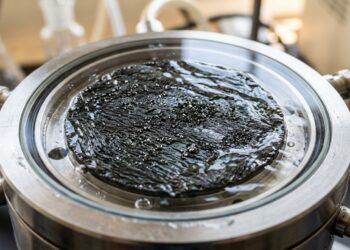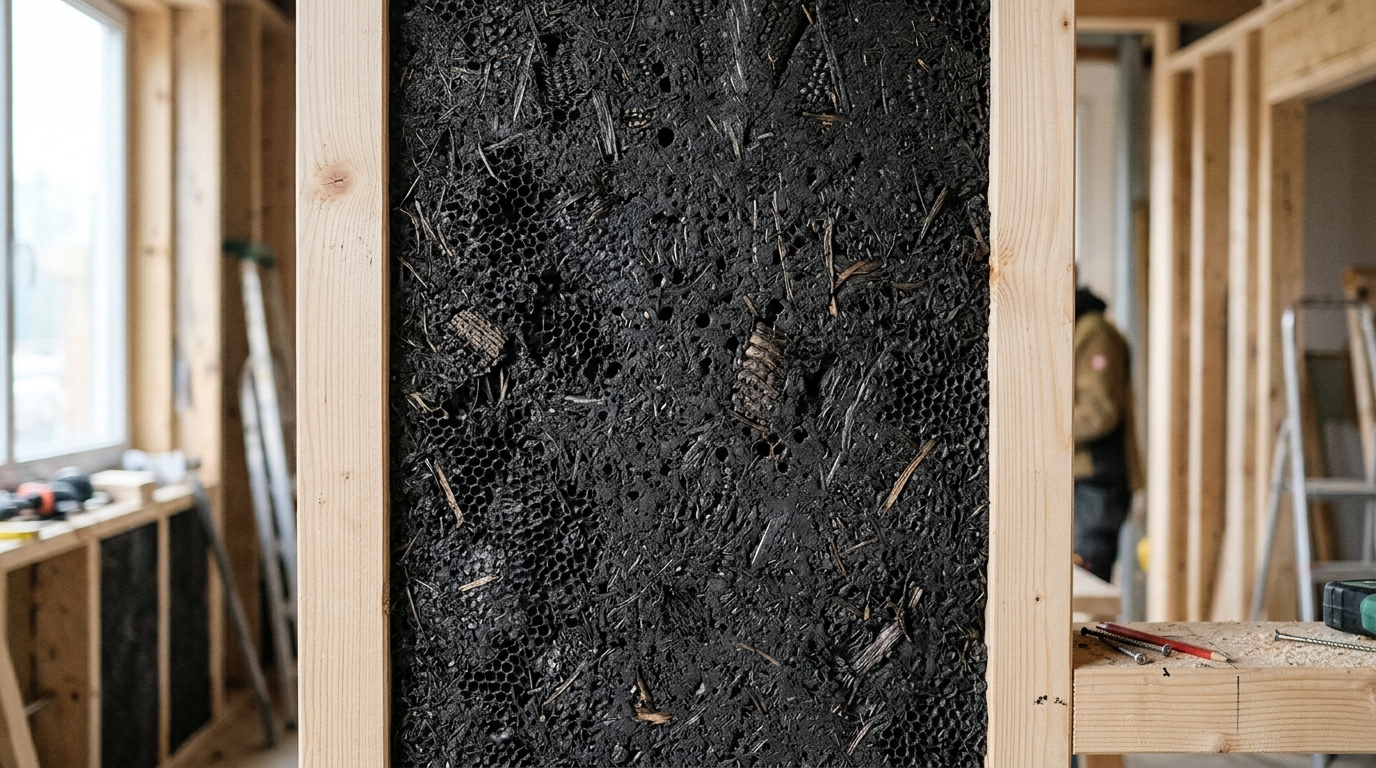
A composite insulation material built from carbonized corn cobs and a modified salt hydrate can hold heat inside a small model room dramatically longer than conventional fillings, according to a study published in the Springer journal Carbon Neutral Systems. The material, labeled CC/BCP, combines porous biomass carbon with sodium sulfate decahydrate treated with borax and a cellulose thickener, and it slowed cooling in a miniature room test by thousands of seconds compared with the same carbon without the phase change salt.
The work addresses a familiar problem in building design. Traditional buildings lose substantial energy through poorly insulated envelopes, and heating and cooling equipment has become routine, further increasing consumption. Phase change materials offer a different route: they absorb heat as they melt and release it as they solidify, buffering indoor temperatures without continuous energy input. Solid-liquid phase change materials are the most widely used type because of their high storage density and the small temperature swing between storing and releasing heat.
Earlier studies of biomass-derived composite phase change materials focused mostly on synthesis and characterization, the authors note, while systematic evaluation of how such materials perform in building envelopes remained scarce. To bridge that gap, the team built a micro-room experimental platform and paired it with numerical simulation, aiming for the first quantitative assessment of the composite’s dynamic heat storage and release behavior inside a building-like structure.
The starting material was agricultural waste. Corn cobs, which have regular pores, transparent structures, wide distribution and economical recycling, were carbonized at high temperature to produce a porous biomass carbon the researchers call CC. This carbon serves as an adsorption carrier with a rich pore network. Into it the team loaded a modified phase change salt, BCP, made by grinding sodium sulfate decahydrate crystals into powder and mixing in 7 percent sodium carboxymethyl cellulose and 6 percent borax. The cellulose and borax address two chronic weaknesses of the salt hydrate: phase separation and supercooling.
Combining the two happened by vacuum impregnation. The carbon was covered entirely with the modified salt and placed in a vacuum oven at 40 degrees Celsius, allowing the salt to soak into the pores. To make the composite leak-proof, it was then set on filter paper in an oven at 40 degrees for 12 hours, with the paper replaced regularly until no phase change material seeped out. The impregnation rate was calculated from the mass gain relative to the starting mass.
Thermal characterization defined the material’s working window. Differential scanning calorimetry showed an initial phase change temperature of 29.73 degrees Celsius, a peak at 32.67 degrees and an end point at 35.13 degrees, with a phase change enthalpy of 63.31 joules per gram. Compared with pure sodium sulfate decahydrate, the salt inside the composite melted slightly earlier, and its melting enthalpy dropped by 125.59 joules per gram, likely because the modifier weakened the binding between sodium sulfate and water molecules. Thermogravimetric analysis attributed most weight loss below 100 degrees to loss of crystal water, with total weight loss up to 600 degrees at roughly 20 percent.
The building test used seven double-layer aluminum plates, five measuring 36 by 12 centimeters and two measuring 31 by 12 centimeters, assembled into a miniature room with a multi-channel thermometer probing the top, center and bottom of the interior. Three comparative experiments were run. In the first, polyurethane foam filling was benchmarked against an air-filled control: after one hour of heating in a 50-degree oven, the foam-filled model ran hotter at every position, and its center cooling from 32 to 28 degrees took about 494 seconds longer, confirming the foam insulates far better than bare air.
The second experiment compared the biomass carbon with polyurethane foam at matched mass. During heating the two models tracked closely, but during cooling the carbon-filled model’s center fell from 30 to 25 degrees about 325 seconds later than the foam-filled one. Early in cooling the carbon model actually shed heat faster, a quirk the authors attribute to density: light foam fills the cavity completely at the same mass, while carbon leaves larger unfilled gaps that dissipate heat quickly at first. Once temperatures stabilized near 27 degrees, the carbon’s porous structure and high specific surface area took over, slowing conduction and extending heat retention.
The decisive test pitted the full composite against the carbon alone. As the models cooled below 26 degrees, the composite-filled sandwich showed a slight temperature rise of about 0.3 degrees and a plateau, resembling the supercooling behavior of sodium sulfate decahydrate and indicating the material was releasing latent heat as it solidified. That exothermic phase transition delayed the center’s fall from 30 to 25 degrees by roughly 2364 seconds relative to the carbon-filled model, and from 30 to 24 degrees by about 4342 seconds. The maximum top temperature was also lower in the composite model, which the team attributes to its heat storage capacity and thermal buffering.
Simulations in ANSYS FLUENT reinforced the experimental picture. The computational model mirrored the micro-room with an internal air space of 360 by 360 by 120 millimeters, a 24-millimeter filling layer and a 6-millimeter external polyurethane layer, using a mesh of 1,005,702 cells with quality 0.8 and convergence below 10 to the minus 6. When the filling was polyurethane foam, the internal temperature fell from 40 to 35 degrees within 360 seconds and reached about 20 degrees by 1000 seconds; with carbon, the same 5-degree drop took 620 seconds and the cooling curve stayed smoother. With the composite, the decline was markedly slower, the maximum, average and minimum temperature curves stayed nearly aligned, and after 5000 seconds the internal temperature remained slightly above 35 degrees while the liquid-phase fraction had fallen only 12 percent, meaning the material stayed largely solid and buffered temperature through a minor solid-liquid transition. Cross-section snapshots at 1000, 3000 and 5000 seconds showed the most uniform internal temperature distribution of the three fillings, with clearly defined isothermal regions. The authors caution that large-scale use still depends on cost, long-term cycling stability, leakage risks during repeated thermal cycles and compatibility with building envelopes, and they note no datasets were generated or analysed during the study beyond the reported tests.
Subject of Research: Biomass carbon-based composite phase change materials for building thermal regulation
Article Title: Application simulation research on biomass carbon-based composite phase change materials
Article References: Yang, Y., Liang, Q., Akbar, R. F., Shahobidinovich, S. S., Zhang, X., Yi, S., Pan, D., & Izatullo, G. (2025). Application simulation research on biomass carbon-based composite phase change materials. Carbon Neutral Systems, 1(1), Article 20. https://doi.org/10.1007/s44438-025-00020-0
Image Credits: AI Generated
DOI: 10.1007/s44438-025-00020-0
Keywords: phase change materials, biomass carbon, corn cobs, sodium sulfate decahydrate, thermal energy storage, building insulation, micro-room experiment, numerical simulation, latent heat, energy efficiency, carbon neutral systems, thermal regulation
News Source: Alan Morgan. (November 6, 2026). Corn cob carbon turns farm waste into heat-storing building insulation. Scienmag.