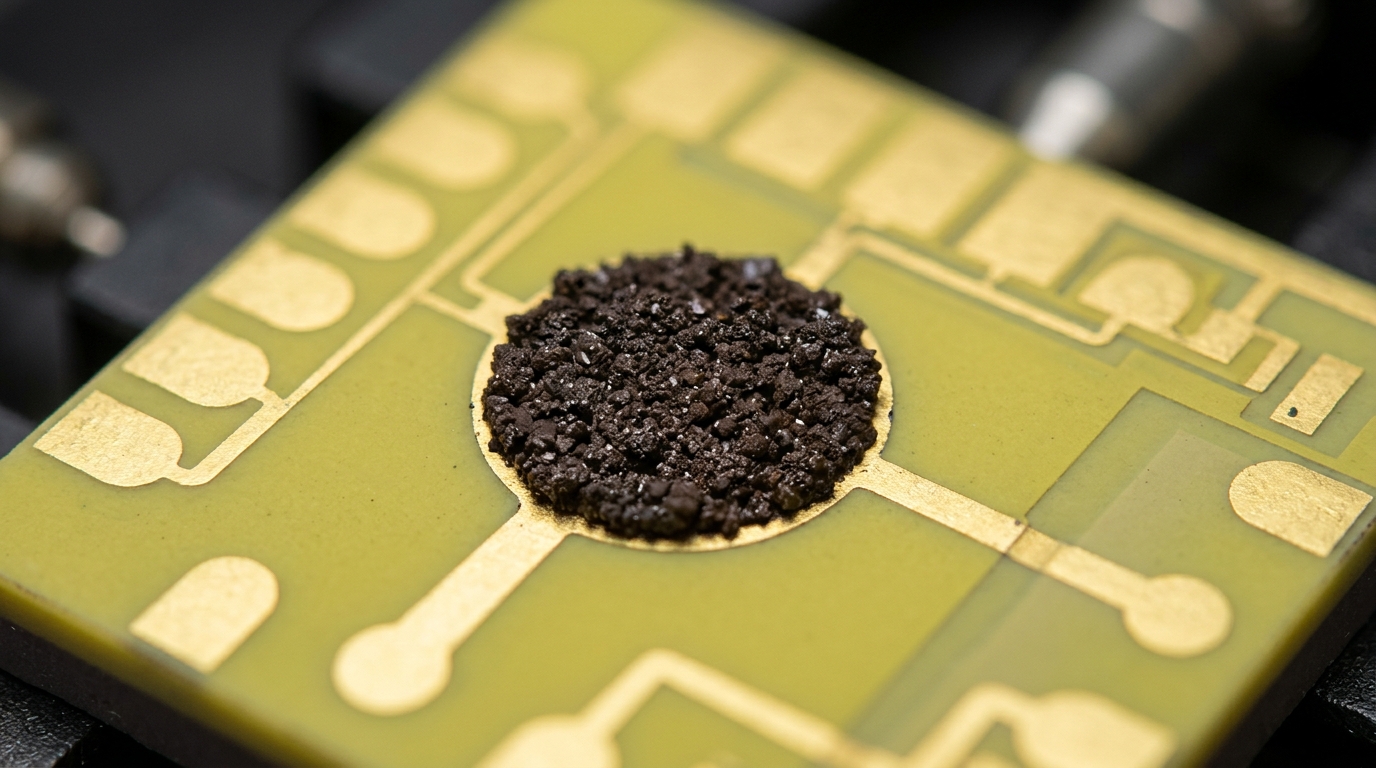
Copper oxide nanoparticles synthesized with a simple hydrothermal recipe have been shown to detect hydrazine, an industrially vital but highly toxic chemical, at picomolar concentrations. A team led by Faizan Malik, Sheetal Sharma, Ashok K. Sundramoorthy, and Sandeep Arya reports in Discover Sensors that a CuO-modified conductive fabric electrode achieved a linear response over 10 to 100 picomolar hydrazine, with a limit of detection of 7.15 picomolar and a limit of quantification of 21.72 picomolar. The sensor also held its performance over five weeks of testing, with negligible signal degradation, and produced nearly identical peak currents across five consecutive measurements. The work, published on 2 November 2026, presents the platform as a simple, cost-effective route to trace-level hydrazine monitoring in environmental and industrial settings.
Hydrazine, with the chemical formula N2H4, is widely used in rocket propellants, pesticides, pharmaceuticals, and polymer blowing agents. Acute exposure, however, poses serious health risks, including respiratory distress, liver and kidney damage, and impairment of the central nervous system. The toxicological stakes are reflected in strict regulatory limits: the Occupational Safety and Health Administration sets a permissible exposure limit of 1 ppm, equivalent to 1.3 mg per cubic meter, as an 8-hour time-weighted average, and considerably lower occupational threshold values have also been recommended. Proposed acceptance limits as low as 7.5 mg have been reported for hydrazine hydrochloride and dihydrazine sulfate in pharmaceutical substances. Against this backdrop, the authors argue that electrochemical sensing offers a simple, rapid, portable, and cost-effective strategy for hydrazine determination.
Conventional electrodes struggle with hydrazine. The anodic oxidation of the compound at noble-metal and carbon electrodes suffers from relatively high overpotential and sluggish electron-transfer kinetics, which has prompted the development of advanced electrocatalysts such as metal complexes, conducting polymers, and nanomaterials. Recent studies have explored metal-, metal-oxide-, carbon-, and polymer-based nanocomposites to improve the electrocatalytic oxidation of hydrazine and reach trace-level detection in aqueous and environmental samples, including CuO nanosheet-based non-enzymatic sensors, molecularly imprinted cobalt-barium stannate/MWCNT nanocomposites, and Ag@ZIF-based electrodes. Copper oxide nanostructures have attracted particular attention because of their low cost, good electrochemical stability, catalytic activity, and multifunctionality in sensing, catalysis, solar energy conversion, and environmental applications.
The novelty of the present work lies in its deliberate simplicity. Rather than relying on complex multicomponent nanocomposite architectures, the researchers synthesized CuO nanostructures through a hydrothermal approach and systematically correlated the material’s physicochemical characteristics with its electrochemical response toward hydrazine. Hydrothermal synthesis offers distinct advantages, enabling relatively good control over composition, crystallinity, particle morphology, and surface characteristics under comparatively mild reaction conditions. The team notes that the electrochemical behavior of CuO is highly dependent on its structural and morphological characteristics, which makes further investigation of simply synthesized CuO nanostructures relevant for developing efficient and reproducible sensing platforms.
The synthesis itself followed a procedure adapted from Wang and colleagues. A total of 0.1 mol of CuCl2·2H2O was dissolved in 50 mL of distilled water under continuous magnetic stirring for 15 minutes. Then 20 mL of 2 M NaOH solution was added slowly, dropwise over 30 minutes, to facilitate the formation of the copper hydroxide precursor and minimize localized changes in the reaction environment. After a further 10 minutes of stirring, the suspension was transferred to a Teflon-lined stainless-steel autoclave and heated at 110 °C. Once the autoclave had cooled naturally to room temperature, the black precipitate was washed repeatedly with distilled water and ethanol, dried at 65 °C for 24 hours, and ground into a fine powder. The process yielded 2.8 g of CuO nanoparticles, an experimental yield of approximately 35.2 percent based on a theoretical yield of 7.96 g.
Characterization confirmed the material’s identity and purity. X-ray diffraction showed peaks at 32.64°, 35.71°, 38.86°, 48.71°, 53.50°, 58.29°, 61.60°, 66.33°, 68.14°, 72.58°, and 75.27°, matching the planes of monoclinic CuO and consistent with the JCPDS 45-0937 reference. Strong reflections at 35.71° and 38.86° indicated the formation of pure CuO without detectable Cu2O or Cu(OH)2 impurities. The lattice parameters, a = 4.6 Å, b = 3.4 Å, and c = 5.1 Å in the space group C2/c, aligned well with reported values. Using the Scherrer equation with a wavelength of 1.54 Å, the average crystallite size was calculated to be approximately 18.3 nm. Field-emission scanning electron microscopy confirmed nanoparticle morphology, with noticeable agglomeration attributed to the very small size and high surface energy of the particles, which tend to form covalent or metallic interparticle bonds that are difficult to break.
Compositional and surface analyses reinforced the picture of a clean, well-defined material. Energy-dispersive X-ray spectroscopy showed distinct peaks corresponding only to copper and oxygen, with atomic and weight percentages closely matching the expected stoichiometric ratios. Fourier-transform infrared spectroscopy revealed a prominent Cu-O stretching band at 520 to 800 cm−1, a broad O-H stretching band centered at 3378 cm−1 from surface hydroxyl groups and adsorbed water, and an H-O-H bending feature at 1627 cm−1. Weak bands at 1467 and 1365 cm−1 were attributed to carbonate or bicarbonate species formed through adsorption of atmospheric CO2, though minor contributions from trace surface contamination could not be ruled out. X-ray photoelectron spectroscopy, calibrated with the C 1s peak at 284.5 eV, showed Cu 2p peaks at 933.58 eV and 953.48 eV with an energy separation of 19.9 eV, confirming the presence of Cu²⁺. The O 1s peak at 533.24 eV corresponded to adsorbed oxygen species, and the absence of a peak near 530.4 eV indicated that the Cu2O phase was not present.
The electrode was built on a 1 cm² fabric substrate cleaned by ultrasonication and rinsed with acetone, ethanol, and deionized water, then dried at 60 °C for 12 hours. A slurry of the electroactive material, graphite powder, and polyvinyl alcohol binder in an 8:1:1 mass ratio was dispersed in N-methyl-2-pyrrolidone, ground into a uniform viscous paste, deposited on the substrate, and dried at 60 °C for 8 hours. Electrochemical testing then proceeded in a three-electrode configuration with an Ag/AgCl reference electrode and a platinum wire counter electrode. Cyclic voltammetry in phosphate buffers spanning pH 5 to 9 showed that both the current response and the position of the redox features varied with pH, indicating the involvement of proton transfer in the electrode reaction. The most well-defined and enhanced response appeared at pH 7, which was selected as the optimum condition. The pH 9 response exhibited wavy, poorly defined features, possibly due to increased background or capacitive current, changes in the electrode-electrolyte interface, or unstable interfacial charge-transfer conditions, and was deemed unsuitable for reliable peak-potential analysis.
Kinetic studies added further detail. Increasing the scan rate produced a proportional increase in the redox peak currents of CuO along with a slight positive shift in peak potentials, indicating an irreversible electrochemical process. Linear calibration plots of peak current versus scan rate yielded regression coefficients of 0.97644 for the anodic and 0.92546 for the cathodic peaks, which the authors interpret as evidence of an adsorption-controlled process in which peak current is directly proportional to scan rate. Incubation time also mattered: the response signal gradually improved with longer incubation as analyte molecules interacted with active surface sites, and beyond an optimized period of 120 seconds no significant change in signal intensity was observed, indicating saturation of the available adsorption sites. The logarithmic dependence of peak current on scan rate was analyzed further in the supporting information to elucidate the electrode reaction mechanism.
Quantitative sensing was performed with differential pulse voltammetry, chosen for its high sensitivity and low capacitive current. Measurements recorded for hydrazine concentrations from 10 to 100 picomolar in 20 mL of phosphate buffer at pH 7 showed a proportional increase in peak current with increasing analyte concentration, and the resulting linear calibration enabled quantitative determination. The limit of detection, calculated using the 3.3σ/S criterion, was 7.15 picomolar, while the limit of quantification, calculated using the 10σ/S criterion, was 21.72 picomolar. Long-term stability was assessed over five weeks with weekly response measurements, showing minimal degradation in current response. Repeatability was evaluated with five consecutive DPV measurements in buffer containing 100 picomolar hydrazine, and the peak current values remained nearly identical across all measurements. Selectivity testing against ascorbic acid, hydroquinone, dopamine, and uric acid, electroactive species commonly encountered in practical samples, showed markedly higher response for hydrazine than for the interferents, which generated relatively low current responses within the studied potential window. The authors conclude that the CuO-modified electrode exhibits a preferential electrocatalytic interaction with hydrazine, supporting its suitability for selective electrochemical detection and promising prospects for environmental surveillance, industrial process control, and public health protection.
Subject of Research: Electrochemical detection of hydrazine using hydrothermally synthesized CuO nanoparticles on a conductive fabric electrode
Article Title: Synthesis and characterization of CuO nanoparticles for efficient electrochemical detection of hydrazine
Article References: Malik, F., Sharma, S., Sundramoorthy, A. K., & Arya, S. (2026). Synthesis and characterization of CuO nanoparticles for efficient electrochemical detection of hydrazine. Discover Sensors, 2(1), Article 61. https://doi.org/10.1007/s44397-026-00095-5
Image Credits: AI Generated
DOI: 10.1007/s44397-026-00095-5
Keywords: CuO nanoparticles, hydrazine detection, electrochemical sensing, hydrothermal synthesis, picomolar detection, conductive fabric electrode, differential pulse voltammetry, cyclic voltammetry, X-ray photoelectron spectroscopy, sensor stability, selectivity, environmental monitoring
News Source: Denise Maddox. (November 6, 2026). Copper oxide nanoparticles detect trace hydrazine at picomolar levels. Scienmag.