Keratin is a highly resilient, water-insoluble fibrous protein whose complex hierarchical organization, compact morphology, and extensive disulfide cross-linkages formed by sulfur-containing amino acids confer mechanical stability and resistance to degradation by conventional proteolytic enzymes. Hydrolysis of feathers releases amino acids including tryptophan, methionine, and histidine, as well as cysteine, glycine, serine, and alanine, and tryptophan serves as a precursor for indole-3-acetic acid, a plant growth hormone that promotes root development.
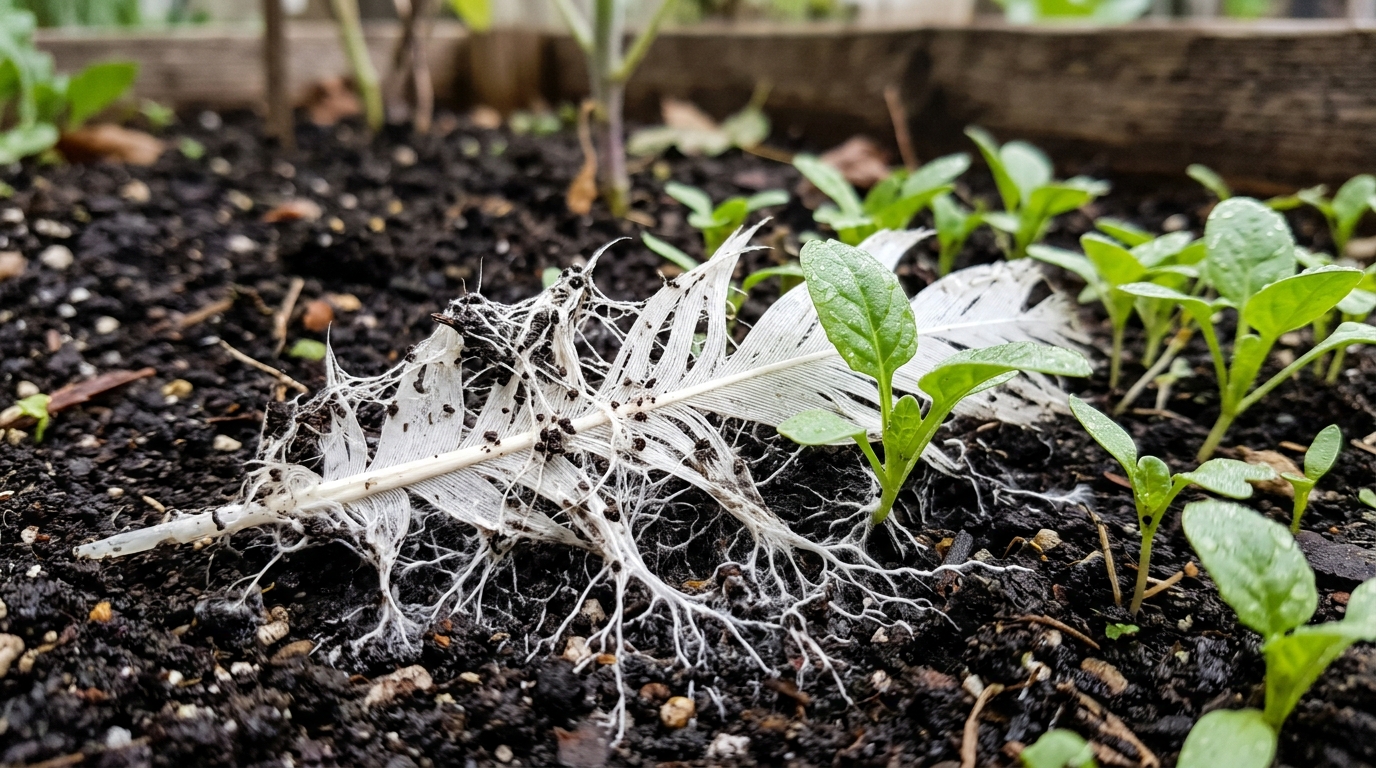
Biocomposting employs defined microbial inocula with specific functional attributes to accelerate the decomposition and stabilization of organic matter, and keratinolytic fungi are particularly suitable for feather composting because their filamentous growth enables direct penetration and colonization of the compact keratin matrix, while secretion of keratinases and related hydrolytic enzymes promotes substrate solubilization and progressive release of bioavailable nutrients.
Each bin was inoculated with roughly one litre of a spore suspension containing 10⁶ spores per millilitre of either A. niger or A. gorakhpurensis, while an un-inoculated control received an equal volume of sterile deionized water. Moisture was held at approximately 60 percent, aeration came from manual turning every five days, and temperature and pH were tracked throughout the 60-day run. Every treatment was conducted in triplicate with independent composting bins.
Temperature climbed during the initial phase to a maximum between 48.3 and 55.6 degrees Celsius, characteristic of the thermophilic phase, before gradually declining into cooling and maturation. The pH first rose, likely from ammonia volatilization during ammonification, and then fell, plausibly as nitrification oxidized ammonium to nitrate with the release of hydrogen ions. Keratinase activity peaked at 122 units per millilitre in the A. gorakhpurensis treatment before declining as available keratin was depleted. The authors note that keratinase activity alone does not directly quantify keratin degradation, so they interpreted it alongside physicochemical changes; scanning electron microscopy of feather remnants recovered after 60 days revealed fragmentation, fibrillation, and loss of the characteristic keratin architecture in inoculated bins, whereas the un-inoculated control retained intact barbules and rachis.
Maturity and phytotoxicity were assessed with a seed germination index using spinach seeds. The A. gorakhpurensis-inoculated substrate achieved the highest germination index at 62 percent, which the authors interpret as partial maturity and reduced phytotoxicity; values above 50 percent generally indicate moderate maturity, while fully matured compost is typically considered to be at or above 80 percent. Residual ammoniacal compounds or incompletely degraded intermediates may explain why the index fell short of full maturity, and the authors suggest that extending the curing period could push quality toward the maturity threshold. The lower index in the un-inoculated control points to incomplete feather decomposition and persistence of inhibitory compounds such as volatile fatty acids and ammonia.
After 60 days, the A. gorakhpurensis compost had a pH of 6.34, significantly lower than the un-inoculated control at 7.28, alongside an electrical conductivity of 2.08 decisiemens per metre, reduced from 2.66 in the control, suggesting microbial assimilation of soluble salts. Total nitrogen reached 0.23 percent and sulfur 0.18 percent, compared with 0.07 percent and 0.03 percent respectively in the control soil, consistent with mineralization of the sulfur-rich keratin. The carbon-to-nitrogen ratio dropped from an initial 15.10 in the control soil to 7.22 in the A. gorakhpurensis treatment and 9.13 with A. niger, remaining well within the acceptable range below 20 for agricultural application and indicating considerable progress toward compost maturity.
The agronomic test used a nine-treatment pot design with six replicates per group. Composted substrates were applied at 10, 15, or 20 percent by weight, equivalent to 200, 300, or 400 grams per 2 kilograms of soil, alongside a positive control treated with diammonium phosphate at 2 grams per 2 kilograms of soil and a negative control of un-inoculated composted substrate and untreated soil. Five seeds were sown per grow bag, and germination was recorded 10 days after sowing to capture late-emerging seedlings. Spinach treated with the A. gorakhpurensis compost reached the highest germination at 66 percent, and the strongest growth metrics appeared at the 15 percent application rate, while membrane stability index peaked at 20 percent, a differential the authors attribute to altered physicochemical conditions at higher doses rather than additional biomass accumulation.
Total chlorophyll and carotenoids were highest in spinach treated with 15 percent composted substrate, which the researchers link to improved availability of nitrogen, a structural component of chlorophyll molecules, and phosphorus, which facilitates the energy transfer needed for pigment production. Cabbage treated with 10 percent A. gorakhpurensis compost also germinated at 66 percent, though germination declined at the 20 percent rate, suggesting that higher application rates may adversely affect seed emergence; the DAP positive control produced more leaves and larger leaf area, but the compost-treated groups showed higher chlorophyll content. In brinjal, the 10 percent A. gorakhpurensis treatment delivered the highest germination, leaf number, and leaf area, and fruit production occurred in compost-treated groups and the DAP treatment, whereas the negative control produced no fruit within 70 days and was classified as non-yielding.
The composting and plant growth experiments were conducted under controlled laboratory and pot conditions in a soil-amended system, which may not reflect field-scale composting or agricultural production. Agronomic performance was assessed only in spinach, cabbage, and brinjal under pot conditions, and validation across diverse soil types, environmental conditions, and growing seasons is needed before practical recommendations can be formulated. Economic feasibility, scalability, and cost-effectiveness of fungal-assisted feather composting also remain to be evaluated.
Subject of Research: Fungal composting of chicken feather waste into a soil amendment for vegetable crop growth
Article Title: Keratinolytic fungi mediated composting of chicken feather waste and its potential for promoting growth of vegetable crops
Article References: Bagwai, M. A., Kaur, M., Sooch, B. S., & Bhari, R. (2026). Keratinolytic fungi mediated composting of chicken feather waste and its potential for promoting growth of vegetable crops. BMC Agriculture, 2(1), Article 31. https://doi.org/10.1186/s44399-026-00052-y
Image Credits: AI Generated
DOI: 10.1186/s44399-026-00052-y
Keywords: chicken feather waste, keratinolytic fungi, Aspergillus gorakhpurensis, composting, soil amendment, germination index, spinach, cabbage, brinjal, nitrogen mineralization, keratinase, poultry waste valorisation
News Source: Roger Howard. (November 6, 2026). Fungi Turn Chicken Feather Waste Into Fertilizer That Boosts Vegetable Growth. Scienmag.