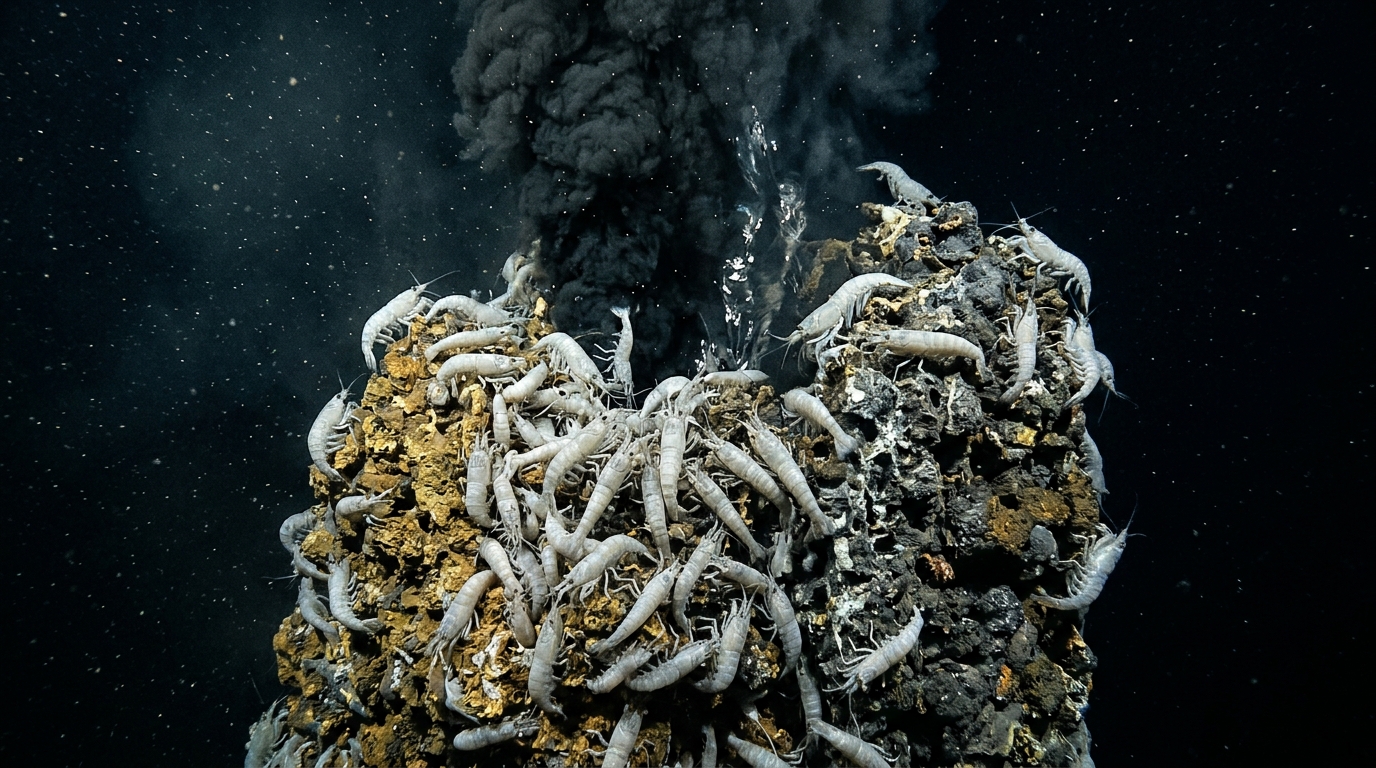
A novel midgut-associated bacterial symbiont belonging to the order Lachnospirales has been identified in two endemic hydrothermal vent shrimp species, Rimicaris exoculata and Rimicaris chacei, shedding new light on microbial partnerships along the Mid-Atlantic Ridge. To determine the functional contribution and structural organization of this newly observed microbe within the host holobiont, researchers integrated fluorescent in situ hybridization, metabarcoding, and genome-resolved metagenomic analyses. The investigation examined raw sequencing reads derived from a recent metabarcoding study together with two metagenome-assembled genomes originally obtained in earlier research from the TAG and Snake Pit hydrothermal vent fields. While earlier metabarcoding and metagenomic surveys had initially detected the presence of an abundant candidate digestive bacterium from an undescribed Lachnospirales family, its specific role, metabolic capacity, and anatomical localization in the shrimp holobiont had remained entirely unknown until the completion of this genomic assessment.
For both Rimicaris exoculata and Rimicaris chacei, this physiological dependency involves three distinct anatomical symbiotic bacterial communities that perform vital functions in host nutrition and in scaling up their immune systems. The first of these symbiotic consortia resides within the cephalothoracic cavity, the second community inhabits the foregut, and the third community populates the midgut, where bacterial diversity has long been known to be dominated primarily by Candidatus Microvillispirillaceae.
The genomic and observational findings indicate that this novel Lachnospirales family likely engages in a syntrophic relationship with Candidatus Microvillispirillaceae inside the midgut microenvironment. In this metabolic cooperation, Lachnospirales bacteria are able to degrade chitin, yielding degradation products that Candidatus Microvillispirillaceae can subsequently utilize to support their own cellular metabolism. Furthermore, developmental tracking reveals that Lachnospirales symbionts are acquired following the settlement of juvenile shrimp at active hydrothermal vent sites, establishing residency specifically during the developmental transition between juvenile stage B and subadult metamorphosis.
Subject of Research: Identification and functional characterization of a novel Lachnospirales digestive symbiont in hydrothermal vent shrimp
Article Title: A novel digestive symbiont for both holobiont Rimicaris exoculata and Rimicaris chacei: the case of Lachnospirales
Article References: Guéganton, M., Ailliot, L., Aubé, J., Cueff-Gauchard, V., Durand, L., & Cambon, M.-A. (2026). A novel digestive symbiont for both holobiont Rimicaris exoculata and Rimicaris chacei: the case of Lachnospirales. Environmental Microbiome. https://doi.org/10.1186/s40793-026-00977-6
Image Credits: AI Generated
DOI: 10.1186/s40793-026-00977-6
Keywords: Rimicaris exoculata, Rimicaris chacei, Lachnospirales, hydrothermal vents, digestive symbiosis, metagenomics, Candidatus Microvillispirillaceae, Mid-Atlantic Ridge, novel, digestive, symbiont, both
News Source: Drew Townsend. (November 6, 2026). Novel Lachnospirales Gut Symbiont Discovered in Mid-Atlantic Ridge Hydrothermal Vent Shrimp. Scienmag.