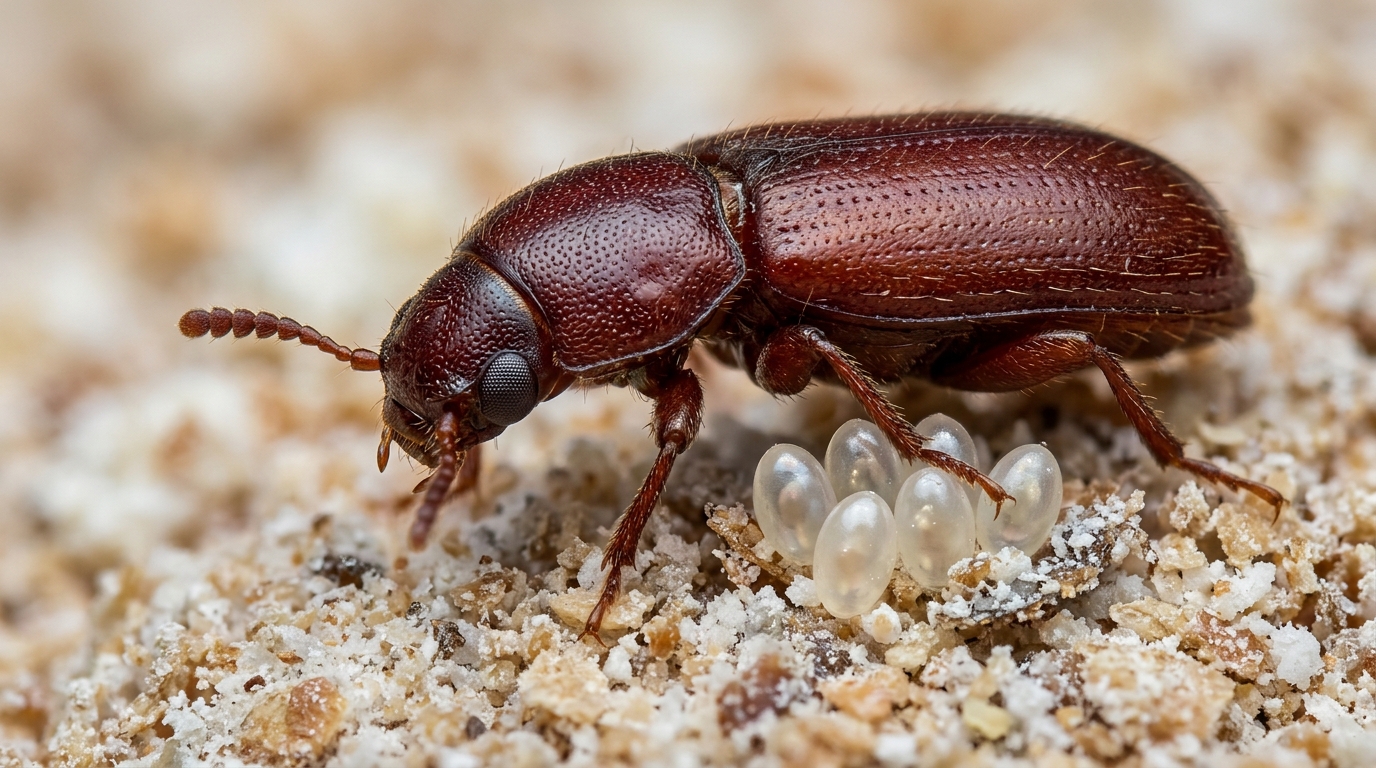
Scientists studying the red flour beetle Tribolium castaneum have built a transgenic tool that suppresses the insect’s unusually powerful RNA interference response, allowing them to knock down genes that previously caused injected mothers to become sterile. The tool uses a viral protein called CrPV1A, a suppressor of RNAi taken from Cricket Paralysis virus, and it has now enabled the researchers to settle a long-standing question about how the beetle establishes its head-to-tail body axis: maternal repression of Wnt signalling alone is sufficient to specify the anterior pole of the embryo. The work, published as an open access research article in the journal now titled Developmental Biology Advances, was carried out by Muhammad Salim Hakeemi, Ann-Kathrin Müller, Julia Ulrich and Gregor Bucher.
RNA interference is a natural antiviral defence mechanism found in plants, fungi and animals, and many viruses have evolved viral suppressors of RNAi, or VSRs, as a counter-strategy. These suppressor proteins evolved independently and block the RNAi machinery through different mechanisms of action. In earlier work, the same research group had tested several known VSRs for their functionality in Tribolium and found that heat-shock induced expression of CrPV1A effectively blocked an ongoing RNAi response, allowing temporal control of the silencing effect. In that previous experiment, the researchers performed parental RNAi of pair-rule genes and then blocked the ongoing response in embryos at an advanced elongation stage: the anterior embryonic segments still showed the pair-rule phenotype while the posterior ones were rescued.
The strength of Tribolium’s RNAi response is precisely what makes the beetle such a powerful model organism, and precisely what creates the problem the new tool addresses. Injecting double-stranded RNA into the hemolymph of larvae leads to silencing in all cells, and injecting mothers elicits knockdown in the offspring, because Tribolium cells take up dsRNA from the surrounding fluid. But when a developmental gene is also required for oogenesis, dsRNA injection renders the injected females sterile, so no offspring are produced to study. This had been observed for the genes Tc-decapentaplegic and Tc-axin. In the latter case, researchers had to reduce the dsRNA concentration to avoid sterility, which risked an incomplete knockdown. For pleiotropic genes with both maternal and zygotic functions, parental RNAi suppresses both functions at once, making it difficult to determine which part of the phenotype is maternal and which is zygotic.
The team hypothesized that the same viral suppressor could overcome the sterility problem. Their strategy was to express CrPV1A ubiquitously in the mother so that RNAi would be blocked in her body, protecting her fertility, while the silencing effect would still be transferred to the offspring, revealing the embryonic phenotype of the targeted gene. They generated a series of transgenic lines by piggyBac-mediated transgenesis, controlling VSR expression with different ubiquitous promoters: α-tubulin, polyUbiquitin and GAPDH. To boost the amount of suppressor protein, they also built bicistronic constructs in which two copies of CrPV1A are separated by a 2A-peptide sequence, which causes ribosomal skipping so that two separate proteins are translated from a single mRNA transcript. In total, 12 transgenic lines were generated from different VSR constructs, and most were tested for their RNAi rescue effect.
A serious complication emerged during this construction work. Several transgenic VSR lines driven by strong ubiquitous promoters turned out to be unhealthy and infertile and could not be included in the rescue tests. High embryonic lethality was observed during microinjection of the bicistronic constructs and of constructs driven by putatively strong promoters such as GAPDH. This lethality was largely rescued when the researchers co-injected dsRNA targeting the VSR-EGFP transcript, supporting their assumption that high amounts of the viral suppressor protein are toxic to the developing beetle. Only VSR lines driven by the comparably weak α-tubulin and polyUbiquitin promoters could be made homozygous. The authors also note that a previous study from their lab had found that heat-shock activation of VSR expression in adults, pupae and larvae significantly reduced survival compared to wildtype, and that other work indicates CrPV1A interferes with Ago-2-dependent miRNA silencing and the miRNA regulatory network in Drosophila as well.
The sterility rescue test focused on the α-tubulin driven line, which proved to be the only one among those tested showing a strong rescue. The researchers injected homozygous female pupae from VSR lines with dsRNA targeting Tc-dpp and Tc-axin, using the minimal amounts that induced a complete sterile phenotype in wildtype: 500 nanograms per microlitre for Tc-dpp and 250 nanograms per microlitre for Tc-axin. Injected females were mated to wildtype males, and eggs from 16 surviving females were collected over nine days. In wildtype females, the same injections yielded only 4 and 5 embryos respectively across the collection period. In the α-tubulin VSR line, the numbers rose to 101 embryos for Tc-axin and 169 for Tc-dpp. The technique demonstrably overcomes the sterility barrier, opening the possibility of studying the embryonic function of such genes by parental RNAi with standard downstream methods, rather than resorting to the far more tedious procedure of injecting dsRNA directly into embryos, which can damage them and makes collection for whole-mount analyses difficult.
The tool was then combined with a second VSR component to separate maternal from zygotic gene function. The researchers crossed α-tubulin VSR females, injected with Tc-axin dsRNA at 250 nanograms per microlitre, with males carrying a previously described heat-shock driven VSR construct, in which CrPV1A expression is controlled by the endogenous Tribolium heat-shock promoter. Embryos were heat-shocked twice for 10 minutes at 48 degrees Celsius, first after 10 hours and then after 13 hours of egg collection, corresponding to 10 to 13 and 13 to 16 hours of development at 32 degrees Celsius. The maternal function of Tc-axin remained knocked down, while the heat-shock induced suppressor blocked the RNAi effect in the offspring, rescuing the gene’s later zygotic functions and allowing normal cuticle formation.
The results were striking. Upon regular parental Tc-axin RNAi, most offspring showed the empty egg phenotype, in which no cuticle forms at all, or the cuticle crumbs phenotype, consisting of cuticle remnants with no recognizable morphology. In contrast, heat-shocked embryos showed a reduction of empty egg phenotypes and an increased number of cuticles in two independent experiments. Head phenotypes emerged in both experiments, accounting for 27 embryos, or 27.55 percent. In one experiment, several cuticles displayed the double abdomen phenotype, in which the head is replaced by a second abdomen, leaving an embryo with two posterior ends and a median thorax with appendages. This amounted to 7 embryos, or 7.14 percent of both experiments combined and 25 percent of the single experiment in which the effect was observed. The number of wildtype cuticles also increased significantly, from 15 out of 512 embryos, or 2.92 percent, in the non-heat-shocked controls to 20 out of 98 embryos, or 20.4 percent, after heat-shock.
These observations carry substantial weight for the field of axis formation. The current model holds that maternal Tc-axin mRNA, which encodes a Wnt signalling inhibitor, is localized at the anterior pole of the oocyte during oogenesis, where its presence blocks the Wnt pathway locally and helps define the anterior pole. The gene Tc-gcl acts upstream, being required for this anterior localization of Tc-axin mRNA, and RNAi targeting Tc-gcl leads to double abdomen phenotypes. However, whether Wnt repression alone was sufficient had remained disputed, because Tc-axin RNAi alone had not produced double abdomen phenotypes in an initial study, while a subsequent study by others had described such phenotypes at low frequency. The discrepancy was unexplained, and the sterility induced by Tc-axin RNAi had forced the use of reduced dsRNA doses, so a full knockdown in the embryo was not expected. In addition, Tc-axin has later zygotic functions whose disruption prevents normal cuticle formation, masking any double abdomen phenotype. The new experiments, with stronger knockdown made possible by the sterility rescue and zygotic functions rescued by heat-shock, produced double abdomen cuticles and support the hypothesis that blocking the Wnt pathway through maternal Tc-axin is sufficient to define the anterior pole of the Tribolium embryo.
The authors are candid about the tool’s limitations. No VSR line showed complete phenotypic rescue of zygotic genes even in the homozygous state, although tests with the zygotic genes Tc-paired, even-skipped and Tc-hedgehog confirmed that the constructs work in principle, with only Tc-hedgehog RNAi showing some degree of rescue. The researchers cannot exclude that VSR protein is carried over from mother to oocytes, dampening the RNAi response in offspring that lack the construct. Strong ubiquitous expression appears to interfere with viability, so only lines with moderate expression survive, and their suppressor activity may not be strong enough for separating maternal from zygotic functions without additional tools such as the heat-shock system. The team suggests two possible workarounds: heat-shock mediated expression, which works efficiently despite increased lethality, and expression through the binary Gal4/UAS system, which is established in Tribolium and might provide strong localized expression without affecting processes sensitive to chronic VSR misexpression. Further improvements, the authors write, are required to allow studying zygotic gene function while rescuing maternal functions and for spatially restricting the RNAi effect. The transgenic lines are available from the last author, and the plasmids are distributed through Addgene.
Subject of Research: A viral suppressor of RNAi used in transgenic red flour beetles to overcome knockdown-induced sterility and separate maternal from zygotic gene functions in axis formation
Article Title: A tool for repression of RNAi overcomes sterility in Tribolium castaneum
Article References: Hakeemi, M. S., Müller, A.-K., Ulrich, J., & Bucher, G. (2026). A tool for repression of RNAi overcomes sterility in Tribolium castaneum. Developmental Biology Advances, 17(1), Article 3. https://doi.org/10.1186/s13227-025-00258-2
Image Credits: AI Generated
DOI: 10.1186/s13227-025-00258-2
Keywords: Tribolium castaneum, RNA interference, viral suppressor of RNAi, CrPV1A, parental RNAi, maternal gene function, zygotic gene function, Wnt signalling, axis formation, Tc-axin, double abdomen phenotype, transgenesis
News Source: Kristina Jarvis. (November 6, 2026). Viral RNAi Suppressor Unlocks Sterile Beetle Knockdowns and Resolves Axis Formation Debate. Scienmag.