• HOME
  • NEWS
  • EXPLORE
    • CAREER
      • Companies
      • Jobs
    • EVENTS
    • iGEM
      • News
      • Team
    • PHOTOS
    • VIDEO
    • WIKI
  • BLOG
  • COMMUNITY
    • FACEBOOK
    • INSTAGRAM
    • TWITTER
Friday, November 6, 2026
BIOENGINEER.ORG
No Result
View All Result
  • Login
  • HOME
  • NEWS
  • EXPLORE
    • CAREER
      • Companies
      • Jobs
        • Lecturer
        • PhD Studentship
        • Postdoc
        • Research Assistant
    • EVENTS
    • iGEM
      • News
      • Team
    • PHOTOS
    • VIDEO
    • WIKI
  • BLOG
  • COMMUNITY
    • FACEBOOK
    • INSTAGRAM
    • TWITTER
No Result
View All Result
Bioengineer.org
No Result
View All Result
Home NEWS Science News Biology

Amazonian Mammals Alter Activity and Space Use Unevenly Near Human Infrastructure

by
November 6, 2026
in Biology
Reading Time: 2 mins read
0
Amazonian Mammals Alter Activity and Space Use Unevenly Near Human Infrastructure

Amazonian Mammals Alter Activity and Space Use Unevenly Near Human Infrastructure

Share on FacebookShare on TwitterShare on LinkedinShare on RedditShare on Telegram

An extensive camera-trap investigation across the Las Piedras region of Madre de Dios, Peru, found that Amazonian mammals respond unevenly to human infrastructure across both temporal activity and local space use rather than through a single community-wide behavioral pathway.

Researchers evaluated camera-trap records from 483 monitoring stations across the survey landscape to assess how distance from human infrastructure related to behavioral patterns across 30 Neotropical mammal taxa.

The study modeled two complementary binomial metrics: nocturnality, defined as the probability that independent detections occurred at night rather than during the day, and detection-night probability, defined as the probability that a species was detected on a given active camera night.

Hierarchical generalized additive models estimated nonlinear species-specific and trophic-group associations with distance to infrastructure while controlling for species identity, trail placement, spatial structure, survey grid, camera station, and relevant environmental covariates.

Model comparisons revealed that the best-supported formulations combined both species-specific and trophic-group distance smooths, whereas models relying solely on trophic-group predictors remained strongly unsupported.

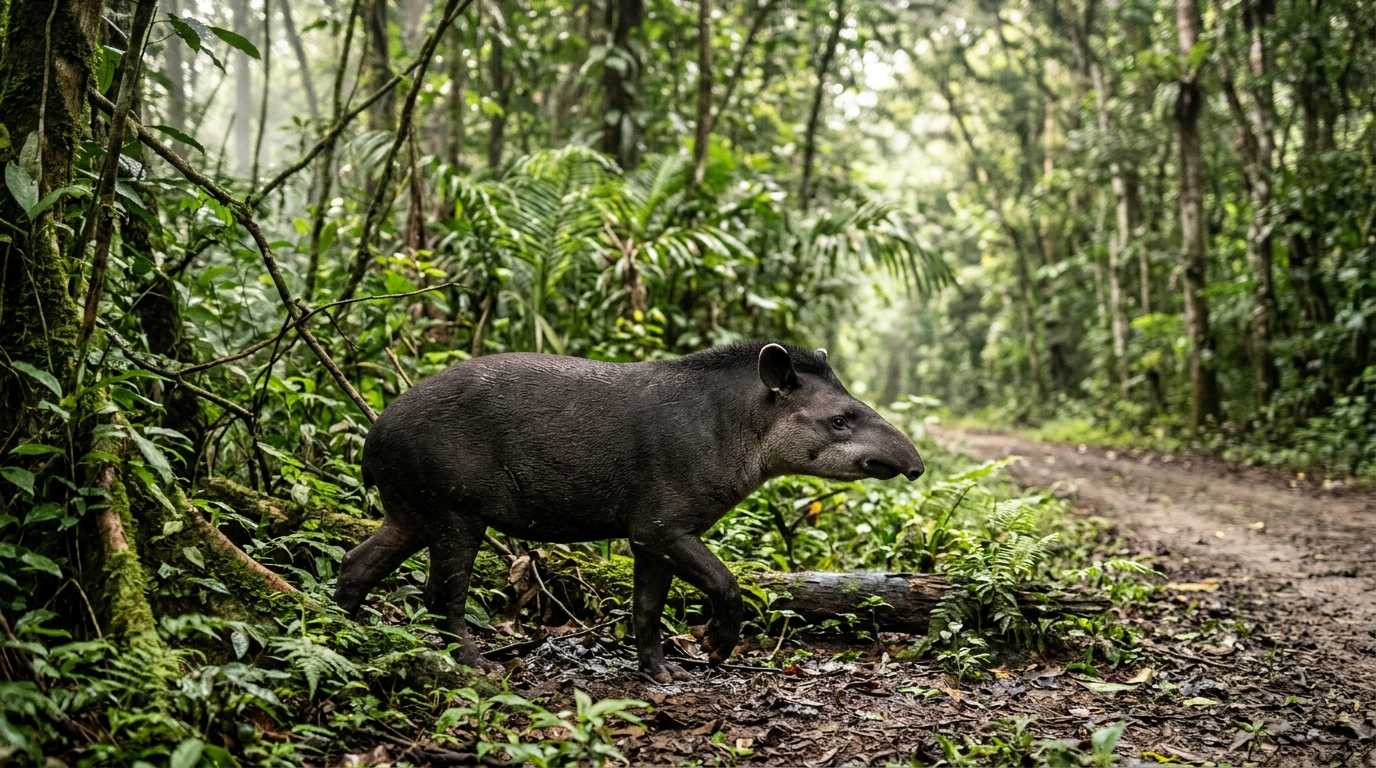
Across the primary near-to-far contrast spanning 0.85 to 7.20 kilometers from infrastructure, lowland tapir demonstrated the clearest temporal response, exhibiting higher predicted nocturnality near human infrastructure than farther away.

Responses in detection-night probability were generally smaller in absolute magnitude, with small rodents showing higher predicted detection-night probability nearer infrastructure, collared peccaries showing higher predicted detection-night probability farther from infrastructure, brocket deer displaying a similar but less certain positive trend farther away, and tayra showing a small, supported increase nearer infrastructure.

Many carnivores exhibited weak, nonlinear, or uncertain near-to-far detection-night responses, indicating that temporal and local-use adjustments are concentrated in particular taxa and ecological contexts, underscoring the importance of assessing when species are active alongside where they are detected.

Subject of Research: Neotropical mammal behavioral responses to human infrastructure

Article Title: The night shift: temporal activity and local use respond unevenly to human infrastructure in an Amazonian mammal community

Article References: Laidlaw, F., & Zwicker, S. (2026). The night shift: temporal activity and local use respond unevenly to human infrastructure in an Amazonian mammal community. Frontiers in Conservation Science, 7, Article 1895829. https://doi.org/10.3389/fcosc.2026.1895829

Image Credits: AI Generated

DOI: 10.3389/fcosc.2026.1895829

Keywords: Amazonia, camera trapping, nocturnality, detection-night probability, human infrastructure, mammal ecology, Madre de Dios, diel activity, night, shift, temporal, activity

News Source: Drew Townsend. (November 6, 2026). Amazonian Mammals Alter Activity and Space Use Unevenly Near Human Infrastructure. Scienmag.

Tags: activityAmazoniacamera trappingdetection-night probabilitydiel activityhuman infrastructureMadre de Diosmammal ecologyNightnocturnalityshiftTemporal
Share12Tweet7Share2ShareShareShare1

Related Posts

Microbial oils edge closer to the mainstream as fermentation strategies mature

Review examines microbial oil fermentation strategies and industrial scale-up barriers

November 6, 2026
Cellular chaperone EMC found essential for building calcium channels

Cellular chaperone EMC found essential for building calcium channels

November 6, 2026

First Mpox Genomes from Uruguay Reveal Multiple Introductions and Limited Spread

November 6, 2026

Information-Theoretic Modeling Links T Cell Dynamics to Cancer Immunotherapy Outcomes

November 6, 2026

POPULAR NEWS

  • Surgical AI on a Clock: New Review Maps How Real-Time Operating Room Models Are Built

    Surgical AI on a Clock: New Review Maps How Real-Time Operating Room Models Are Built

    29 shares
    Share 12 Tweet 7
  • Multimodal IoT Framework Blends Gesture Control and Deep Learning for Adaptive Art

    29 shares
    Share 12 Tweet 7
  • Deep Learning Network Reconstructs Missing Geometry in Maize Leaf Point Clouds

    29 shares
    Share 12 Tweet 7
  • Frequent Wildfires Alter Forest Structure and Create Distinct Fire Behavior Patterns

    29 shares
    Share 12 Tweet 7

About

We bring you the latest biotechnology news from best research centers and universities around the world. Check our website.

Follow us

Recent News

Diabetes and pre-treatment fatigue flag men at risk of years-long exhaustion after prostate radiotherapy

Two neighboring Tibetan townships, one shared policy, and two very different fates for their grasslands

Solid-state caloric cooling edges closer to replacing vapour compression

Subscribe to Blog via Email

Enter your email address to subscribe to this blog and receive notifications of new posts by email.

Join 86 other subscribers
  • Contact Us

Bioengineer.org © Copyright 2023 All Rights Reserved.

Welcome Back!

Login to your account below

Forgotten Password?

Retrieve your password

Please enter your username or email address to reset your password.

Log In
No Result
View All Result
  • Homepages
    • Home Page 1
    • Home Page 2
  • News
  • National
  • Business
  • Health
  • Lifestyle
  • Science

Bioengineer.org © Copyright 2023 All Rights Reserved.