An extensive camera-trap investigation across the Las Piedras region of Madre de Dios, Peru, found that Amazonian mammals respond unevenly to human infrastructure across both temporal activity and local space use rather than through a single community-wide behavioral pathway.
Researchers evaluated camera-trap records from 483 monitoring stations across the survey landscape to assess how distance from human infrastructure related to behavioral patterns across 30 Neotropical mammal taxa.
The study modeled two complementary binomial metrics: nocturnality, defined as the probability that independent detections occurred at night rather than during the day, and detection-night probability, defined as the probability that a species was detected on a given active camera night.
Hierarchical generalized additive models estimated nonlinear species-specific and trophic-group associations with distance to infrastructure while controlling for species identity, trail placement, spatial structure, survey grid, camera station, and relevant environmental covariates.
Model comparisons revealed that the best-supported formulations combined both species-specific and trophic-group distance smooths, whereas models relying solely on trophic-group predictors remained strongly unsupported.
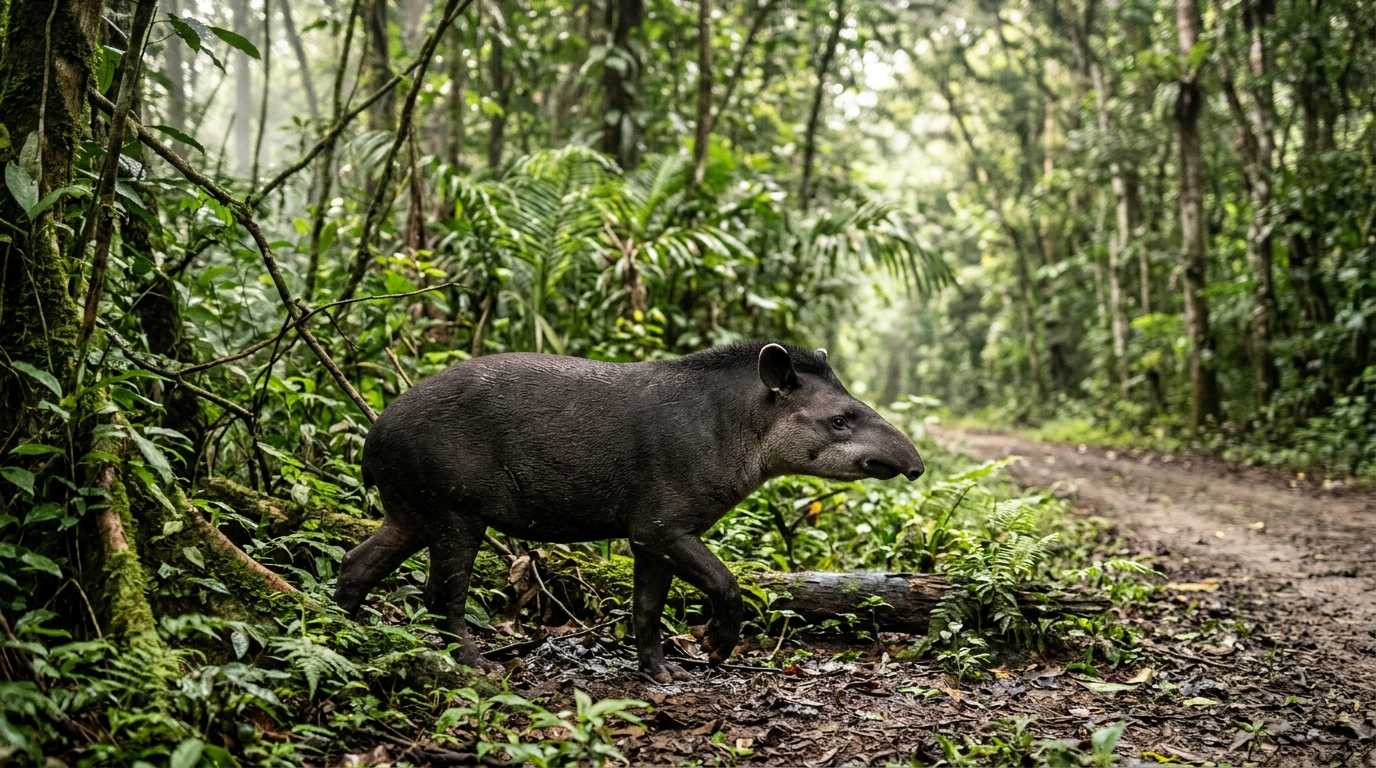
Across the primary near-to-far contrast spanning 0.85 to 7.20 kilometers from infrastructure, lowland tapir demonstrated the clearest temporal response, exhibiting higher predicted nocturnality near human infrastructure than farther away.
Responses in detection-night probability were generally smaller in absolute magnitude, with small rodents showing higher predicted detection-night probability nearer infrastructure, collared peccaries showing higher predicted detection-night probability farther from infrastructure, brocket deer displaying a similar but less certain positive trend farther away, and tayra showing a small, supported increase nearer infrastructure.
Many carnivores exhibited weak, nonlinear, or uncertain near-to-far detection-night responses, indicating that temporal and local-use adjustments are concentrated in particular taxa and ecological contexts, underscoring the importance of assessing when species are active alongside where they are detected.
Subject of Research: Neotropical mammal behavioral responses to human infrastructure
Article Title: The night shift: temporal activity and local use respond unevenly to human infrastructure in an Amazonian mammal community
Article References: Laidlaw, F., & Zwicker, S. (2026). The night shift: temporal activity and local use respond unevenly to human infrastructure in an Amazonian mammal community. Frontiers in Conservation Science, 7, Article 1895829. https://doi.org/10.3389/fcosc.2026.1895829
Image Credits: AI Generated
DOI: 10.3389/fcosc.2026.1895829
Keywords: Amazonia, camera trapping, nocturnality, detection-night probability, human infrastructure, mammal ecology, Madre de Dios, diel activity, night, shift, temporal, activity
News Source: Drew Townsend. (November 6, 2026). Amazonian Mammals Alter Activity and Space Use Unevenly Near Human Infrastructure. Scienmag.