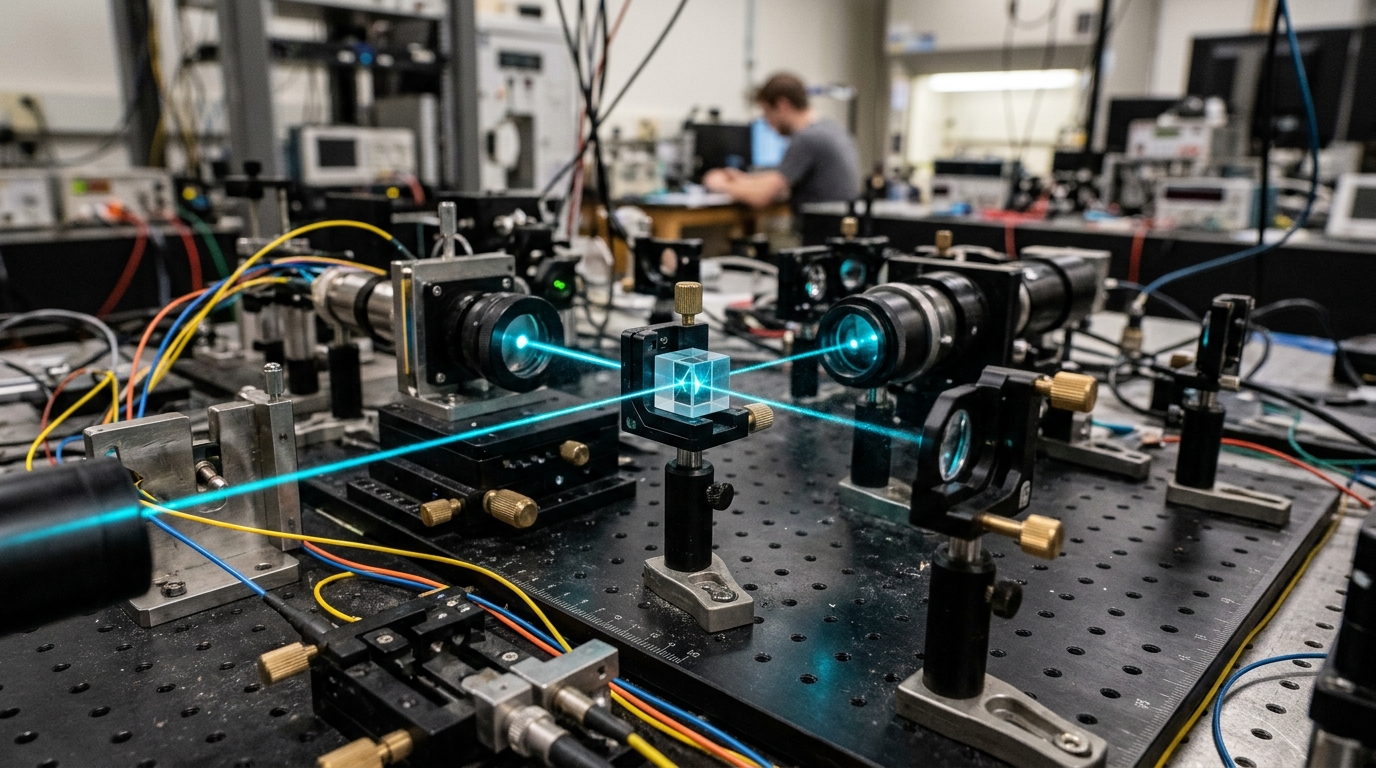
Quantum networks have long faced a stubborn obstacle: the no-cloning theorem forbids copying an unknown quantum state, which rules out the classic trick that makes wireless links robust in the classical world. Now a team of quantum communication researchers at the Quantum Internet Research Group of the University of Naples Federico II argues that the obstacle is not a dead end but an invitation to redesign the principle itself. In a Perspective article published in Frontiers in Communications and Networks, Angela Sara Cacciapuoti, Claudio Pellitteri and Marcello Caleffi propose spatial path superposition as a no-cloning-compatible analogue of the spatial diversity that underpins classical Multi-Input Multi-Output, or MIMO, communications.
Classical MIMO systems exploit the spatial dimension of the wireless channel through multiple antennas at the transmitter and receiver, improving reliability, increasing throughput and supporting multiuser multiplexing. Among the mechanisms this enables, spatial diversity is especially important: the same information travels along multiple spatially distinct propagation paths, and the redundant observations arriving at the receiver can be combined to reduce the probability of error. That principle, dating back to landmark work such as the Alamouti scheme of 1998, has become one of the key ingredients behind the robustness of classical wireless systems.
Transplanting that intuition into the quantum domain is fundamentally non-trivial. A direct quantum counterpart of classical spatial diversity would require sending multiple identical copies of an unknown quantum state through different communication links, and the no-cloning theorem, established by Wootters and Zurek in 1982, forbids exactly that. The classical MIMO intuition therefore cannot be imported into quantum communications simply by replacing classical signals with quantum states. The relevant question, the authors argue, is instead whether the state encoded in a quantum carrier can be conveyed by exploiting multiple communication links without requiring copies of that state.
Their answer is to exploit quantum coherence at the propagation level. Rather than duplicating the transmitted quantum state, a single quantum carrier, such as a photon, can be coherently delocalized over multiple spatial trajectories. In this regime the propagation process itself is quantized: the communication link is no longer regarded only as a fixed classical structure through which a quantum state propagates, but becomes part of the quantum dynamics through the channel map associated with each link. Classical redundancy is replaced by spatial coherence, and the alternative spatial evolutions are experienced in quantum superposition rather than as parallel copies.
The authors are careful to restrict the analogy. The correspondence is deliberately limited to the diversity principle and does not aim to reproduce the full MIMO toolbox. Multiple propagation alternatives are exploited simultaneously, not by creating redundant copies of a quantum state, but by coherently controlling the path degree-of-freedom of a quantum carrier. The resulting mechanism relies on interference patterns activated by alternative channel evolutions experienced by the state, providing a MIMO-inspired quantum spatial-diversity principle without violating the no-cloning theorem. A comparison table in the article contrasts the two approaches: classical diversity relies on redundant observations over multiple links, with copying allowed for classical information, while spatial path superposition relies on a coherent superposition of link alternatives, with copying forbidden for unknown quantum states, and its robustness mechanism is interference between channel evolutions rather than redundancy and combining.
The operational counterpart of the classical diversity gain, in this view, is the improvement of the transmitted quantum state’s quality, typically quantified through output fidelity. In classical MIMO spatial diversity, redundant observations are combined to reduce the probability of error. In spatial path superposition, alternative channel evolutions interfere coherently, and this interference can increase the fidelity of the received state with respect to the target state. The authors quantify the quantum diversity gain by the fidelity improvement achieved through spatial path superposition with respect to the best individual path, since fidelity measures how closely the resulting state approaches the desired target. This advantage is intrinsically coherence-based and, they note, is a genuinely quantum form of diversity that is inaccessible to strategies based on approximate clones of the transmitted state, whose fidelity is necessarily limited by the no-cloning theorem.
The formal machinery behind the idea extends the Hilbert space associated with the quantum carrier by introducing a vacuum state, which accounts for the possibility that a given link is not traversed by the carrier. Together with a quantum control system, typically a qubit or more generally a qudit, this vacuum extension describes a carrier propagating through either a single link or a coherent superposition of different links, with the control system encoding the path information. For two links, the coherent superposition is described by an extended channel map whose Kraus operators include vacuum amplitudes satisfying normalization conditions. These amplitudes are not fixed by the reduced channel maps alone; they depend on the underlying system-environment interaction, so different physical implementations of the same channel can lead to different vacuum extensions and therefore different interference effects.
Concrete implementations show how the abstraction maps onto hardware. In an interferometric photonic realization reported by Pang and colleagues in 2023, the control degree-of-freedom is encoded in the path taken by the carrier, while the target system is encoded in polarization. Each channel realization is implemented through liquid-crystal wave-plates that reproduce the relevant Pauli operations via applied voltages, and a phase control plate sets the relative phase between the superposed paths. The effective vacuum amplitudes are controlled through calibrated wave-plate voltages, phase shifters and, when required, amplitude-balancing elements such as variable beam splitters or attenuators, although the specific mapping between these hardware parameters and the vacuum amplitudes remains implementation-dependent and must be derived and calibrated for each physical realization. For a fixed realization, the amplitudes are treated as fixed complex coefficients rather than dynamical variables.
Spatial path superposition belongs to the broader framework of coherent control of quantum trajectories, and the authors distinguish it carefully from related schemes. One alternative is the superposition of causal orders, implemented by the quantum switch, in which the order in which two or more channels are applied is coherently controlled. From the perspective of the Naples group, the quantum switch can also be regarded as a form of coherence-assisted diversity, because the communication process benefits from controlling multiple order alternatives without improving the individual channels themselves, and recent work shows the switch can be seen as a two-step application of spatial path superposition. Yet the two are operationally distinct: the quantum switch controls the order of channel applications, whereas spatial path superposition controls the physical link traversed by the carrier. The switch’s experimental realization remains highly demanding, and its physical interpretation is still under active debate, particularly regarding whether current implementations genuinely exhibit indefinite causal order or merely simulate it. Spatial path superposition, by contrast, is described as more experimentally accessible and conceptually transparent, implementable with well-established interferometric setups or quantum-walk-inspired architectures. In a discrete-time quantum walk, the coin degree-of-freedom plays the role of a control system while the position degree-of-freedom encodes the spatial alternatives explored by the carrier, and the walker evolves through interference among multiple paths, producing non-classical propagation features; the authors view it as a specific instantiation of the broader spatial path-superposition framework.
Perhaps the most striking claim is that path coherence can do more than protect information. By generating interference terms between alternative channel evolutions, it can act as an active networking resource and produce non-classical correlations during propagation. When a carrier is delocalized over multiple communication links, the path-control degree-of-freedom and the target degree-of-freedom are jointly involved in the channel evolution; after measuring the control system, path coherence can be converted into entanglement among the target systems, starting from initially separable inputs. Recent results cited in the Perspective make this explicit: noisy communication channels placed in spatial superposition can generate Bell, GHZ and W-type entangled states during the distribution process. Even depolarizing channels, usually regarded as a worst-case noise model, can contribute to Bell-state generation in the bipartite case and to GHZ-state generation in multipartite extensions, while W-state generation requires a more structured superposition of noisy operations, reflecting the different entanglement structure of W states.
The authors are precise about what this means for noise. Under coherent path control, noisy channel evolutions can contribute to entanglement generation through interference, but this constructive effect depends on the channel structure and on its physical vacuum extension, including the associated amplitudes and phases, and it requires the preservation of control coherence. Strictly speaking, they write, it is not the noise that is constructive but the engineered coherence: the effect is an engineering possibility that emerges when the amplitudes and phases of a coherently controlled propagation process can be properly tuned, not a generic beneficial effect of noise. The assumptions matter as well. If the control system decoheres, the interference terms responsible for fidelity enhancement and entanglement generation are suppressed and the process reduces to an effective classical mixture. Treating the control as effectively protected is nonetheless well motivated: the most demanding noise is assigned to the target system carrying the quantum information, while the low-dimensional control can in principle be protected more easily, for instance through decoherence-free subspaces, and in interferometric realizations the path degree-of-freedom can encode the control while the noisy channel acts on an internal degree-of-freedom of the carrier. Moderate noise on the control system has been shown not to qualitatively destroy the operational advantages of the framework.
The Perspective also sets honest limits. Spatial path superposition should not be regarded as a general replacement for conventional direct-transmission or repeater-based entanglement-distribution schemes, but as a complementary coherence-enabled primitive whose distinctive advantage arises when multiple propagation alternatives can be coherently controlled. When such path coherence cannot be established or maintained, the interference-based mechanism is no longer available, and a quantitative resource-normalized comparison with conventional entanglement-distribution architectures remains an important direction for future research. Experimental implementations require path coherence and relative-phase stability among the alternative trajectories, with the relative phase actively set and stabilized to select different interference regimes. At the networking level, a key open problem is whether coherent path control can be lifted from a link-level resource to a full quantum-native routing primitive for multi-hop quantum networks, a scaling challenge that demands increasing path-control overhead together with synchronization and control in the presence of loss, relative-phase errors and hardware non-idealities. Within this reframing, fidelity improvement plays the role of a quantum diversity gain, while entanglement generation shows that path coherence can become an active resource for quantum networking, positioning spatial path superposition as a quantum-native primitive for the emerging Quantum Internet.
Subject of Research: A quantum communication Perspective proposing spatial path superposition as a no-cloning-compatible analogue of MIMO spatial diversity that can enhance fidelity and generate entanglement during propagation.
Article Title: Spatial path superposition: a no-cloning perspective on MIMO-inspired spatial diversity
Article References: Cacciapuoti, A. S., Pellitteri, C., & Caleffi, M. (2026). Spatial path superposition: a no-cloning perspective on MIMO-inspired spatial diversity. Frontiers in Communications and Networks, 7, Article 1882590. https://doi.org/10.3389/frcmn.2026.1882590
Image Credits: AI Generated
DOI: 10.3389/frcmn.2026.1882590
Keywords: quantum internet, spatial path superposition, MIMO, spatial diversity, no-cloning theorem, quantum coherence, entanglement generation, fidelity, quantum switch, quantum walks, quantum networks, photonics
News Source: Katie Riggs. (November 6, 2026). Quantum Internet Gains a No-Cloning Twist on MIMO Diversity Through Spatial Path Superposition. Scienmag.